
基于机器学习的 COVID-19 死亡率预测模型和识别低危与高危死亡风险患者。
Machine-learning-based COVID-19 mortality prediction model and identification of patients at low and high risk of dying.
机构信息
Department of Critical Care Medicine, University of Calgary, Alberta, Canada.
Department of Biological Science, University of Calgary, Alberta, Canada.
出版信息
Crit Care. 2021 Sep 8;25(1):328. doi: 10.1186/s13054-021-03749-5.
BACKGROUND
The coronavirus disease 2019 (COVID-19) pandemic caused by the SARS-Cov2 virus has become the greatest health and controversial issue for worldwide nations. It is associated with different clinical manifestations and a high mortality rate. Predicting mortality and identifying outcome predictors are crucial for COVID patients who are critically ill. Multivariate and machine learning methods may be used for developing prediction models and reduce the complexity of clinical phenotypes.
METHODS
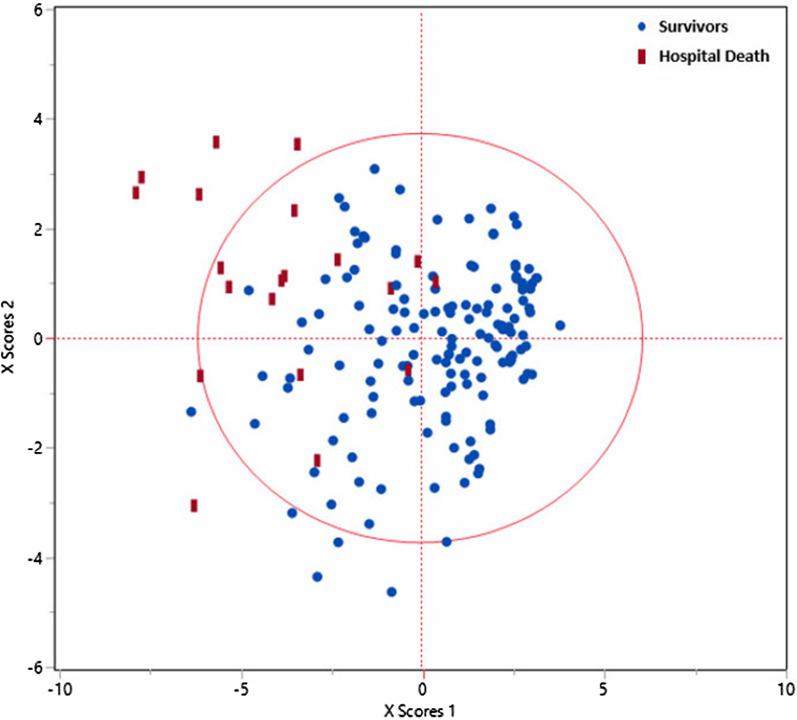
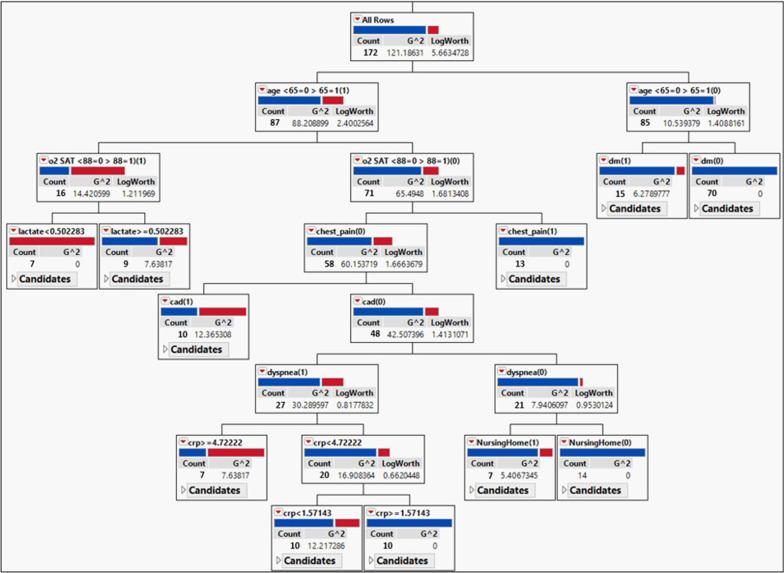
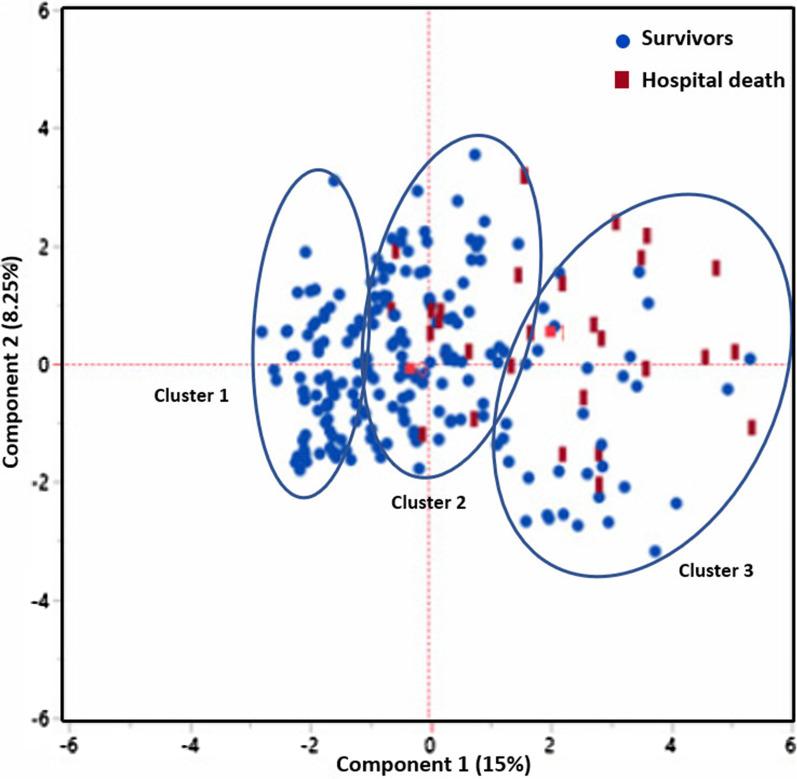
Multivariate predictive analysis was applied to 108 out of 250 clinical features, comorbidities, and blood markers captured at the admission time from a hospitalized cohort of patients (N = 250) with COVID-19. Inspired modification of partial least square (SIMPLS)-based model was developed to predict hospital mortality. Prediction accuracy was randomly assigned to training and validation sets. Predictive partition analysis was performed to obtain cutting value for either continuous or categorical variables. Latent class analysis (LCA) was carried to cluster the patients with COVID-19 to identify low- and high-risk patients. Principal component analysis and LCA were used to find a subgroup of survivors that tends to die.
RESULTS
SIMPLS-based model was able to predict hospital mortality in patients with COVID-19 with moderate predictive power (Q = 0.24) and high accuracy (AUC > 0.85) through separating non-survivors from survivors developed using training and validation sets. This model was obtained by the 18 clinical and comorbidities predictors and 3 blood biochemical markers. Coronary artery disease, diabetes, Altered Mental Status, age > 65, and dementia were the topmost differentiating mortality predictors. CRP, prothrombin, and lactate were the most differentiating biochemical markers in the mortality prediction model. Clustering analysis identified high- and low-risk patients among COVID-19 survivors.
CONCLUSIONS
An accurate COVID-19 mortality prediction model among hospitalized patients based on the clinical features and comorbidities may play a beneficial role in the clinical setting to better management of patients with COVID-19. The current study revealed the application of machine-learning-based approaches to predict hospital mortality in patients with COVID-19 and identification of most important predictors from clinical, comorbidities and blood biochemical variables as well as recognizing high- and low-risk COVID-19 survivors.
背景
由 SARS-CoV2 病毒引起的 2019 年冠状病毒病(COVID-19)大流行已成为全球各国最大的健康和争议问题。它与不同的临床表现和高死亡率有关。预测死亡率和确定结局预测因子对于患有重病的 COVID 患者至关重要。多元和机器学习方法可用于开发预测模型并降低临床表型的复杂性。
方法
对 250 名 COVID-19 住院患者入院时的 108 个临床特征、合并症和血液标志物进行多元预测分析。基于偏最小二乘(SIMPLS)的模型得到启发,进行了修改,以预测住院死亡率。预测准确性被随机分配到训练和验证组。进行预测分区分析以获得连续或分类变量的临界值。进行潜在类别分析(LCA)以对 COVID-19 患者进行聚类,以识别低危和高危患者。主成分分析和 LCA 用于发现有死亡倾向的幸存者亚组。
结果
基于 SIMPLS 的模型能够以中等预测能力(Q=0.24)和高准确性(AUC>0.85)预测 COVID-19 患者的住院死亡率,通过使用训练和验证组将非幸存者与幸存者区分开来。该模型通过 18 个临床和合并症预测因子和 3 个血液生化标志物获得。冠状动脉疾病、糖尿病、精神状态改变、年龄>65 岁和痴呆是区分死亡率最高的预测因子。CRP、凝血酶原和乳酸是死亡率预测模型中最具区分力的生化标志物。聚类分析确定了 COVID-19 幸存者中的高危和低危患者。
结论
基于临床特征和合并症的住院患者 COVID-19 死亡率准确预测模型在临床环境中可能发挥有益作用,以更好地管理 COVID-19 患者。本研究揭示了机器学习方法在预测 COVID-19 患者住院死亡率以及识别临床、合并症和血液生化变量中的重要预测因子方面的应用,以及识别 COVID-19 幸存者中的高危和低危患者。


 Zotero 插件