
职业治疗师和/或物理治疗师主导的慢性病疲劳自我管理:一项系统评价与荟萃分析。
Fatigue self-management led by occupational therapists and/or physiotherapists for chronic conditions: A systematic review and meta-analysis.
作者信息
Kim Sungha, Xu Ying, Dore Kelly, Gewurtz Rebecca, Larivière Nadine, Letts Lori
机构信息
63662School of Rehabilitation Science, 3710McMaster University, Hamilton, ON, Canada.
Department of Medicine, 12362McMaster Education Research, Innovation & Theory (MERIT), 12370David Braley Health Science Centre, Hamilton, ON, Canada.
出版信息
Chronic Illn. 2022 Sep;18(3):441-457. doi: 10.1177/17423953211039783. Epub 2021 Sep 13.
OBJECTIVE
The aim of this study was to investigate the effectiveness of occupational therapist-/physiotherapist-guided fatigue self-management for individuals with chronic conditions.
METHODS
Eight databases, including MEDLINE and EMBASE, were searched until September 2019 to identify relevant studies. Randomised controlled trials and quasi-experimental studies of self-management interventions specifically developed or delivered by occupational therapists/physiotherapists to improve fatigue symptoms of individuals with chronic conditions were included. A narrative synthesis and meta-analysis were conducted to determine the effectiveness of fatigue self-management.
RESULTS
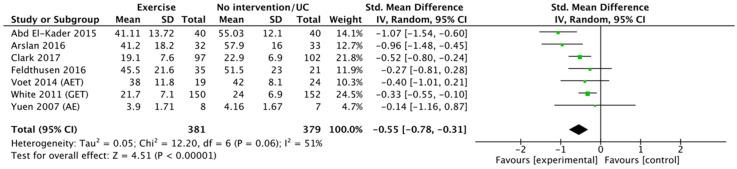
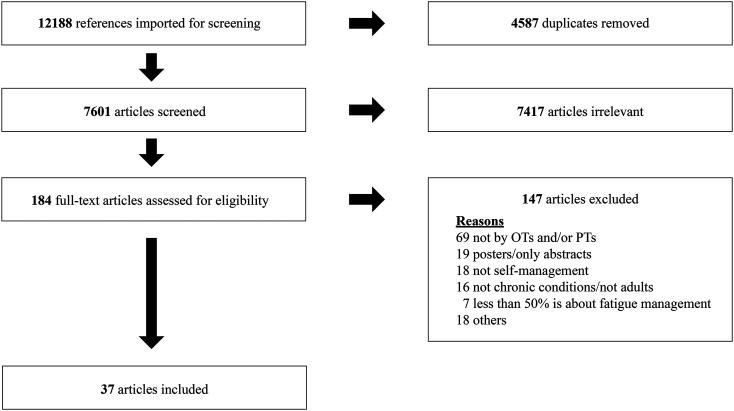
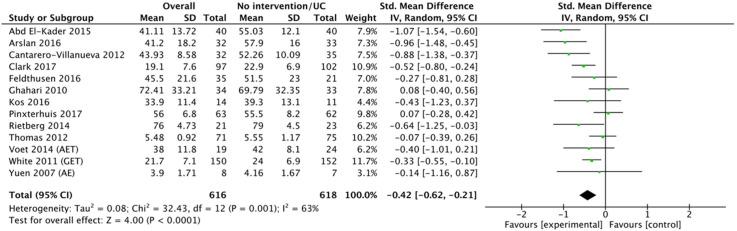
Thirty-eight studies were included, and fatigue self-management approaches led by occupational therapists/physiotherapists were divided into six categories based on the intervention focus: exercise, energy conservation, multimodal programmes, activity pacing, cognitive-behavioural therapy, and comprehensive fatigue management. While all exercise programmes reported significant improvement in fatigue, other categories showed both significant improvement and no improvement in fatigue. Meta-analysis yielded a standardised mean difference of the overall 13 studies: 0.42 (95% confidence interval:-0.62 to - 0.21); standardised mean difference of the seven exercise studies was -0.55 (95% confidence interval: -0.78 to -0.31).
DISCUSSION
Physical exercises inspired by the self-management principles may have positive impacts on fatigue symptoms, quality of life, and other functional abilities.
目的
本研究旨在调查职业治疗师/物理治疗师指导的疲劳自我管理对慢性病患者的有效性。
方法
检索了包括MEDLINE和EMBASE在内的八个数据库,直至2019年9月,以识别相关研究。纳入了由职业治疗师/物理治疗师专门开发或实施的旨在改善慢性病患者疲劳症状的自我管理干预措施的随机对照试验和准实验研究。进行了叙述性综合分析和荟萃分析,以确定疲劳自我管理的有效性。
结果
纳入了38项研究,职业治疗师/物理治疗师主导的疲劳自我管理方法根据干预重点分为六类:运动、能量节约、多模式方案、活动节奏、认知行为疗法和综合疲劳管理。虽然所有运动方案均报告疲劳有显著改善,但其他类别在疲劳方面既有显著改善也有未改善的情况。对13项研究进行的荟萃分析得出的标准化平均差为:0.42(95%置信区间:-0.62至-0.21);7项运动研究的标准化平均差为-0.55(95%置信区间:-0.78至-0.31)。
讨论
受自我管理原则启发的体育锻炼可能对疲劳症状、生活质量和其他功能能力产生积极影响。

 Zotero 插件