
卡尼亚克拉研究:在肯尼亚西部农村地区,一个微型诊所社交网络干预措施促进艾滋病毒护理参与和保留的随机对照试验。
The Kanyakla study: Randomized controlled trial of a microclinic social network intervention for promoting engagement and retention in HIV care in rural western Kenya.
机构信息
Division of HIV, Infectious Diseases & Global Medicine, University of California San Francisco, San Francisco, California, United States of America.
Organic Health Response Research Group, Mfangano Island, Kenya.
出版信息
PLoS One. 2021 Sep 13;16(9):e0255945. doi: 10.1371/journal.pone.0255945. eCollection 2021.
BACKGROUND
Existing social relationships are a potential source of "social capital" that can enhance support for sustained retention in HIV care. A previous pilot study of a social network-based 'microclinic' intervention, including group health education and facilitated HIV status disclosure, reduced disengagement from HIV care. We conducted a pragmatic randomized trial to evaluate microclinic effectiveness.
METHODS
In nine rural health facilities in western Kenya, we randomized HIV-positive adults with a recent missed clinic visit to either participation in a microclinic or usual care (NCT02474992). We collected visit data at all clinics where participants accessed care and evaluated intervention effect on disengagement from care (≥90-day absence from care after a missed visit) and the proportion of time patients were adherent to clinic visits ('time-in-care'). We also evaluated changes in social support, HIV status disclosure, and HIV-associated stigma.
RESULTS
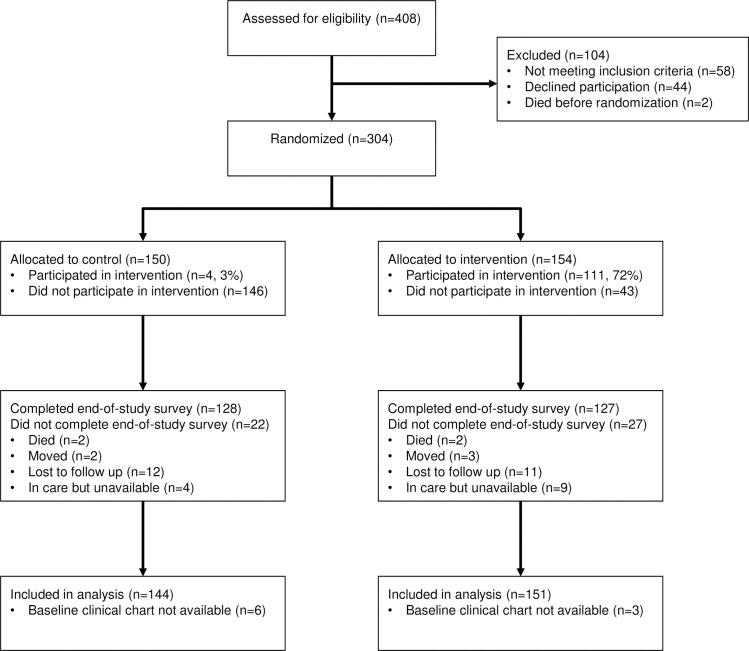
Of 350 eligible patients, 304 (87%) enrolled, with 154 randomized to intervention and 150 to control. Over one year of follow-up, disengagement from care was similar in intervention and control (18% vs 17%, hazard ratio 1.03, 95% CI 0.61-1.75), as was time-in-care (risk difference -2.8%, 95% CI -10.0% to +4.5%). The intervention improved social support for attending clinic appointments (+0.4 units on 5-point scale, 95% CI 0.08-0.63), HIV status disclosure to close social supports (+0.3 persons, 95% CI 0.2-0.5), and reduced stigma (-0.3 units on 5-point scale, 95% CI -0.40 to -0.17).
CONCLUSIONS
The data from our pragmatic randomized trial in rural western Kenya are compatible with the null hypothesis of no difference in HIV care engagement between those who participated in a microclinic intervention and those who did not, despite improvements in proposed intervention mechanisms of action. However, some benefit or harm cannot be ruled out because the confidence intervals were wide. Results differ from a prior quasi-experimental pilot study, highlighting important implementation considerations when evaluating complex social interventions for HIV care.
TRIAL REGISTRATION
Clinical trial number: NCT02474992.
背景
现有的社会关系是“社会资本”的潜在来源,可以增强对持续维持艾滋病护理的支持。先前一项基于社交网络的“微型诊所”干预的试点研究,包括小组健康教育和促进艾滋病毒状况披露,减少了艾滋病毒护理的脱离。我们进行了一项实用的随机试验来评估微型诊所的效果。
方法
在肯尼亚西部的 9 个农村卫生机构中,我们将最近错过诊所就诊的艾滋病毒阳性成年人随机分配到微型诊所组或常规护理组(NCT02474992)。我们在参与者获得护理的所有诊所收集就诊数据,并评估干预措施对护理脱离(错过就诊后 90 天以上未接受护理)和患者遵守诊所就诊时间的比例(“就诊时间”)的影响。我们还评估了社会支持、艾滋病毒状况披露和与艾滋病毒相关的耻辱感的变化。
结果
在 350 名符合条件的患者中,有 304 名(87%)入组,其中 154 名随机分配到干预组,150 名分配到对照组。在一年的随访中,干预组和对照组的护理脱离情况相似(18%对 17%,风险比 1.03,95%置信区间 0.61-1.75),就诊时间也相似(风险差异-2.8%,95%置信区间-10.0%至+4.5%)。该干预措施提高了参加诊所预约的社会支持(5 分制增加 0.4 分,95%置信区间 0.08-0.63),向亲密社会支持披露艾滋病毒状况(增加 0.3 人,95%置信区间 0.2-0.5),并减少了耻辱感(5 分制降低 0.3 分,95%置信区间 0.40 至-0.17)。
结论
我们在肯尼亚西部农村进行的实用随机试验的数据与假设没有参与微型诊所干预的人与参与微型诊所干预的人之间在艾滋病毒护理参与方面没有差异的零假设相吻合,尽管对拟议的干预措施作用机制的改善。然而,由于置信区间较宽,不能排除某些益处或危害。结果与先前的准实验性试点研究不同,突出了在评估艾滋病毒护理的复杂社会干预措施时需要考虑的重要实施因素。
试验注册
临床试验编号:NCT02474992。
 Zotero 插件