
早期轻度感染期间呼出气溶胶中的传染性严重急性呼吸综合征冠状病毒 2(SARS-CoV-2)和口罩的效果
Infectious Severe Acute Respiratory Syndrome Coronavirus 2 (SARS-CoV-2) in Exhaled Aerosols and Efficacy of Masks During Early Mild Infection.
机构信息
Public Health Aerobiology and Biomarker Laboratory, Institute for Applied Environmental Health, University of Maryland School of Public Health, College Park, Maryland, USA.
Department of Epidemiology and Biostatistics, University of Maryland School of Public Health, College Park, Maryland, USA.
出版信息
Clin Infect Dis. 2022 Aug 24;75(1):e241-e248. doi: 10.1093/cid/ciab797.
BACKGROUND
Severe acute respiratory syndrome coronavirus 2 (SARS-CoV-2) epidemiology implicates airborne transmission; aerosol infectiousness and impacts of masks and variants on aerosol shedding are not well understood.
METHODS
We recruited coronavirus disease 2019 (COVID-19) cases to give blood, saliva, mid-turbinate and fomite (phone) swabs, and 30-minute breath samples while vocalizing into a Gesundheit-II, with and without masks at up to 2 visits 2 days apart. We quantified and sequenced viral RNA, cultured virus, and assayed serum samples for anti-spike and anti-receptor binding domain antibodies.
RESULTS
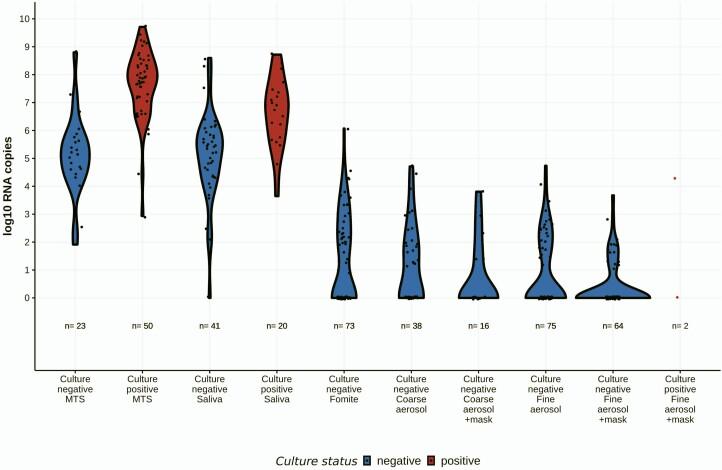
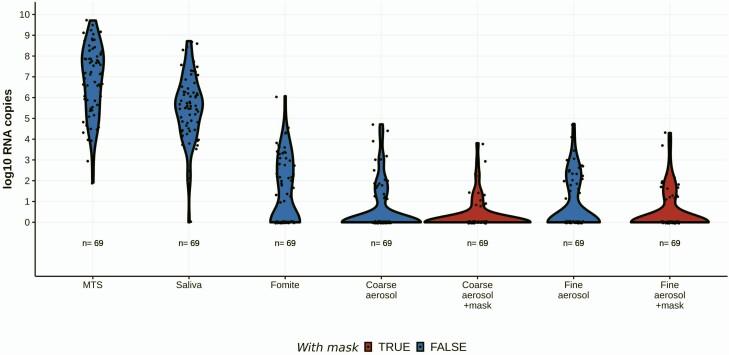
We enrolled 49 seronegative cases (mean days post onset 3.8 ± 2.1), May 2020 through April 2021. We detected SARS-CoV-2 RNA in 36% of fine (≤5 µm), 26% of coarse (>5 µm) aerosols, and 52% of fomite samples overall and in all samples from 4 alpha variant cases. Masks reduced viral RNA by 48% (95% confidence interval [CI], 3 to 72%) in fine and by 77% (95% CI, 51 to 89%) in coarse aerosols; cloth and surgical masks were not significantly different. The alpha variant was associated with a 43-fold (95% CI, 6.6- to 280-fold) increase in fine aerosol viral RNA, compared with earlier viruses, that remained a significant 18-fold (95% CI, 3.4- to 92-fold) increase adjusting for viral RNA in saliva, swabs, and other potential confounders. Two fine aerosol samples, collected while participants wore masks, were culture-positive.
CONCLUSIONS
SARS-CoV-2 is evolving toward more efficient aerosol generation and loose-fitting masks provide significant but only modest source control. Therefore, until vaccination rates are very high, continued layered controls and tight-fitting masks and respirators will be necessary.
背景
严重急性呼吸综合征冠状病毒 2(SARS-CoV-2)的流行病学表明其存在空气传播途径;气溶胶的传染性以及口罩和变异株对气溶胶排放的影响尚不清楚。
方法
我们招募了 2019 年冠状病毒病(COVID-19)患者,让他们在两次相隔两天的就诊中,在佩戴和不佩戴口罩的情况下对着 Gesundheit-II 仪器大声说话,同时采集血液、唾液、中鼻甲和污染物(手机)拭子以及 30 分钟的呼气样本。我们定量和测序了病毒 RNA,培养了病毒,并检测了血清样本中的刺突蛋白和受体结合域抗体。
结果
我们纳入了 49 例血清阴性病例(发病后平均天数为 3.8±2.1 天),这些病例均来自 2020 年 5 月至 2021 年 4 月。我们在细颗粒(≤5 µm)、粗颗粒(>5 µm)气溶胶以及所有样本中总共检测到了 SARS-CoV-2 RNA,其中 36%、26%和 52%的样本来自 4 例阿尔法变异株病例。口罩使细颗粒中的病毒 RNA减少了 48%(95%置信区间 [CI],3 至 72%),使粗颗粒中的病毒 RNA减少了 77%(95% CI,51 至 89%);布制口罩和外科口罩之间没有显著差异。与早期病毒相比,阿尔法变异株使细颗粒气溶胶中的病毒 RNA增加了 43 倍(95% CI,6.6 至 280 倍),即使调整了唾液、拭子和其他潜在混杂因素中的病毒 RNA,其仍然增加了 18 倍(95% CI,3.4 至 92 倍)。在参与者佩戴口罩时采集的 2 份细颗粒气溶胶样本培养呈阳性。
结论
SARS-CoV-2 正在朝着更高效的气溶胶生成方向进化,而宽松的口罩提供了显著但只是适度的源头控制。因此,在接种率非常高之前,仍需要采取分层控制措施和使用紧密贴合的口罩和呼吸器。
 Zotero 插件