
在菲律宾一个流行人类血吸虫病的地区,经灌注法对自然暴露于水中的水牛进行检测,发现日本血吸虫感染率很高。
High prevalence of Schistosoma japonicum by perfusion in naturally exposed water buffalo in a region of the Philippines endemic for human schistosomiasis.
机构信息
Department of Immunology, Research Institute of Tropical Medicine, Manila, Philippines.
Philippine Carabao Center, Science City of Munoz, Nueva Ecija, Philippines.
出版信息
PLoS Negl Trop Dis. 2021 Sep 16;15(9):e0009796. doi: 10.1371/journal.pntd.0009796. eCollection 2021 Sep.
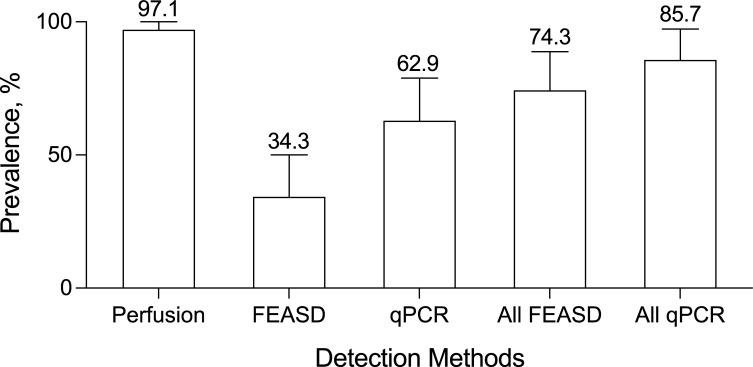
In the past decade, ecological surveys emphasized rats and dogs as the most significant animal reservoirs for Schistosoma japonicum (S.j) in the Philippines. However, recent studies demonstrated 51-91% prevalence of schistosomiasis among water buffalo using qPCR in the Sj endemic regions in the Philippines. In order to resolve the inconsistency of reported surveys regarding Sj endemicity among carabao, a domestic water buffalo that is the most important draught animal, we introduced 42 schistosome negative water buffalo to Macanip, Jaro municipality, Leyte, the Philippines, a subsistence rice-farming village that has been the focus of schistosomiasis japonica studies of our group for the past 20 years. We conducted perfusion to the remaining 34 buffalo that survived 10 months of nature exposure and Typhoon Haiyan. Thirty-three water buffalo were found to be positive with at least 1 pair of worms from the mesenteric vein. The infection rate is 97%, with the worm burden of 94 (95% confidence interval, 49-138 worms) worms. To our knowledge, this is the first report about S. japonicum worm burden in naturally infected water buffalo in the Philippines. The fact that with less than one-year of exposure, in this human schistosomiasis endemic area, only 1 out of 34 water buffalo was uninfected is striking. Urgent attention is needed for a cost-effective technique for monitoring Sj infection in animals and humans. Meanwhile, intervention implementation, including water buffalo treatment and vaccination, should be taken into consideration.
在过去的十年中,生态调查强调老鼠和狗是菲律宾日本血吸虫(S.j)最重要的动物宿主。然而,最近的研究表明,在菲律宾的日本血吸虫流行地区,使用 qPCR 检测水牛的日本血吸虫病患病率为 51-91%。为了解决有关在菲律宾 Carabao(一种重要的役用水牛)中日本血吸虫病流行的报告不一致的问题,我们引入了 42 头日本血吸虫阴性的水牛到菲律宾莱特省甲描育市的 Macanip,这是一个自给自足的水稻种植村庄,也是我们小组过去 20 年来研究日本血吸虫病的重点。我们对其余 34 头在 10 个月的自然暴露和台风“海燕”后幸存下来的水牛进行了灌注。从肠系膜静脉中发现了 33 头水牛至少有 1 对蠕虫呈阳性。感染率为 97%,蠕虫负荷为 94 条(95%置信区间,49-138 条)。据我们所知,这是菲律宾首例关于自然感染的日本血吸虫病水牛的蠕虫负荷报告。在这个人类日本血吸虫病流行地区,经过不到一年的暴露,只有 34 头水牛中的 1 头未被感染,这一事实令人震惊。需要紧急关注监测动物和人类日本血吸虫感染的经济有效的技术。同时,应考虑实施干预措施,包括对水牛进行治疗和接种疫苗。


 Zotero 插件