
在塞拉利昂成年人中,两剂腺病毒载体 26 型(Ad26.ZEBOV)和 MVA-BN-Filo 埃博拉疫苗接种方案的安全性和长期免疫原性:一项联合开放标签、非随机 1 期和随机、双盲、对照 2 期试验。
Safety and long-term immunogenicity of the two-dose heterologous Ad26.ZEBOV and MVA-BN-Filo Ebola vaccine regimen in adults in Sierra Leone: a combined open-label, non-randomised stage 1, and a randomised, double-blind, controlled stage 2 trial.
机构信息
London School of Hygiene & Tropical Medicine, London, UK; EBOVAC Project, Kambia, Kambia district, Sierra Leone.
London School of Hygiene & Tropical Medicine, London, UK.
出版信息
Lancet Infect Dis. 2022 Jan;22(1):97-109. doi: 10.1016/S1473-3099(21)00125-0. Epub 2021 Sep 13.
BACKGROUND
The Ebola epidemics in west Africa and the Democratic Republic of the Congo highlight an urgent need for safe and effective vaccines to prevent Ebola virus disease. We aimed to assess the safety and long-term immunogenicity of a two-dose heterologous vaccine regimen, comprising the adenovirus type 26 vector-based vaccine encoding the Ebola virus glycoprotein (Ad26.ZEBOV) and the modified vaccinia Ankara vector-based vaccine, encoding glycoproteins from Ebola virus, Sudan virus, and Marburg virus, and the nucleoprotein from the Tai Forest virus (MVA-BN-Filo), in Sierra Leone, a country previously affected by Ebola.
METHODS
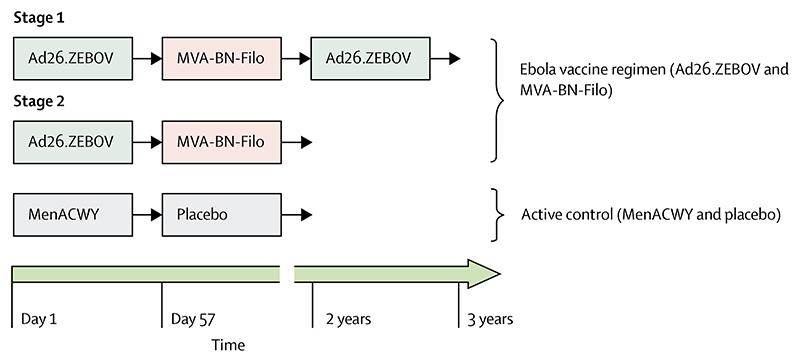
The trial comprised two stages: an open-label, non-randomised stage 1, and a randomised, double-blind, controlled stage 2. The study was done at three clinics in Kambia district, Sierra Leone. In stage 1, healthy adults (aged ≥18 years) residing in or near Kambia district, received an intramuscular injection of Ad26.ZEBOV (5 × 10 viral particles) on day 1 (first dose) followed by an intramuscular injection of MVA-BN-Filo (1 × 10 infectious units) on day 57 (second dose). An Ad26.ZEBOV booster vaccination was offered at 2 years after the first dose to stage 1 participants. The eligibility criteria for adult participants in stage 2 were consistent with stage 1 eligibility criteria. Stage 2 participants were randomly assigned (3:1), by computer-generated block randomisation (block size of eight) via an interactive web-response system, to receive either the Ebola vaccine regimen (Ad26.ZEBOV followed by MVA-BN-Filo) or an intramuscular injection of a single dose of meningococcal quadrivalent (serogroups A, C, W135, and Y) conjugate vaccine (MenACWY; first dose) followed by placebo on day 57 (second dose; control group). Study team personnel, except those with primary responsibility for study vaccine preparation, and participants were masked to study vaccine allocation. The primary outcome was the safety of the Ad26.ZEBOV and MVA-BN-Filo vaccine regimen, which was assessed in all participants who had received at least one dose of study vaccine. Safety was assessed as solicited local and systemic adverse events occurring in the first 7 days after each vaccination, unsolicited adverse events occurring in the first 28 days after each vaccination, and serious adverse events or immediate reportable events occurring up to each participant's last study visit. Secondary outcomes were to assess Ebola virus glycoprotein-specific binding antibody responses at 21 days after the second vaccine in a per-protocol set of participants (ie, those who had received both vaccinations within the protocol-defined time window, had at least one evaluable post-vaccination sample, and had no major protocol deviations that could have influenced the immune response) and to assess the safety and tolerability of the Ad26.ZEBOV booster vaccination in stage 1 participants who had received the booster dose. This study is registered at ClinicalTrials.gov, NCT02509494.
FINDINGS
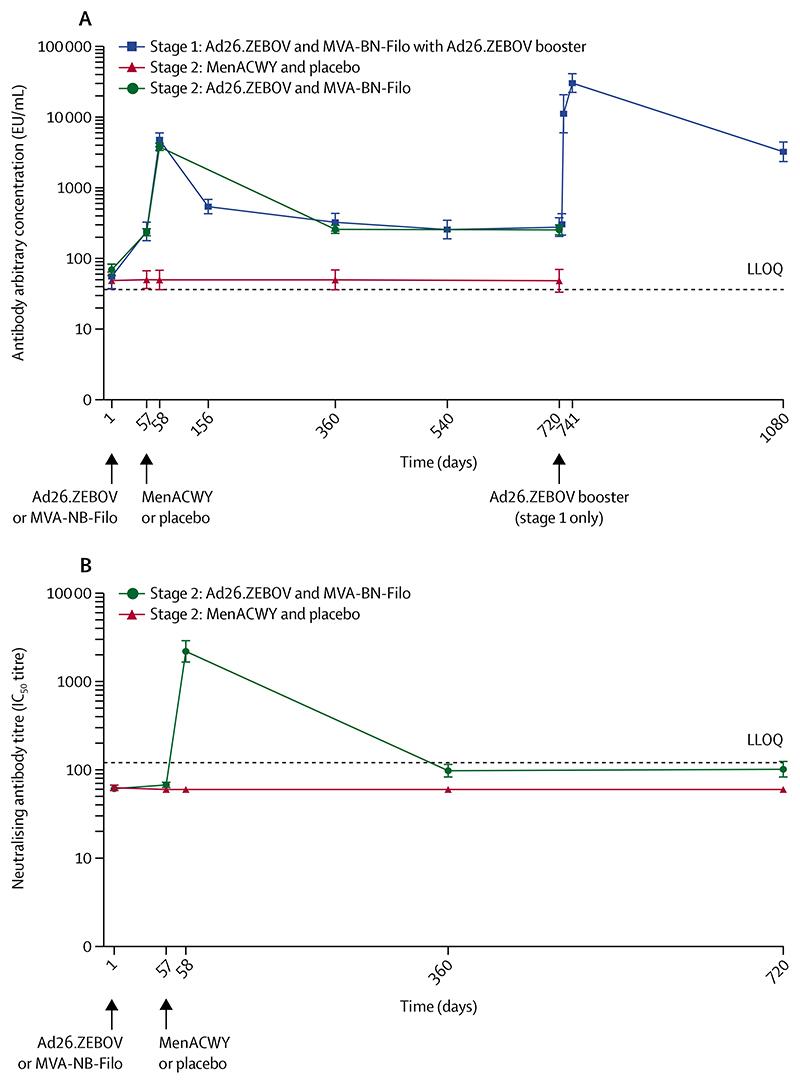
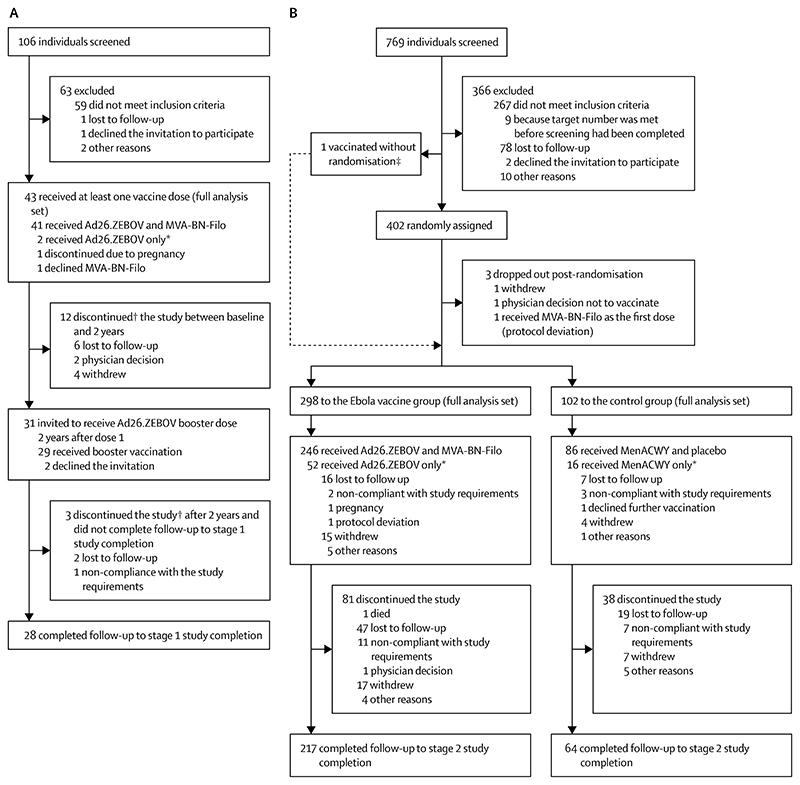
Between Sept 30, 2015, and Oct 19, 2016, 443 participants (43 in stage 1 and 400 in stage 2) were enrolled; 341 participants assigned to receive the Ad26.ZEBOV and MVA-BN-Filo regimen and 102 participants assigned to receive the MenACWY and placebo regimen received at least one dose of study vaccine. Both regimens were well tolerated with no safety concerns. In stage 1, solicited local adverse events (mostly mild or moderate injection-site pain) were reported in 12 (28%) of 43 participants after Ad26.ZEBOV vaccination and in six (14%) participants after MVA-BN-Filo vaccination. In stage 2, solicited local adverse events were reported in 51 (17%) of 298 participants after Ad26.ZEBOV vaccination, in 58 (24%) of 246 after MVA-BN-Filo vaccination, in 17 (17%) of 102 after MenACWY vaccination, and in eight (9%) of 86 after placebo injection. In stage 1, solicited systemic adverse events were reported in 18 (42%) of 43 participants after Ad26.ZEBOV vaccination and in 17 (40%) after MVA-BN-Filo vaccination. In stage 2, solicited systemic adverse events were reported in 161 (54%) of 298 participants after Ad26.ZEBOV vaccination, in 107 (43%) of 246 after MVA-BN-Filo vaccination, in 51 (50%) of 102 after MenACWY vaccination, and in 39 (45%) of 86 after placebo injection. Solicited systemic adverse events in both stage 1 and 2 participants included mostly mild or moderate headache, myalgia, fatigue, and arthralgia. The most frequent unsolicited adverse event after the first dose was headache in stage 1 and malaria in stage 2. Malaria was the most frequent unsolicited adverse event after the second dose in both stage 1 and 2. No serious adverse event was considered related to the study vaccine, and no immediate reportable events were observed. In stage 1, the safety profile after the booster vaccination was not notably different to that observed after the first dose. Vaccine-induced humoral immune responses were observed in 41 (98%) of 42 stage 1 participants (geometric mean binding antibody concentration 4784 ELISA units [EU]/mL [95% CI 3736-6125]) and in 176 (98%) of 179 stage 2 participants (3810 EU/mL [3312-4383]) at 21 days after the second vaccination.
INTERPRETATION
The Ad26.ZEBOV and MVA-BN-Filo vaccine regimen was well tolerated and immunogenic, with persistent humoral immune responses. These data support the use of this vaccine regimen for Ebola virus disease prophylaxis in adults.
FUNDING
Innovative Medicines Initiative 2 Joint Undertaking and Janssen Vaccines & Prevention BV.
背景
西非和刚果民主共和国的埃博拉疫情突显了急需安全有效的疫苗来预防埃博拉病毒病。我们旨在评估两种剂量的异源疫苗方案的安全性和长期免疫原性,该方案包括基于腺病毒 26 型载体的埃博拉病毒糖蛋白编码疫苗(Ad26.ZEBOV)和基于改良痘苗安卡拉病毒载体的疫苗,编码来自埃博拉病毒、苏丹病毒和马尔堡病毒的糖蛋白以及来自泰森林病毒的核蛋白(MVA-BN-Filo),在塞拉利昂,该国以前曾受到埃博拉的影响。
方法
该试验包括两个阶段:开放标签、非随机化的第 1 阶段和随机化、双盲、对照的第 2 阶段。该研究在塞拉利昂坎比亚区的三个诊所进行。在第 1 阶段,居住在坎比亚区或附近的健康成年人(年龄≥18 岁)在第 1 天(第 1 剂)接受肌肉内注射 Ad26.ZEBOV(5×10 个病毒颗粒),然后在第 57 天(第 2 剂)接受肌肉内注射 MVA-BN-Filo(1×10 个感染单位)。第 1 剂后 2 年向第 1 阶段参与者提供 Ad26.ZEBOV 加强疫苗接种。第 2 阶段成人参与者的入选标准与第 1 阶段的入选标准一致。第 2 阶段参与者通过计算机生成的块随机化(块大小为 8)以交互网络响应系统进行随机分配(3:1),接受埃博拉疫苗方案(Ad26.ZEBOV 后接种 MVA-BN-Filo)或肌肉内注射一剂脑膜炎球菌四价(血清群 A、C、W135 和 Y)结合疫苗(MenACWY;第 1 剂),然后在第 57 天(第 2 剂;对照组)接种安慰剂。除了对研究疫苗准备负有主要责任的人员外,研究团队人员和参与者都对研究疫苗分配情况不知情。主要结局是评估 Ad26.ZEBOV 和 MVA-BN-Filo 疫苗方案的安全性,该方案在至少接受过一剂研究疫苗的所有参与者中进行评估。安全性评估为每次接种后 7 天内发生的疫苗接种引起的局部和全身不良事件、每次接种后 28 天内发生的未经请求的不良事件以及在每位参与者的最后一次研究就诊前发生的严重不良事件或立即报告事件。次要结局是评估在方案设定的参与者(即接受方案定义的时间窗口内的两次疫苗接种、至少有一次接种后可评估样本、且没有可能影响免疫反应的主要方案偏差的)中第二次疫苗接种后 21 天的埃博拉病毒糖蛋白特异性结合抗体反应,以及评估第 1 阶段接受加强疫苗接种的参与者的 Ad26.ZEBOV 加强疫苗接种的安全性和耐受性。本研究在 ClinicalTrials.gov 注册,编号为 NCT02509494。
结果
2015 年 9 月 30 日至 2016 年 10 月 19 日,纳入了 443 名参与者(第 1 阶段 43 名,第 2 阶段 400 名);341 名被分配接受 Ad26.ZEBOV 和 MVA-BN-Filo 方案,102 名被分配接受 MenACWY 和安慰剂方案,均至少接受了一剂研究疫苗。两种方案均耐受性良好,无安全性问题。在第 1 阶段,接受 Ad26.ZEBOV 疫苗接种的 43 名参与者中有 12 名(28%)和接受 MVA-BN-Filo 疫苗接种的 6 名参与者(14%)报告了局部不良事件(主要为轻度或中度注射部位疼痛)。在第 2 阶段,接受 Ad26.ZEBOV 疫苗接种的 298 名参与者中有 51 名(17%)、接受 MVA-BN-Filo 疫苗接种的 246 名参与者中有 58 名(24%)、接受 MenACWY 疫苗接种的 102 名参与者中有 17 名(17%)和接受安慰剂注射的 86 名参与者中有 8 名(9%)报告了局部不良事件。在第 1 阶段,接受 Ad26.ZEBOV 疫苗接种的 43 名参与者中有 18 名(42%)和接受 MVA-BN-Filo 疫苗接种的 17 名(40%)报告了全身不良事件。在第 2 阶段,接受 Ad26.ZEBOV 疫苗接种的 298 名参与者中有 161 名(54%)、接受 MVA-BN-Filo 疫苗接种的 246 名参与者中有 107 名(43%)、接受 MenACWY 疫苗接种的 102 名参与者中有 51 名(50%)和接受安慰剂注射的 86 名参与者中有 39 名(45%)报告了全身不良事件。第 1 阶段和第 2 阶段接受疫苗接种的参与者中,全身不良事件主要为轻度或中度头痛、肌痛、疲劳和关节痛。第 1 阶段中第一次接种后的最常见未经请求的不良事件是头痛,而第 2 阶段中最常见的未经请求的不良事件是疟疾。第 1 阶段和第 2 阶段中,第二次接种后最常见的未经请求的不良事件是疟疾。没有认为与研究疫苗相关的严重不良事件,也没有观察到立即报告的事件。在第 1 阶段,加强疫苗接种后的安全性与第一次接种后的安全性没有明显差异。在 42 名第 1 阶段参与者(几何平均结合抗体浓度 4784 ELISA 单位[EU]/mL[3736-6125])和 179 名第 2 阶段参与者(3810 EU/mL[3312-4383])中观察到疫苗诱导的体液免疫应答在第二次接种后 21 天。
解释
Ad26.ZEBOV 和 MVA-BN-Filo 疫苗方案具有良好的耐受性和免疫原性,具有持久的体液免疫应答。这些数据支持该疫苗方案用于预防成人埃博拉病毒病。
资金
创新药物倡议 2 联合承诺和杨森疫苗和预防公司。

 Zotero 插件