
Lu-rhPSMA-7.3 和 Lu-PSMA I&T 治疗转移性去势抵抗性前列腺癌患者的治疗前比较剂量学。
Pretherapeutic Comparative Dosimetry of Lu-rhPSMA-7.3 and Lu-PSMA I&T in Patients with Metastatic Castration-Resistant Prostate Cancer.
机构信息
Department of Nuclear Medicine, School of Medicine, Technical University of Munich, München, Germany;
Partnersite München, German Cancer Consortium (DKTK), Heidelberg, Germany.
出版信息
J Nucl Med. 2022 Jun;63(6):833-839. doi: 10.2967/jnumed.121.262671. Epub 2021 Sep 16.
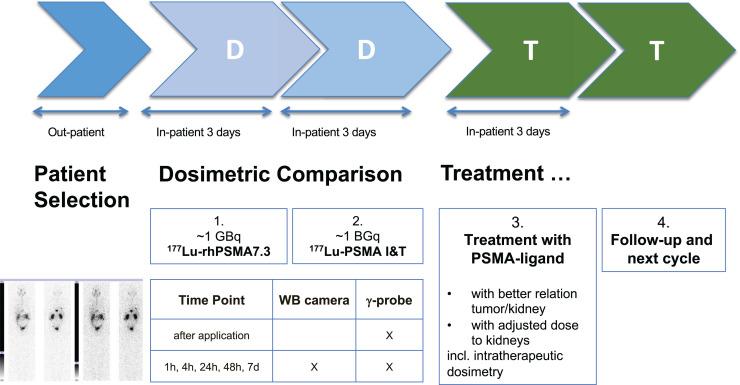
Radiohybrid prostate-specific membrane antigen (rhPSMA) ligands allow for labeling with F and radiometals for endoradiotherapy. rhPSMA-7.3 has been designated as a lead compound with promising preclinical data for Lu-rhPSMA-7.3, which has shown higher tumor uptake than Lu-PSMA I&T. In this retrospective analysis, we compared pretherapeutic clinical dosimetry data of both PSMA ligands. Six patients with metastatic castration-resistant prostate cancer underwent both Lu-rhPSMA-7.3 and Lu-PSMA I&T pretherapeutic dosimetry. Whole-body scintigraphy was performed at 1 h, 4 h, 24 h, 48 h, and 7 d after injection. Regions of interest covering the whole body, organs, bone marrow, and tumor lesions were drawn for each patient. Absorbed doses for individual patients and pretherapeutic applications were calculated using OLINDA/EXM. To facilitate the comparison of both ligands, we introduced the therapeutic index (TI), defined as the ratio of mean pretherapeutic doses to tumor lesions over relevant organs at risk. Mean whole-body pretherapeutic effective doses for Lu-rhPSMA-7.3 and Lu-PSMA I&T were 0.12 ± 0.07 and 0.05 ± 0.03 Sv/GBq, respectively. Mean absorbed organ doses for Lu-rhPSMA-7.3 and Lu-PSMA I&T were, for example, 1.65 ± 0.28 and 0.73 ± 0.18 Gy/GBq for the kidneys, 0.19 ± 0.09 and 0.07 ± 0.03 Gy/GBq for the liver, 2.35 ± 0.78 and 0.80 ± 0.41 Gy/GBq for the parotid gland, and 0.67 ± 0.62 and 0.30 ± 0.27 Gy/GBq for the bone marrow, respectively. Tumor lesions received mean absorbed doses of Lu-rhPSMA-7.3 and Lu-PSMA I&T of 6.44 ± 6.44 and 2.64 ± 2.24 Gy/GBq, respectively. The mean TIs for the kidneys were 3.7 ± 2.2 and 3.6 ± 2.2 for Lu-rhPSMA-7.3 and Lu-PSMA I&T, respectively, and those for the bone marrow were 15.2 ± 10.2 and 15.1 ± 10.2 for Lu-rhPSMA-7.3 and Lu-PSMA I&T, respectively. Pretherapeutic clinical dosimetry confirmed preclinical results of mean absorbed doses for tumors that were 2-3 times higher for Lu-rhPSMA-7.3 than for Lu-PSMA I&T. Absorbed doses to normal organs also tended to be higher for Lu-rhPSMA-7.3, resulting overall in similar average TIs for both radiopharmaceuticals with considerable interpatient variability. Lu-rhPSMA-7.3 has promise for a therapeutic efficacy similar to that of Lu-PSMA I&T at smaller amounts of injected activity, simplifying radiation safety measurements (especially for large patient numbers or dose escalation regimens).
放射性杂交前列腺特异性膜抗原(rhPSMA)配体可与 F 和放射性金属结合,用于内放射治疗。rhPSMA-7.3 已被指定为一种先导化合物,具有有前途的临床前数据,用于 Lu-rhPSMA-7.3,其肿瘤摄取率高于 Lu-PSMA I&T。在这项回顾性分析中,我们比较了两种 PSMA 配体的治疗前临床剂量学数据。六名患有转移性去势抵抗性前列腺癌的患者接受了 Lu-rhPSMA-7.3 和 Lu-PSMA I&T 治疗前的剂量测定。在注射后 1 小时、4 小时、24 小时、48 小时和 7 天进行全身闪烁照相术。为每位患者绘制了涵盖全身、器官、骨髓和肿瘤病变的感兴趣区域。使用 OLINDA/EXM 计算每个患者和治疗前应用的吸收剂量。为了方便比较两种配体,我们引入了治疗指数(TI),定义为平均治疗前剂量与相关风险器官中肿瘤病变的比值。Lu-rhPSMA-7.3 和 Lu-PSMA I&T 的平均全身治疗前有效剂量分别为 0.12±0.07 和 0.05±0.03 Sv/GBq。Lu-rhPSMA-7.3 和 Lu-PSMA I&T 的平均器官吸收剂量分别为肾脏 1.65±0.28 和 0.73±0.18 Gy/GBq,肝脏 0.19±0.09 和 0.07±0.03 Gy/GBq,腮腺 2.35±0.78 和 0.80±0.41 Gy/GBq,骨髓 0.67±0.62 和 0.30±0.27 Gy/GBq。肿瘤病变分别接受 Lu-rhPSMA-7.3 和 Lu-PSMA I&T 的平均吸收剂量为 6.44±6.44 和 2.64±2.24 Gy/GBq。肾脏的平均 TI 分别为 3.7±2.2 和 3.6±2.2,对于 Lu-rhPSMA-7.3 和 Lu-PSMA I&T,骨髓的平均 TI 分别为 15.2±10.2 和 15.1±10.2,对于 Lu-rhPSMA-7.3 和 Lu-PSMA I&T。治疗前临床剂量学证实了临床前结果,即 Lu-rhPSMA-7.3 对肿瘤的平均吸收剂量是 Lu-PSMA I&T 的 2-3 倍。Lu-rhPSMA-7.3 对正常器官的吸收剂量也趋于更高,导致两种放射性药物的平均 TI 相似,但患者间存在相当大的变异性。Lu-rhPSMA-7.3 有望在较小的注射活性剂量下产生与 Lu-PSMA I&T 相似的治疗效果,简化放射安全性测量(特别是对于大量患者或剂量递增方案)。
 Zotero 插件