
自杀者前额叶皮层、海马体、杏仁核和海马体转录组变化的鉴定。
Identification of transcriptome alterations in the prefrontal cortex, hippocampus, amygdala and hippocampus of suicide victims.
机构信息
Department of Psychiatry, University of Medicine and Pharmacy, Craiova, Romania.
Griffith University Menzies Health Institute of Queensland, Gold Coast Campus, Brisbane, QLD, 4000, Australia.
出版信息
Sci Rep. 2021 Sep 22;11(1):18853. doi: 10.1038/s41598-021-98210-6.
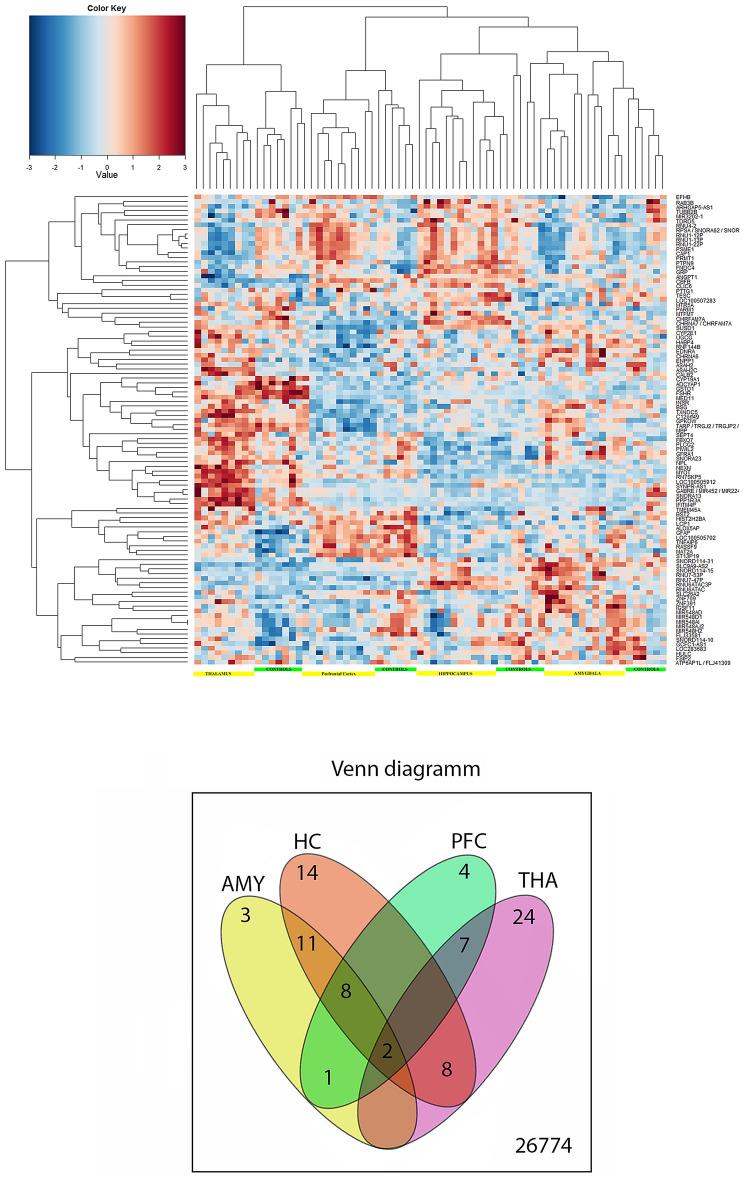
Suicide is one of the leading causes of death globally for all ages, and as such presents a very serious problem for clinicians worldwide. However, the underlying neurobiological pathology remains to a large extent unknown. In order to address this gap, we have carried out a genome-wide investigation of the gene expression in the amygdala, hippocampus, prefrontal cortex and thalamus in post-mortem brain samples obtained from 20 suicide completers and 7 control subjects. By KEGG enrichment analysis indicated we identified novel clusters of downregulated pathways involved in antigen neutralization and autoimmune thyroid disease (amygdala, thalamus), decreased axonal plasticity in the hippocampus. Two upregulated pathways were involved in neuronal death in the hippocampus and olfactory transduction in the thalamus and the prefrontal cortex. Autoimmune thyroid disease pathway was downregulated only in females. Metabolic pathways involved in Notch signaling amino acid metabolism and unsaturated lipid synthesis were thalamus-specific. Suicide-associated changes in the expression of several genes and pseudogenes that point to various functional mechanisms possibly implicated in the pathology of suicide. Two genes (SNORA13 and RNU4-2) involved in RNA processing were common to all brain regions analyzed. Most of the identified gene expression changes were related to region-specific dysregulated manifestation of genetic and epigenetic mechanisms underlying neurodevelopmental disorders (SNORD114-10, SUSd1), motivation, addiction and motor disorders (CHRNA6), long-term depression (RAB3B), stress response, major depression and schizophrenia (GFAP), signal transduction at the neurovascular unit (NEXN) and inhibitory neurotransmission in spatial learning, neural plasticity (CALB2; CLIC6, ENPP1). Some of the differentially expressed genes were brain specific non-coding RNAs involved in the regulation of translation (SNORA13). One, (PARM1) is a potential oncogene and prognostic biomarker for colorectal cancer with no known function in the brain. Disturbed gene expression involved in antigen neutralization, autoimmunity, neural plasticity, stress response, signal transduction at the neurovascular unit, dysregulated nuclear RNA processing and translation and epigenetic imprinting signatures is associated with suicide and point to regulatory non-coding RNAs as potential targets of new drugs development.
自杀是全球所有年龄段人群的主要死亡原因之一,因此对全球临床医生来说是一个非常严重的问题。然而,其潜在的神经生物学病理在很大程度上仍然未知。为了解决这一差距,我们对 20 名自杀既遂者和 7 名对照者死后大脑样本的杏仁核、海马体、前额叶皮层和丘脑中的基因表达进行了全基因组研究。通过 KEGG 富集分析,我们确定了涉及抗原中和和自身免疫性甲状腺疾病的下调途径的新簇(杏仁核、丘脑),海马体中轴突可塑性降低。两个上调途径涉及海马体中的神经元死亡和丘脑和前额叶皮层中的嗅觉转导。只有女性的自身免疫性甲状腺疾病途径下调。涉及 Notch 信号、氨基酸代谢和不饱和脂质合成的代谢途径是丘脑特有的。与自杀相关的几个基因和假基因的表达变化表明,这些基因和假基因可能参与了自杀的病理过程。两个涉及 RNA 加工的基因(SNORA13 和 RNU4-2)存在于所有分析的大脑区域中。大多数鉴定出的基因表达变化与神经发育障碍(SNORD114-10、SUSD1)、动机、成瘾和运动障碍(CHRNA6)、长时程抑郁(RAB3B)、应激反应、重度抑郁症和精神分裂症(GFAP)、神经血管单元的信号转导(NEXN)和空间学习中的抑制性神经传递相关。一些差异表达的基因是参与翻译调控的脑特异性非编码 RNA(SNORA13)。其中一个(PARM1)是结直肠癌的潜在致癌基因和预后生物标志物,在大脑中没有已知功能。涉及抗原中和、自身免疫、神经可塑性、应激反应、神经血管单元信号转导、核 RNA 加工和翻译失调以及表观遗传印记特征的基因表达紊乱与自杀有关,并指出调节性非编码 RNA 可能是新药物开发的潜在靶点。
 Zotero 插件