
体力活动多基因评分与多种常见疾病相关。
Polygenic Score for Physical Activity Is Associated with Multiple Common Diseases.
机构信息
Institute for Molecular Medicine Finland, HiLIFE, Helsinki, FINLAND.
Faculty of Sport and Health Sciences, University of Jyväskylä, Jyväskylä, FINLAND.
出版信息
Med Sci Sports Exerc. 2022 Feb 1;54(2):280-287. doi: 10.1249/MSS.0000000000002788.
INTRODUCTION
Genetic pleiotropy, in which the same genes affect two or more traits, may partially explain the frequently observed associations between high physical activity (PA) and later reduced morbidity or mortality. This study investigated associations between PA polygenic risk scores (PRS) and cardiometabolic diseases among the Finnish population.
METHODS
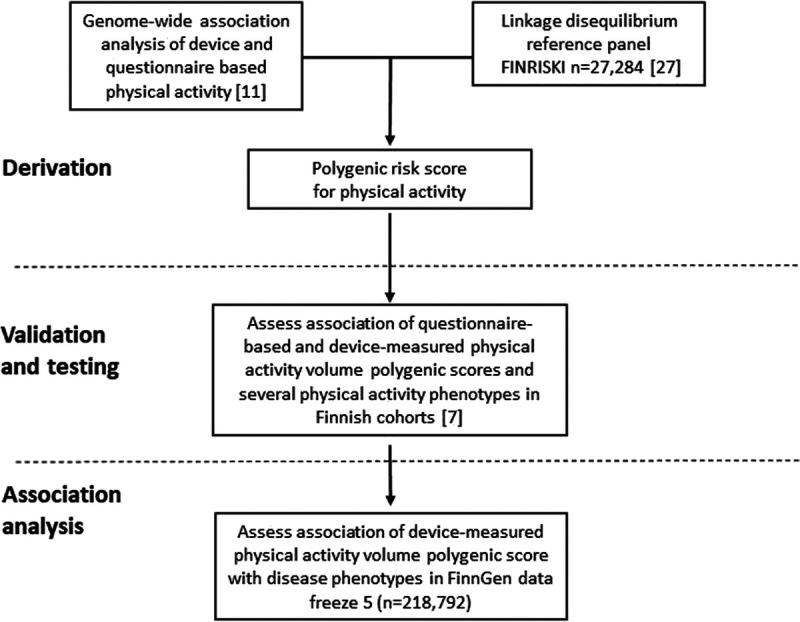
PRS for device-measured overall PA were adapted to a FinnGen study cohort of 218,792 individuals with genomewide genotyping and extensive digital longitudinal health register data. Associations between PA PRS and body mass index, diseases, and mortality were analyzed with linear and logistic regression models.
RESULTS
A high PA PRS predicted a lower body mass index (β = -0.025 kg·m-2 per one SD change in PA PRS, SE = 0.013, P = 1.87 × 10-80). The PA PRS also predicted a lower risk for diseases that typically develop later in life or not at all among highly active individuals. A lower disease risk was systematically observed for cardiovascular diseases (odds ratio [OR] per 1 SD change in PA PRS = 0.95, P = 9.5 × 10⁻¹⁹) and, for example, hypertension [OR = 0.93, P = 2.7 × 10-44), type 2 diabetes (OR = 0.91, P = 4.1 × 10-42), and coronary heart disease (OR = 0.95, P = 1.2 × 10⁻⁹). Participants with high PA PRS had also lower mortality risk (OR = 0.97, P = 0.0003).
CONCLUSIONS
Genetically less active persons are at a higher risk of developing cardiometabolic diseases, which may partly explain the previously observed associations between low PA and higher disease and mortality risk. The same inherited physical fitness and metabolism-related mechanisms may be associated both with PA levels and with cardiometabolic disease risk.
简介
遗传多效性是指同一基因影响两个或多个特征,这可能部分解释了高体力活动(PA)与随后发病率或死亡率降低之间经常观察到的关联。本研究调查了芬兰人群中 PA 多基因风险评分(PRS)与心血管代谢疾病之间的关联。
方法
采用适应 FinnGen 研究队列的设备测量的总体 PA 的 PRS,该队列包含 218792 名个体,他们具有全基因组基因分型和广泛的数字化纵向健康登记数据。使用线性和逻辑回归模型分析 PA PRS 与体重指数、疾病和死亡率之间的关联。
结果
高 PA PRS 预测体重指数较低(β=-0.025kg·m-2/PA PRS 每标准差变化,SE=0.013,P=1.87×10-80)。PA PRS 还预测了在高度活跃的个体中,通常在生命后期或根本不会发生的疾病的风险较低。心血管疾病的疾病风险呈系统下降(PA PRS 每标准差变化的比值比[OR]=0.95,P=9.5×10⁻¹⁹),例如高血压[OR=0.93,P=2.7×10-44]、2 型糖尿病[OR=0.91,P=4.1×10-42]和冠心病[OR=0.95,P=1.2×10⁻⁹]。PA PRS 较高的参与者的死亡率风险也较低(OR=0.97,P=0.0003)。
结论
遗传上不太活跃的人患心血管代谢疾病的风险较高,这可能部分解释了先前观察到的低 PA 与更高的疾病和死亡率风险之间的关联。相同的遗传体力活动和与代谢相关的机制可能与 PA 水平和心血管代谢疾病风险都相关。
 Zotero 插件