
对一组细胞遗传学正常的急性髓系白血病患者的突变和克隆进化模式进行综合分析。
Comprehensive analysis of mutations and clonal evolution patterns in a cohort of patients with cytogenetically normal acute myeloid leukemia.
作者信息
Mat Yusoff Yuslina, Ahid Fadly, Abu Seman Zahidah, Abdullah Julia, Kamaluddin Nor Rizan, Esa Ezalia, Zakaria Zubaidah
机构信息
Hematology Unit, Cancer Research Centre, Institute for Medical Research, National Institutes of Health, Ministry of Health Malaysia, 40170, Shah Alam, Selangor, Malaysia.
Centre for Medical Laboratory Technology Studies, Faculty of Health Sciences, Universiti Teknologi MARA, 42300, Puncak Alam, Selangor, Malaysia.
出版信息
Mol Cytogenet. 2021 Sep 24;14(1):45. doi: 10.1186/s13039-021-00561-2.
BACKGROUND
Relapsed acute myeloid leukemia (AML) is associated with the acquisition of additional somatic mutations which are thought to drive phenotypic adaptability, clonal selection and evolution of leukemic clones during treatment. We performed high throughput exome sequencing of matched presentation and relapsed samples from 6 cytogenetically normal AML (CN-AML) patients treated with standard remission induction chemotherapy in order to contribute with the investigation of the mutational landscape of CN-AML and clonal evolution during AML treatment.
RESULT
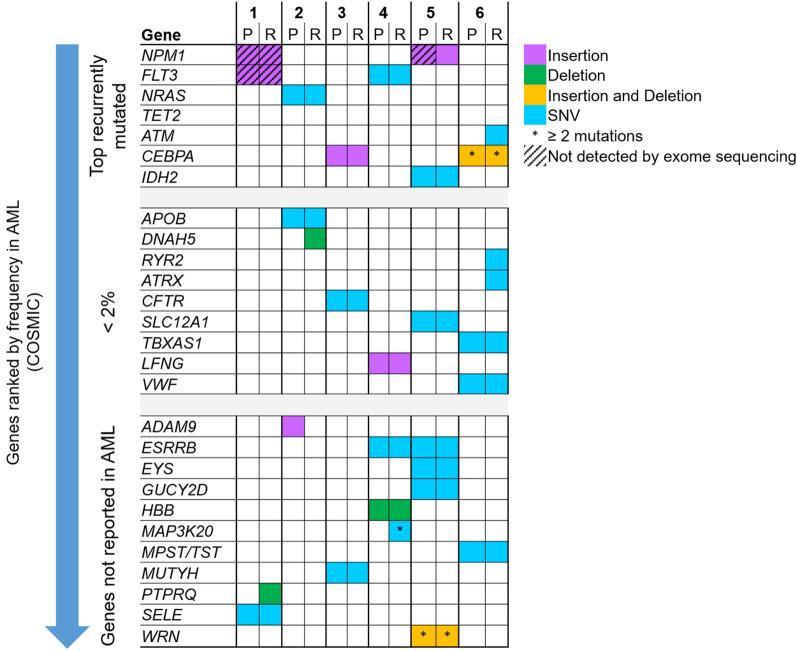
A total of 24 and 32 somatic variants were identified in presentation and relapse samples respectively with an average of 4.0 variants per patient at presentation and 5.3 variants per patient at relapse, with SNVs being more frequent than indels at both disease stages. All patients have somatic variants in at least one gene that is frequently mutated in AML at both disease presentation and relapse, with most of these variants are classic AML and recurrent hotspot mutations including NPM1 p.W288fs, FLT3-ITD, NRAS p.G12D and IDH2 p.R140Q. In addition, we found two distinct clonal evolution patterns of relapse: (1) a leukemic clone at disease presentation acquires additional mutations and evolves into the relapse clone after the chemotherapy; (2) a leukemic clone at disease presentation persists at relapse without the addition of novel somatic mutations.
CONCLUSIONS
The findings of this study suggest that the relapse-initiating clones may pre-exist prior to therapy, which harbor or acquire mutations that confer selective advantage during chemotherapy, resulting in clonal expansion and eventually leading to relapse.
背景
复发的急性髓系白血病(AML)与获得额外的体细胞突变相关,这些突变被认为在治疗期间驱动白血病克隆的表型适应性、克隆选择和进化。我们对6例接受标准缓解诱导化疗的细胞遗传学正常的AML(CN-AML)患者的初诊和复发样本进行了高通量外显子组测序,以助力对CN-AML的突变图谱及AML治疗期间克隆进化的研究。
结果
在初诊和复发样本中分别鉴定出24个和32个体细胞变异,初诊时平均每位患者有4.0个变异,复发时平均每位患者有5.3个变异,在两个疾病阶段,单核苷酸变异(SNV)都比插入缺失更常见。所有患者在疾病初诊和复发时至少有一个在AML中频繁突变的基因存在体细胞变异,其中大多数变异是经典的AML和复发性热点突变,包括NPM1 p.W288fs、FLT3-ITD、NRAS p.G12D和IDH2 p.R140Q。此外,我们发现了两种不同的复发克隆进化模式:(1)疾病初诊时的白血病克隆获得额外突变,并在化疗后演变为复发克隆;(2)疾病初诊时的白血病克隆在复发时持续存在,未添加新的体细胞突变。
结论
本研究结果表明,引发复发的克隆可能在治疗前就已存在,其携带或获得在化疗期间赋予选择性优势的突变,导致克隆扩增并最终导致复发。



 Zotero 插件