
从诊断到靶向治疗的相关过度生长谱系:1例使用阿培利司治疗的 CLOVES 综合征病例
-Related Overgrowth Spectrum From Diagnosis to Targeted Therapy: A Case of CLOVES Syndrome Treated With Alpelisib.
作者信息
Pagliazzi Angelica, Oranges Teresa, Traficante Giovanna, Trapani Chiara, Facchini Flavio, Martin Alessandra, Semeraro Alessandro, Perrone Anna, Filippeschi Cesare, Giglio Sabrina
机构信息
Medical Genetics Unit, Meyer Children's University Hospital, Florence, Italy.
Dermatology Unit, Department of Pediatrics, Meyer Children's University Hospital, Florence, Italy.
出版信息
Front Pediatr. 2021 Sep 9;9:732836. doi: 10.3389/fped.2021.732836. eCollection 2021.
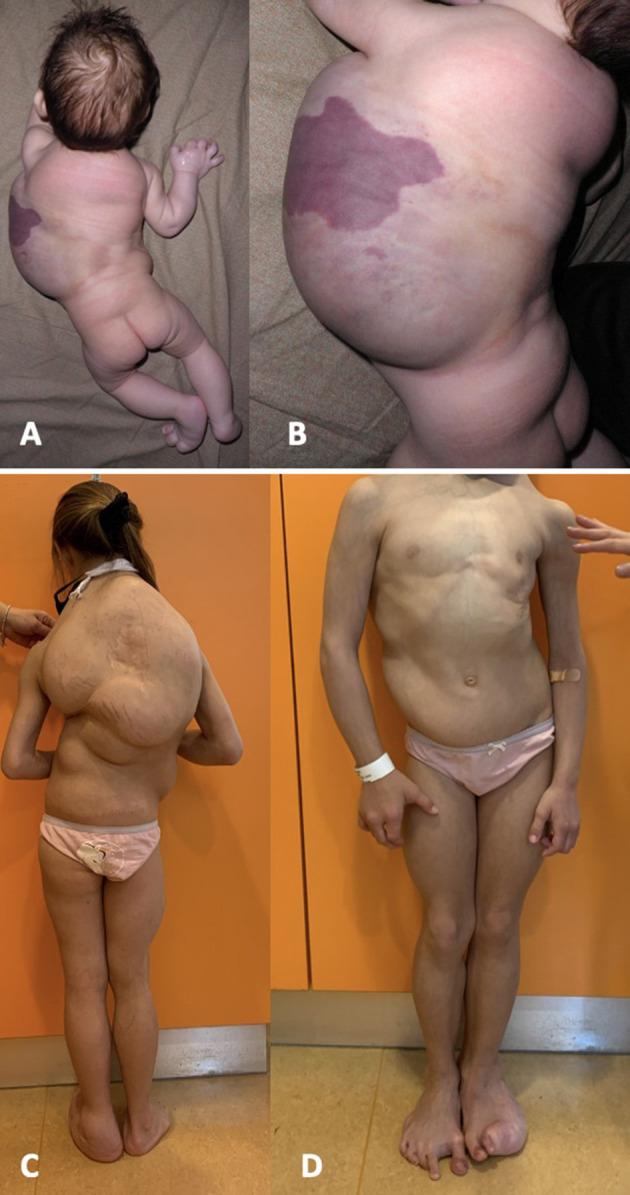
-related overgrowth spectrum (PROS) is an umbrella term referring to various clinical entities, which share the same pathogenetic mechanism. These conditions are caused by somatic gain-of-function mutations in , which encodes the 110-kD catalytic α subunit of PI3K (p110α). These mutations occur as post-zygotic events and lead to a gain of function of PI3K, with consequent constitutional activation of the downstream cascades (e.g., AKT/mTOR pathway), involved in cellular proliferation, survival and growth, as well as in vascular development in the embryonic stage. -related cancers and PROS share almost the same mutational profile, with about 80% of mutations occurring at three hotspots, E542, E545, and H1047. These hotspot mutations show the most potent effect on enzymatic activation of PI3K and consequent downstream biological responses. If present at the germinal level, these gain-of-function mutations would be lethal to the embryo, therefore we only see them in the mosaic state. The common clinical denominator of PROS disorders is that they are sporadic conditions, presenting with congenital or early childhood onset overgrowth with a typical mosaic distribution. However, the severity of PROS is highly variable, ranging from localized and apparently isolate overgrowth to progressive and extensive lipomatous overgrowth associated with life-threatening vascular malformations, as seen in CLOVES syndrome. Traditional therapeutic approaches, such as sclerotherapy and surgical debulking, are often not curative in PROS patients, leading to a recrudescence of the overgrowth in the treated area. Specific attention has been recently paid to molecules that are used and studied in the oncogenic setting and that are targeted on specific alterations of the pathway PI3K/AKT/mTOR. In June 2018, Venot et al. showed the effect of Alpelisib (BYL719), a specific inhibitor for the p110α subunit of PI3K, in patients with PROS disorders who had severe or life-threatening complications and were not sensitive to any other treatment. In these cases, dramatic anatomical and functional improvements occurred in all patients across many types of affected organ. Molecular testing in PROS patients is a crucial step in providing the conclusive diagnosis and then the opportunity for tailored therapy. The somatic nature of this group of diseases makes challenging to reach a molecular diagnosis, requiring deep sequencing methods that have to be performed on DNA extracted from affected tissue. Moreover, even analyzing the DNA extracted from affected tissue there is no guarantee to succeed in detection of the casual somatic mutation, since the affected tissue itself is highly heterogeneous and biopsy approaches can be burdened by incorrect sampling or inadequate tissue sample. We present an 8-year-old girl with CLOVES syndrome, born with a large cystic lymphangioma involving the left hemithorax and flank, multiple lipomas, and hypertrophy of the left foot and leg. She developed severe scoliosis. Many therapeutic approaches have been attempted, including Sildenafil treatment, scleroembolization, laser therapy, and multiple debulking surgeries, but none of these were of benefit to our patient's clinical status. She then started treatment with Rapamycin from May 2019, without significant improvement in both vascular malformation and leg hypertrophy. A high-coverage Whole Exome Sequencing analysis performed on DNA extracted from a skin sample showed a mosaic gain-of-function variant in the gene (p.H1047R, 11% of variant allele frequency). Once molecular confirmation of our clinical suspicion was obtained, after a multidisciplinary evaluation, we decided to discontinue Sirolimus and start targeted therapy with Alpelisib (50 mg/day). We noticed a decrease in fibroadipose overgrowth at the dorsal level, an improvement in in posture and excellent tolerability. The treatment is still ongoing.
相关过度生长谱系(PROS)是一个统称,指的是各种临床实体,它们具有相同的致病机制。这些病症是由体细胞功能获得性突变引起的,该突变发生在编码PI3K(p110α)的110-kD催化α亚基的基因中。这些突变作为合子后事件发生,导致PI3K功能获得,从而使下游级联反应(如AKT/mTOR途径)发生组成性激活,这些级联反应参与细胞增殖、存活和生长,以及胚胎期的血管发育。与相关的癌症和PROS几乎具有相同的突变谱,约80%的突变发生在三个热点E542、E545和H1047。这些热点突变对PI3K的酶促激活以及随之而来的下游生物学反应具有最显著的影响。如果这些功能获得性突变出现在生殖细胞水平,对胚胎将是致命的,因此我们仅在镶嵌状态下看到它们。PROS疾病的共同临床特征是它们为散发性病症,表现为先天性或儿童早期出现的过度生长,具有典型的镶嵌分布。然而,PROS的严重程度差异很大,从局部且明显孤立的过度生长到与危及生命的血管畸形相关的进行性和广泛性脂肪瘤样过度生长,如在CLOVES综合征中所见。传统的治疗方法,如硬化疗法和手术减容,对PROS患者往往无法治愈,导致治疗区域的过度生长复发。最近人们特别关注在致癌环境中使用和研究的、针对PI3K/AKT/mTOR途径特定改变的分子。2018年6月,韦诺特等人展示了Alpelisib(BYL719)的效果,Alpelisib是一种针对PI3K的p110α亚基的特异性抑制剂,用于患有严重或危及生命并发症且对任何其他治疗均无反应的PROS疾病患者。在这些病例中,所有患者的多种受累器官均出现了显著的解剖和功能改善。对PROS患者进行分子检测是提供确诊诊断并进而获得量身定制治疗机会的关键步骤。这组疾病的体细胞性质使得进行分子诊断具有挑战性,需要对从受影响组织中提取的DNA进行深度测序方法。此外,即使分析从受影响组织中提取的DNA,也不能保证成功检测到偶然的体细胞突变,因为受影响组织本身高度异质性,活检方法可能因采样错误或组织样本不足而受到影响。我们报告一名8岁患有CLOVES综合征的女孩,出生时患有累及左半胸和侧腹的巨大囊性淋巴管瘤、多个脂肪瘤以及左脚和左腿肥大。她出现了严重的脊柱侧弯。尝试了许多治疗方法,包括西地那非治疗、硬化栓塞、激光治疗和多次减容手术,但这些对我们患者的临床状况均无益处。然后她于2019年5月开始使用雷帕霉素治疗,血管畸形和腿部肥大均无明显改善。对从皮肤样本中提取的DNA进行高覆盖全外显子测序分析显示基因中存在镶嵌功能获得性变异(p.H1047R,变异等位基因频率为11%)。一旦获得对我们临床怀疑的分子确认,经过多学科评估后,我们决定停用西罗莫司并开始使用Alpelisib(50毫克/天)进行靶向治疗。我们注意到背部纤维脂肪过度生长减少,姿势改善且耐受性良好。治疗仍在进行中。

 Zotero 插件