
城市自然与公共健康:自然暴露与社会文化背景如何与抑郁风险相关。
Urban Nature and Public Health: How Nature Exposure and Sociocultural Background Relate to Depression Risk.
机构信息
Institute of Landscape Planning and Ecology, University of Stuttgart, 70174 Stuttgart, Germany.
出版信息
Int J Environ Res Public Health. 2021 Sep 14;18(18):9689. doi: 10.3390/ijerph18189689.
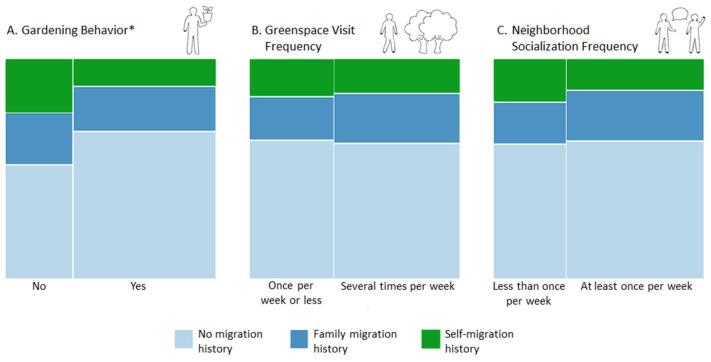
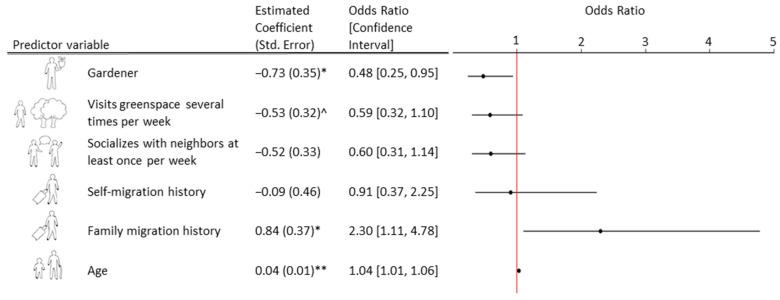
As the world's population becomes more urbanized, there is an associated decrease in nature exposure and a rise in noncommunicable diseases, including depression. Previous cross-sectional studies examining urban nature exposure and depression have reported favorable associations. However, many of these studies rely primarily on nature exposure metrics that measure the intensity of nature exposure, while other dimensions of urban nature exposure remain understudied. Therefore, in a cross-sectional, questionnaire-based case study targeting a general urban population ( = 282), we examined the relationship between two less commonly studied urban nature exposure variables (i.e., gardening behavior and greenspace visit frequency) and depression risk while also considering sociocultural background (multivariate logistic regression model). Results indicated that being a gardener was significantly associated with a reduced odds of being at risk of depression and that having a family migration history, but not a self-migration history, was associated with increased odds of being at risk of depression. In the examination of neighborhood socialization frequency and depression risk, we did not determine any significant association. The results of this study, therefore, highlight the importance of considering both people's sociocultural backgrounds and urban nature exposure in more detail to help plan for and support healthier cities in the future.
随着世界人口变得更加城市化,与自然接触的机会减少,同时非传染性疾病(包括抑郁症)的发病率上升。先前的横断面研究检查了城市自然暴露与抑郁症之间的关系,报告了有利的关联。然而,这些研究中的许多主要依赖于衡量自然暴露强度的自然暴露指标,而城市自然暴露的其他方面仍研究不足。因此,我们在一项针对一般城市人口(= 282)的基于问卷调查的横断面病例研究中,检验了两个研究较少的城市自然暴露变量(即园艺行为和绿地访问频率)与抑郁风险之间的关系,同时还考虑了社会文化背景(多变量逻辑回归模型)。结果表明,园艺者患抑郁症风险的几率显著降低,而有家庭移民史(而非自我移民史)则与患抑郁症风险的几率增加有关。在考察邻里社交频率与抑郁风险之间的关系时,我们没有发现任何显著关联。因此,这项研究的结果强调了在未来规划和支持更健康的城市时,需要更详细地考虑人们的社会文化背景和城市自然暴露的重要性。
 Zotero 插件