
食欲素-A 通过 AKT/ERK 信号通路调节小鼠初级颗粒细胞的卵泡生长、增殖、细胞周期和凋亡。
Orexin-A Regulates Follicular Growth, Proliferation, Cell Cycle and Apoptosis in Mouse Primary Granulosa Cells via the AKT/ERK Signaling Pathway.
机构信息
Key Laboratory of Agricultural Animal Genetics, Breeding and Reproduction, Education Ministry of China, College of Animal Sciences and Technology, Huazhong Agricultural University, Wuhan 430070, China.
Faculty of Veterinary and Animal Sciences, Muhammad Nawaz Shareef University of Agriculture, Multan 66000, Pakistan.
出版信息
Molecules. 2021 Sep 16;26(18):5635. doi: 10.3390/molecules26185635.
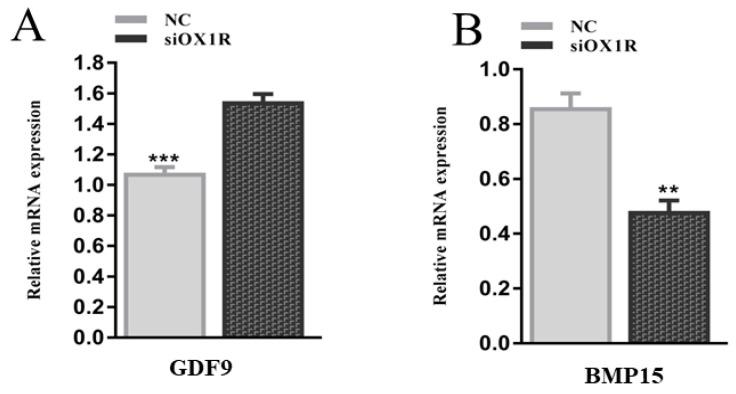
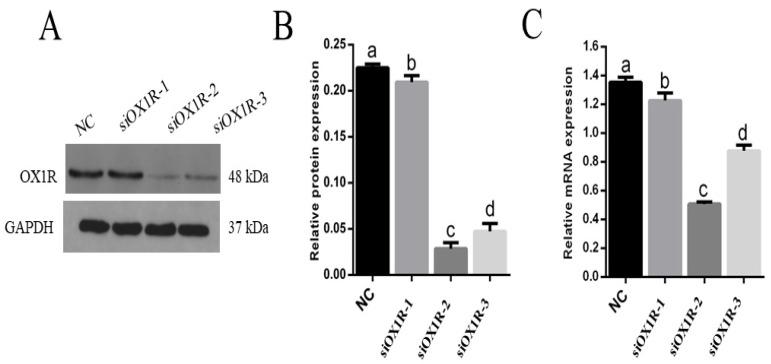
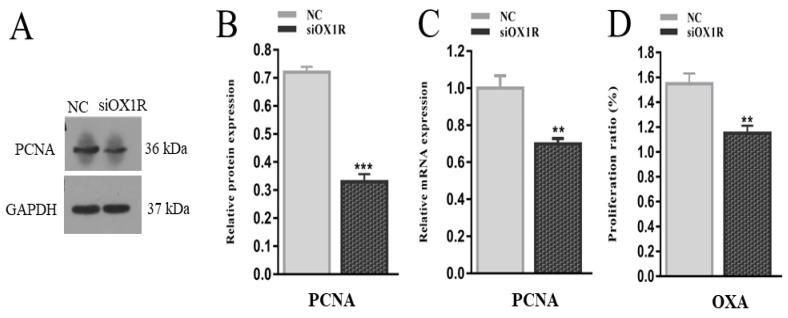
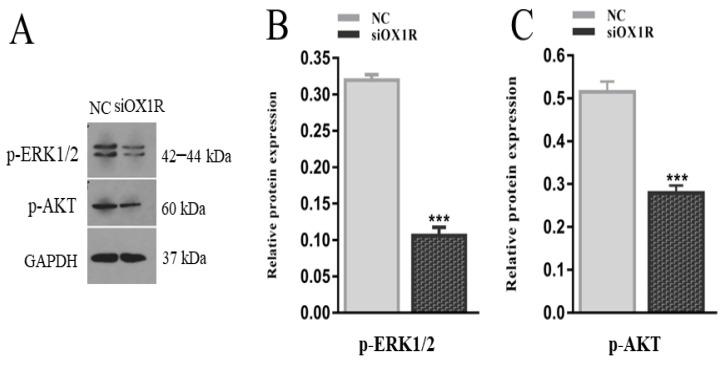
Granulosa cells (GCs) are essential for follicular growth, development, and atresia. The orexin-A (OXA) neuropeptide is widely involved in the regulation of various biological functions. OXA selectively binds to orexin receptor type 1 (OX1R) and mediates all its biological actions via OX1R. This study aimed to explore the expression of OXA and OX1R and their regulatory role in GCs proliferation, cell cycle progression, apoptosis, oocyte maturation, and underlying molecular mechanisms of these processes and elucidate its novel signaling pathway. Western blotting and RT-qPCR showed that OXA and OX1R were expressed during different developmental stages of GCs, and siRNA transfection successfully inhibited the expression of OX1R at the translational and transcriptional levels. Flow cytometry revealed that OX1R knockdown upregulated GCs apoptosis and triggered S-phase arrest in cell cycle progression. RT-qPCR and Western blotting showed significantly reduced expression of Bcl-2 and elevated expression of Bax, caspase-3, TNF-α, and P21 in OX1R-silenced GCs. Furthermore, the CCK-8 assay showed that knockdown of OX1R suppressed GCs proliferation by downregulating the expression of PCNA, a proliferation marker gene, at the translational and transcriptional levels. Western blotting revealed that knockdown of OX1R resulted in a considerable decrease of the phosphorylation level of the AKT and ERK1/2 proteins, indicating that the AKT/ERK1/2 pathway is involved in regulating GCs proliferation and apoptosis. In addition, OX1R silencing enhanced the mRNA expression of GDF9 and suppressed the mRNA expression of BMP15 in mouse GCs. Collectively, these results reveal a novel regulatory role of OXA in the development of GCs and folliculogenesis by regulating proliferation, apoptosis, and cell cycle progression. Therefore, OXA can be a promising therapeutic agent for female infertility.
颗粒细胞 (GCs) 是卵泡生长、发育和闭锁所必需的。食欲素-A (OXA) 神经肽广泛参与各种生物功能的调节。OXA 选择性地与食欲素受体 1 (OX1R) 结合,并通过 OX1R 介导其所有生物学作用。本研究旨在探讨 OXA 和 OX1R 的表达及其对 GCs 增殖、细胞周期进程、凋亡、卵母细胞成熟的调节作用及其潜在的分子机制,并阐明其新的信号通路。Western blot 和 RT-qPCR 显示,OXA 和 OX1R 在 GCs 的不同发育阶段表达,siRNA 转染成功抑制了 OX1R 在翻译和转录水平上的表达。流式细胞术显示,OX1R 敲低上调 GCs 凋亡,并触发细胞周期进程中的 S 期阻滞。RT-qPCR 和 Western blot 显示,OX1R 沉默的 GCs 中 Bcl-2 表达明显降低,Bax、caspase-3、TNF-α 和 P21 表达升高。此外,CCK-8 检测显示,通过下调增殖标志物基因 PCNA 在翻译和转录水平上的表达,OX1R 敲低抑制 GCs 增殖。Western blot 显示,OX1R 敲低导致 AKT 和 ERK1/2 蛋白的磷酸化水平显著降低,表明 AKT/ERK1/2 通路参与调节 GCs 增殖和凋亡。此外,OX1R 沉默增强了 GCs 中 GDF9 的 mRNA 表达,抑制了 BMP15 的 mRNA 表达。综上所述,这些结果揭示了 OXA 通过调节增殖、凋亡和细胞周期进程在 GCs 发育和卵泡发生中的新的调节作用。因此,OXA 可能成为治疗女性不孕的有前途的治疗剂。



 Zotero 插件