
利用唾液碘浓度评估临床成人碘营养状况。
Use of Salivary Iodine Concentrations to Estimate the Iodine Status of Adults in Clinical Practice.
机构信息
Internal Medicine, Department of Endocrinology, University Medical Center Groningen, University of Groningen, Groningen, The Netherlands.
Department of Clinical Pharmacy and Pharmacology, University Medical Center Groningen, University of Groningen, Groningen, The Netherlands.
出版信息
J Nutr. 2021 Dec 3;151(12):3671-3677. doi: 10.1093/jn/nxab303.
BACKGROUND
Measurement of the 24-h urinary iodine concentration or urinary iodine excretion (UIE) is the gold standard to determine iodine status; however, this method is inconvenient. The use of salivary iodine could be a possible alternative since salivary glands express the sodium-iodine symporter.
OBJECTIVES
We aimed to establish the correlation between the salivary iodine secretion and UIE, to evaluate the clinical applicability of the iodine saliva measurement.
METHODS
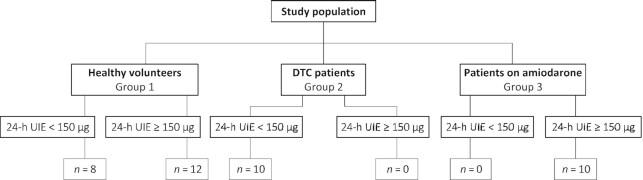
We collected 24-h urine and saliva samples from 40 participants ≥18 y: 20 healthy volunteers with no specific diet (group 1), 10 patients with differentiated thyroid cancer with a low dietary intake (<50 μg/d, group 2), and 10 patients with a high iodine status as the result of the use of amiodarone (group 3). Urinary and salivary iodine were measured using a validated inductively coupled plasma MS method. To correct for differences in water content, the salivary iodine concentration (SIC) was corrected for salivary protein and urea concentrations (SI/SP and SI/SU, respectively). The intra- and inter-individual CVs were calculated, and the Kruskal-Wallis test and Spearman's correlation were used.
RESULTS
The intra-individual CVs for SIC, SI/SP, and SI/SU were 63.8%, 37.7%, and 26.9%, respectively. The inter-individual CVs for SIC, SI/SP, and SI/SU were 77.5%, 41.6% and 47.0%, respectively. We found significant differences (P < 0.01) in urinary and salivary iodine concentrations between all groups [the 24-h UIE values were 176 μg/d (IQR, 96.1-213 μg/d), 26.0 μg/d (IQR, 22.0-37.0 μg/d), and 10.0103 μg/d (IQR, 7.57103-11.4103 μg/d) in groups 1-3, respectively; the SIC values were 136 μg/L (IQR, 86.3-308 μg/L), 71.5 μg/L (IQR, 29.5-94.5 μg/L), and 14.3103 μg/L (IQR, 10.6103-25.6103 μg/L) in groups 1-3, respectively]. Correlations between the 24-h UIE and SIC, SI/SP, and SI/SU values were strong (ρ = 0.80, ρ = 0.90, and ρ = 0.86, respectively; P < 0.01).
CONCLUSIONS
Strong correlations were found between salivary and urinary iodine in adults with different daily iodine intakes. A salivary iodine measurement can be performed to assess the total iodine body pool, with the recommendation to correct for salivary protein or urea.
背景
24 小时尿碘浓度或尿碘排泄量(UIE)的测量是确定碘状态的金标准;然而,这种方法不太方便。唾液碘的使用可能是一种可行的替代方法,因为唾液腺表达钠碘转运体。
目的
我们旨在建立唾液碘分泌与 UIE 之间的相关性,评估碘唾液测量的临床适用性。
方法
我们收集了 40 名年龄≥18 岁的参与者的 24 小时尿液和唾液样本:20 名无特殊饮食的健康志愿者(第 1 组),10 名甲状腺癌患者,其饮食摄入较低(<50μg/d,第 2 组),以及 10 名因使用胺碘酮而碘状态较高的患者(第 3 组)。使用经过验证的电感耦合等离子体质谱法(ICP-MS)方法测量尿碘和唾液碘。为了校正水分含量的差异,唾液碘浓度(SIC)校正了唾液蛋白和尿素浓度(SI/SP 和 SI/SU,分别)。计算了个体内和个体间的变异系数(CV),并使用了 Kruskal-Wallis 检验和 Spearman 相关性。
结果
SIC、SI/SP 和 SI/SU 的个体内 CV 分别为 63.8%、37.7%和 26.9%。SIC、SI/SP 和 SI/SU 的个体间 CV 分别为 77.5%、41.6%和 47.0%。我们发现所有组之间的尿碘和唾液碘浓度均有显著差异(P<0.01)[第 1-3 组的 24 小时 UIE 值分别为 176μg/d(IQR,96.1-213μg/d)、26.0μg/d(IQR,22.0-37.0μg/d)和 10.0103μg/d(IQR,7.57103-11.4103μg/d);SIC 值分别为 136μg/L(IQR,86.3-308μg/L)、71.5μg/L(IQR,29.5-94.5μg/L)和 14.3103μg/L(IQR,10.6103-25.6103μg/L)]。24 小时 UIE 与 SIC、SI/SP 和 SI/SU 值之间的相关性很强(ρ=0.80、ρ=0.90 和 ρ=0.86,均 P<0.01)。
结论
在不同日常碘摄入量的成年人中,发现唾液碘和尿碘之间存在很强的相关性。可以进行唾液碘测量来评估总碘体池,建议校正唾液蛋白或尿素。


 Zotero 插件