
阿尔茨海默病患者视网膜多层厚度和血管网络的变化。
Changes in retinal multilayer thickness and vascular network of patients with Alzheimer's disease.
机构信息
Kangning Hospital of Ningbo, Ningbo Kangning Hospital, Zhuangyu South Road 1#, Ningbo, Zhejiang, China.
Ningbo University, Ningbo, Zhejiang, China.
出版信息
Biomed Eng Online. 2021 Oct 3;20(1):97. doi: 10.1186/s12938-021-00931-2.
BACKGROUND
Retinal biomarkers of Alzheimer's disease (AD) have been extensively investigated in recent decades. Retinal nervous and vascular parameters can reflect brain conditions, and they can facilitate early diagnosis of AD.
OBJECTIVE
Our study aimed to evaluate the difference in retinal neuro-layer thickness and vascular parameters of patients with AD and healthy controls (HCs).
METHODS
Non-invasive optical coherence tomography angiography (OCTA) was used to determine the combined thickness of the retinal nerve fiber layer (RNFL) and ganglion cell layer (GCL), as well as the full retinal thickness (FRT). The vascular branching (VB), vascular curvature (VC), and vascular density (VD) for AD and HC groups were also obtained. The Mini-Mental State Examination (MMSE) was used to evaluate the cognitive performance of all the participants. After obtaining all the parameters, two-way analysis of variance (ANOVA) was used to compare the mean values of all the retinal parameters of the patients with AD and the HCs. Pearson's correlation was used to test the association between retinal parameters, MMSE scores, and vascular parameters.
RESULTS
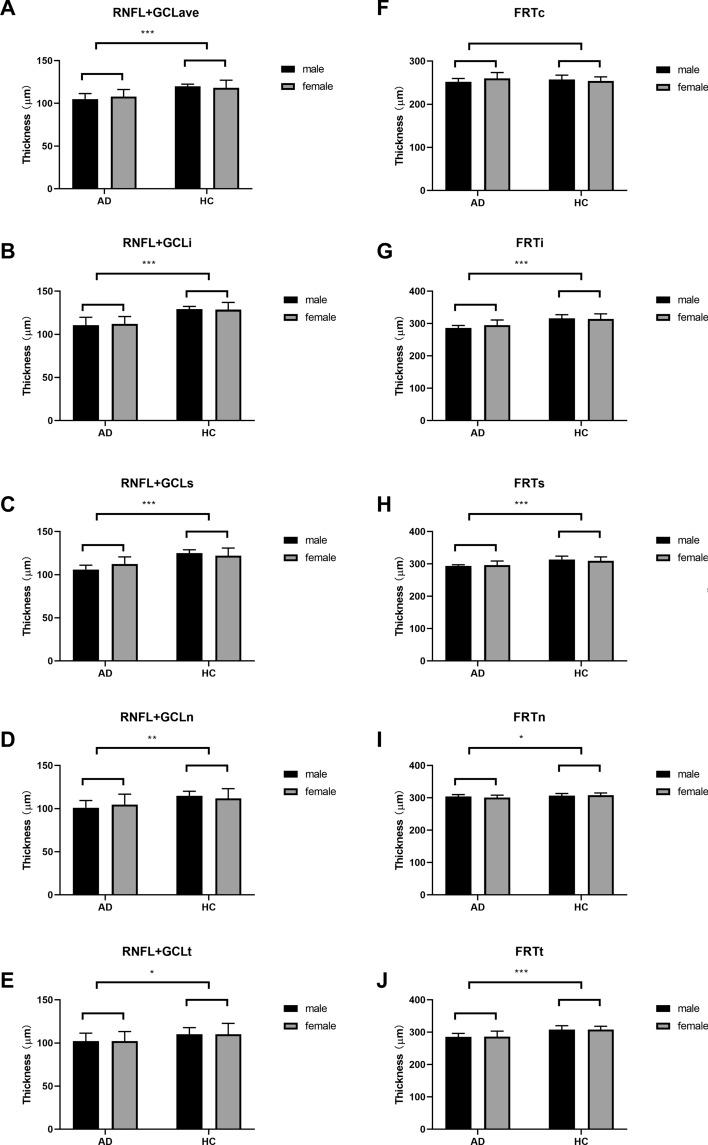
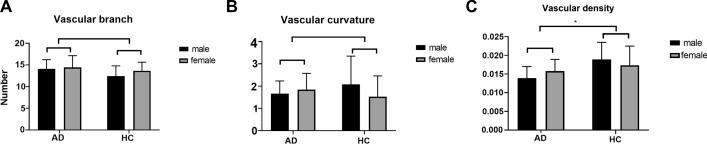
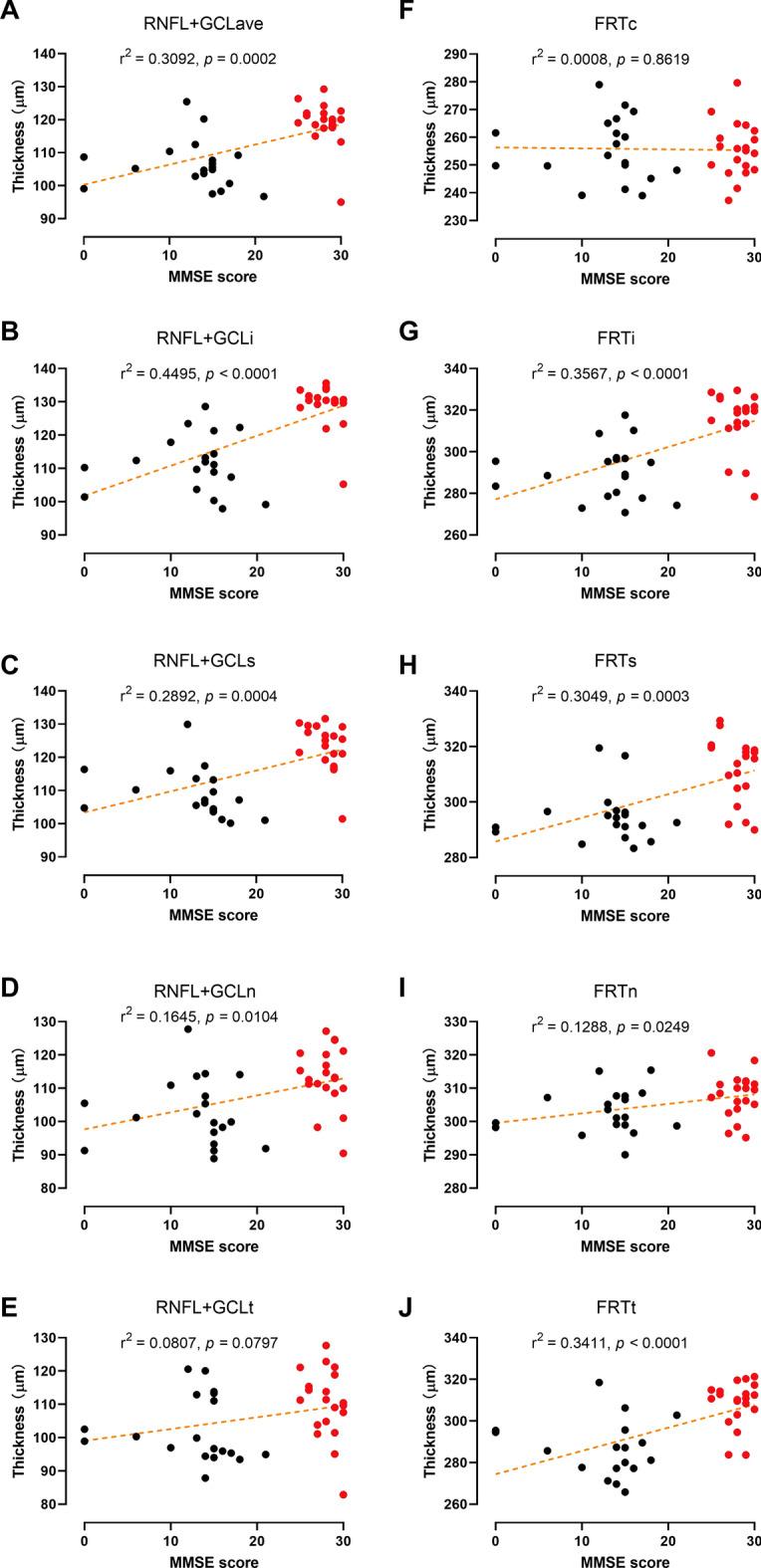
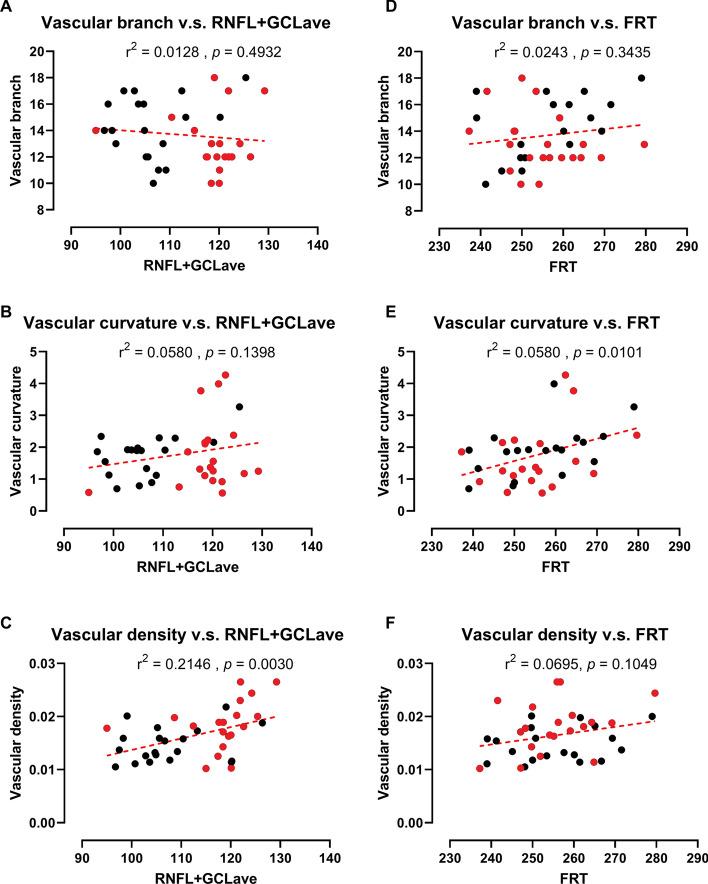
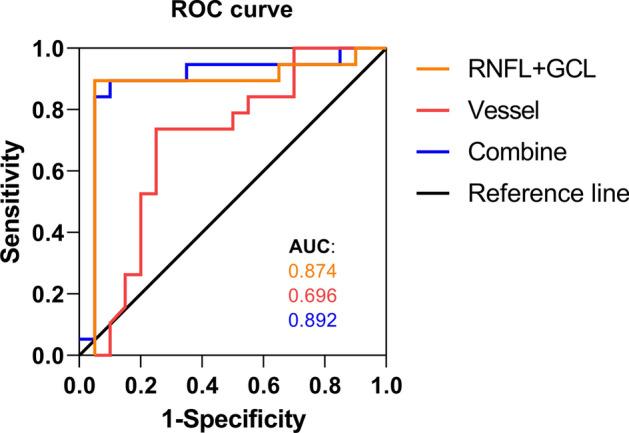
Seventy-eight eyes from 39 participants (19 AD and 20 HC; male, 52.6% in AD and 45.0% in HC; mean [standard deviation] age of 73.79 [7.22] years in AD and 74.35 [6.07] years in HC) were included for the analysis. The average RNFL + GCL thickness (106.32 ± 7.34 μm), FRTs of the four quadrants (290.35 ± 13.05 μm of inferior quadrant, 294.68 ± 9.37 μm of superior quadrant, 302.97 ± 6.52 μm of nasal quadrant, 286.02 ± 13.74 μm of temporal quadrant), and retinal VD (0.0148 ± 0.003) of patients with AD, compared with the HCs, were significantly reduced (p < 0.05). Retinal thickness was significantly correlated with the MMSE scores (p < 0.05). Meanwhile, retinal VD was significantly correlated with the average RNFL + GCL thickness (r = 0.2146, p < 0.01). When the vascular parameters were considered, the sensitivity of the AD diagnosis was increased from 0.874 to 0.892.
CONCLUSION
Our study suggested that the patients with AD, compared with age-matched HCs, had significantly reduced RNFL + GCL thickness and vascular density. These reductions correlated with the cognitive performance of the participants. By combining nerve and vessel parameters, the diagnosis of AD can be improved using OCTA technology. Trail registration Name of the registry: Chinese Clinical Trail Registry, Trial registration number: ChiCTR2000035243, Date of registration: Aug. 5, 2020. URL of trial registry record: http://www.chictr.org.cn/index.aspx.
背景
在过去的几十年里,阿尔茨海默病(AD)的视网膜生物标志物已经得到了广泛的研究。视网膜神经和血管参数可以反映大脑状况,并有助于 AD 的早期诊断。
目的
我们的研究旨在评估 AD 患者和健康对照组(HCs)的视网膜神经层厚度和血管参数的差异。
方法
使用非侵入性的光相干断层扫描血管造影术(OCTA)来确定视网膜神经纤维层(RNFL)和节细胞层(GCL)的总和厚度,以及整个视网膜的厚度(FRT)。还获得了 AD 和 HC 组的血管分支(VB)、血管曲率(VC)和血管密度(VD)。使用简易精神状态检查(MMSE)评估所有参与者的认知表现。获得所有参数后,使用双向方差分析(ANOVA)比较 AD 患者和 HCs 的所有视网膜参数的平均值。使用 Pearson 相关分析测试视网膜参数、MMSE 评分和血管参数之间的关联。
结果
纳入了 39 名参与者的 78 只眼睛(19 名 AD 和 20 名 HC;AD 组男性占 52.6%,HC 组男性占 45.0%;AD 组的平均年龄为 73.79[7.22]岁,HC 组的平均年龄为 74.35[6.07]岁)进行分析。AD 患者的平均 RNFL+GCL 厚度(106.32±7.34μm)、四个象限的 FRT(下象限 290.35±13.05μm、上象限 294.68±9.37μm、鼻象限 302.97±6.52μm、颞象限 286.02±13.74μm)和视网膜 VD(0.0148±0.003)均显著降低(p<0.05)。视网膜厚度与 MMSE 评分显著相关(p<0.05)。同时,视网膜 VD 与平均 RNFL+GCL 厚度显著相关(r=0.2146,p<0.01)。当考虑血管参数时,AD 的诊断敏感性从 0.874 提高到 0.892。
结论
我们的研究表明,与年龄匹配的 HCs 相比,AD 患者的 RNFL+GCL 厚度和血管密度显著降低。这些减少与参与者的认知表现相关。通过结合神经和血管参数,OCTA 技术可以提高 AD 的诊断准确性。
试验注册
中国临床试验注册中心,注册号:ChiCTR2000035243,注册日期:2020 年 8 月 5 日。试验注册网址:http://www.chictr.org.cn/index.aspx。

 Zotero 插件