
基于表面肌电信号的新型可穿戴机器人手部外骨骼控制
Control of Newly-Designed Wearable Robotic Hand Exoskeleton Based on Surface Electromyographic Signals.
作者信息
Li Ke, Li Zhengzhen, Zeng Haibin, Wei Na
机构信息
Laboratory of Rehabilitation Engineering, Research Center of Intelligent Medical Engineering, School of Control Science and Engineering, Shandong University, Jinan, China.
Department of Radiotherapy, Suzhou Dushu Lake Hospital, Suzhou, China.
出版信息
Front Neurorobot. 2021 Sep 15;15:711047. doi: 10.3389/fnbot.2021.711047. eCollection 2021.
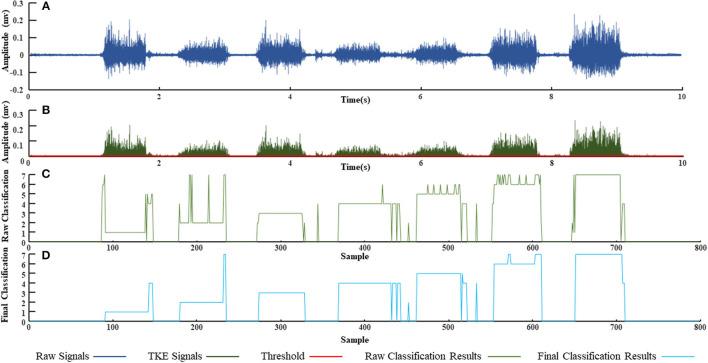
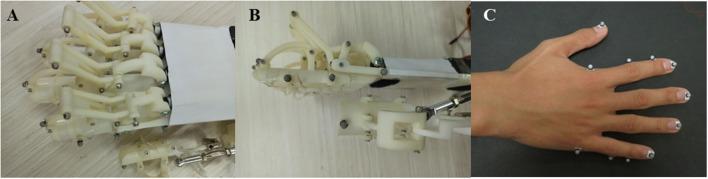
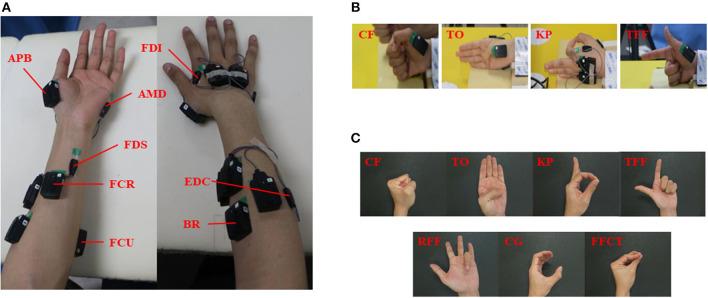
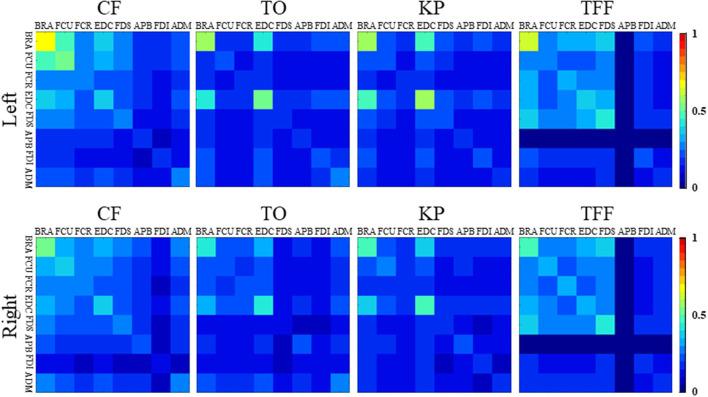
The human hand plays a role in a variety of daily activities. This intricate instrument is vulnerable to trauma or neuromuscular disorders. Wearable robotic exoskeletons are an advanced technology with the potential to remarkably promote the recovery of hand function. However, the still face persistent challenges in mechanical and functional integration, with real-time control of the multiactuators in accordance with the motion intentions of the user being a particular sticking point. In this study, we demonstrated a newly-designed wearable robotic hand exoskeleton with multijoints, more degrees of freedom (DOFs), and a larger range of motion (ROM). The exoskeleton hand comprises six linear actuators (two for the thumb and the other four for the fingers) and can realize both independent movements of each digit and coordinative movement involving multiple fingers for grasp and pinch. The kinematic parameters of the hand exoskeleton were analyzed by a motion capture system. The exoskeleton showed higher ROM of the proximal interphalangeal and distal interphalangeal joints compared with the other exoskeletons. Five classifiers including support vector machine (SVM), K-near neighbor (KNN), decision tree (DT), multilayer perceptron (MLP), and multichannel convolutional neural networks (multichannel CNN) were compared for the offline classification. The SVM and KNN had a higher accuracy than the others, reaching up to 99%. For the online classification, three out of the five subjects showed an accuracy of about 80%, and one subject showed an accuracy over 90%. These results suggest that the new wearable exoskeleton could facilitate hand rehabilitation for a larger ROM and higher dexterity and could be controlled according to the motion intention of the subjects.
人类的手在各种日常活动中发挥着作用。这一复杂的器官容易受到创伤或神经肌肉疾病的影响。可穿戴机器人外骨骼是一项先进技术,具有显著促进手部功能恢复的潜力。然而,它们在机械和功能整合方面仍面临持续挑战,根据用户的运动意图对多个执行器进行实时控制是一个特别棘手的问题。在本研究中,我们展示了一种新设计的多关节、更多自由度(DOF)和更大运动范围(ROM)的可穿戴机器人手部外骨骼。该外骨骼手包括六个线性执行器(两个用于拇指,另外四个用于手指),可以实现每个手指的独立运动以及涉及多个手指的抓握和捏合的协调运动。通过运动捕捉系统分析了手部外骨骼的运动学参数。与其他外骨骼相比,该外骨骼在近端指间关节和远端指间关节处显示出更高的运动范围。比较了包括支持向量机(SVM)、K近邻(KNN)、决策树(DT)、多层感知器(MLP)和多通道卷积神经网络(多通道CNN)在内的五种分类器进行离线分类。SVM和KNN的准确率高于其他分类器,高达99%。对于在线分类,五名受试者中有三名的准确率约为80%,一名受试者的准确率超过90%。这些结果表明,这种新型可穿戴外骨骼可以促进手部康复,实现更大的运动范围和更高的灵活性,并可以根据受试者的运动意图进行控制。





 Zotero 插件