
经股中肌入路全膝关节置换术后康复方案的优化:一项随机对照试验。
Enhanced recovery after surgery protocols in total knee arthroplasty via midvastus approach: a randomized controlled trial.
机构信息
Department of Orthopaedic Surgery, Nanjing First Hospital, Nanjing Medical University, Nanjing, 210006, Jiangsu, China.
Digital Medicine Institute, Nanjing Medical University, Nanjing, 210006, Jiangsu, China.
出版信息
BMC Musculoskelet Disord. 2021 Oct 8;22(1):856. doi: 10.1186/s12891-021-04731-6.
BACKGROUND
Enhanced recovery after surgery (ERAS) protocols were rapidly adopted in many surgeries such as fast-track arthroplasty. The study aimed to investigate the impact of ERAS protocols on the clinical effect of total knee arthroplasty (TKA) via the midvastus approach.
METHODS
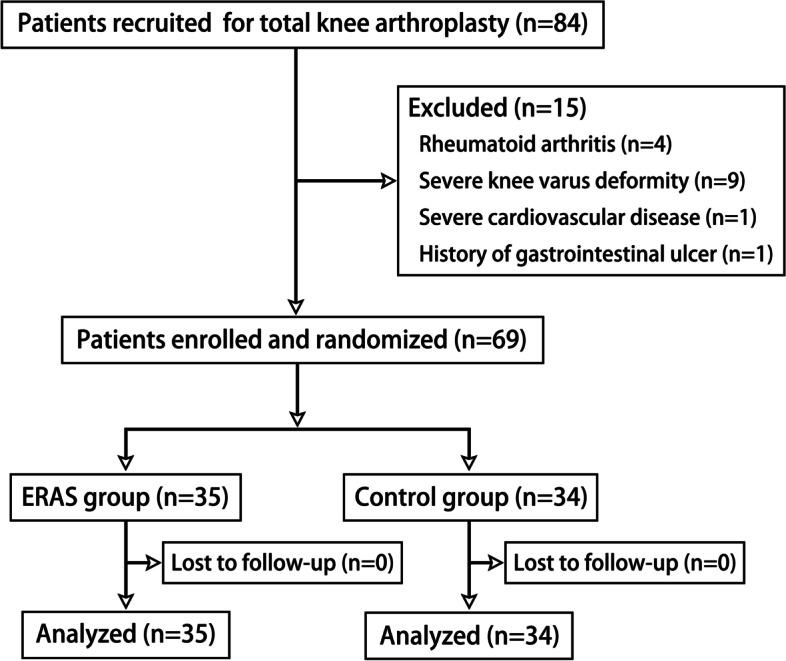
A total of 69 patients who underwent primary unilateral TKA via the midvastus approach from October 2018 to June 2019 were enrolled and randomly divided into two groups: ERAS group and Control group. The ERAS protocols were adopted for the ERAS group and consisted of pure juice drinking 2 h before the surgery, optimization of the preoperative anesthesia plan, phased use of tourniquets, and the use of tranexamic acid as well as a drug cocktail. The operative time, first postoperative walking time, first straight leg elevation time, postoperative hospitalization time, visual analogue scale score (VAS score), Hospital for Special Surgery score (HSS score), conventional Knee Society score (KSS), and knee range of motion (ROM) were used to assess the clinical effects in the two groups. All the included patients were followed up for 12 months.
RESULTS
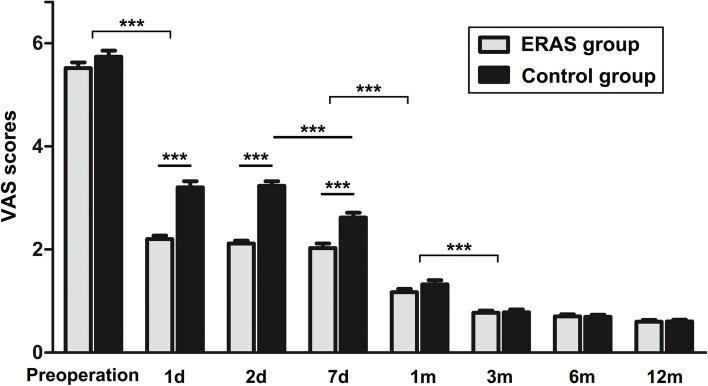
There were no significant differences in the basic demographic information and operation time between the ERAS and Control groups (P > 0.05). The first postoperative walking time (2.11 ± 0.11 h) and first postoperative straight leg elevation time (6.14 ± 1.73 h) in the ERAS group were significantly earlier than those in the Control group (P < 0.001) and the postoperative hospitalization time was significantly shorter (3.11 ± 0.32 days). The postoperative mean VAS scores in both groups were significantly reduced compared with those before surgery (P < 0.001). The VAS scores for the ERAS group were significantly lower than those for the Control group at 1, 2, and 7 days after surgery (P < 0.001). The mean HSS scores, KSS, and knee ROM were significantly increased in both the ERAS and Control groups at 1, 3, 6, and 12 months after surgery (P < 0.001). In addition, the HSS scores, KSS, and knee ROM in the ERAS group were significantly higher than those in the Control group at 1 month after surgery (P < 0.001).
CONCLUSIONS
ERAS protocols improved the clinical effects of TKA via the midvastus approach, facilitating early out-of-bed activity and comfortable postoperative rehabilitation exercise, and further increasing patient satisfaction.
TRIAL REGISTRATION
ClinicalTrials.gov Identifier: NCT04873544 .
背景
加速康复外科(ERAS)方案在许多手术中迅速得到采用,如快速通道关节置换术。本研究旨在通过股中肌入路探讨 ERAS 方案对全膝关节置换术(TKA)临床效果的影响。
方法
选取 2018 年 10 月至 2019 年 6 月间行初次单侧 TKA 股中肌入路的 69 例患者,随机分为 ERAS 组和对照组。ERAS 组采用 ERAS 方案,包括术前 2 h 饮用纯果汁、优化术前麻醉方案、分阶段使用止血带以及使用氨甲环酸和药物鸡尾酒。评估两组患者的手术时间、术后首次行走时间、术后首次直腿抬高时间、术后住院时间、视觉模拟评分(VAS 评分)、美国特种外科医院评分(HSS 评分)、常规膝关节协会评分(KSS)和膝关节活动度(ROM)。所有纳入患者均随访 12 个月。
结果
两组患者基本人口统计学资料和手术时间比较差异无统计学意义(P>0.05)。ERAS 组术后首次行走时间(2.11±0.11 h)和术后首次直腿抬高时间(6.14±1.73 h)明显早于对照组(P<0.001),术后住院时间明显缩短(3.11±0.32 d)。两组患者术后 VAS 评分均较术前明显降低(P<0.001)。术后 1、2、7 d,ERAS 组 VAS 评分明显低于对照组(P<0.001)。术后 1、3、6、12 个月,ERAS 组和对照组 HSS 评分、KSS 评分和膝关节 ROM 均明显升高(P<0.001)。术后 1 个月,ERAS 组 HSS 评分、KSS 评分和膝关节 ROM 明显高于对照组(P<0.001)。
结论
通过股中肌入路,ERAS 方案改善了 TKA 的临床效果,促进了早期下床活动和舒适的术后康复锻炼,进一步提高了患者满意度。
试验注册
ClinicalTrials.gov 标识符:NCT04873544。
 Zotero 插件