
镰刀状小鼠模型中GBT1118停药的流变学影响
Rheological Impact of GBT1118 Cessation in a Sickle Mouse Model.
作者信息
Kanne Celeste K, Nebor Danitza, Pochron Mira, Oksenberg Donna, Sheehan Vivien A
机构信息
Aflac Cancer & Blood Disorders Center Children's Healthcare of Atlanta, School of Medicine, Emory University, Atlanta, GA, United States.
Department of Pediatrics, Section of Hematology/Oncology, Baylor College of Medicine, Houston, TX, United States.
出版信息
Front Physiol. 2021 Sep 24;12:742784. doi: 10.3389/fphys.2021.742784. eCollection 2021.
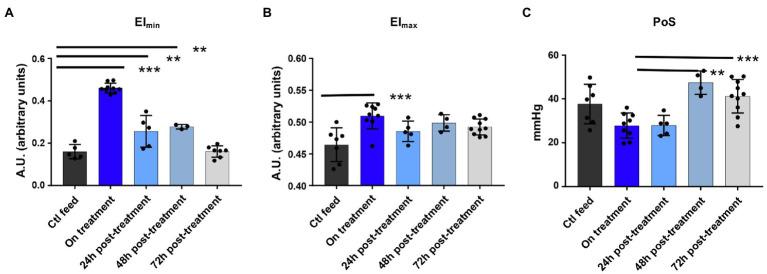
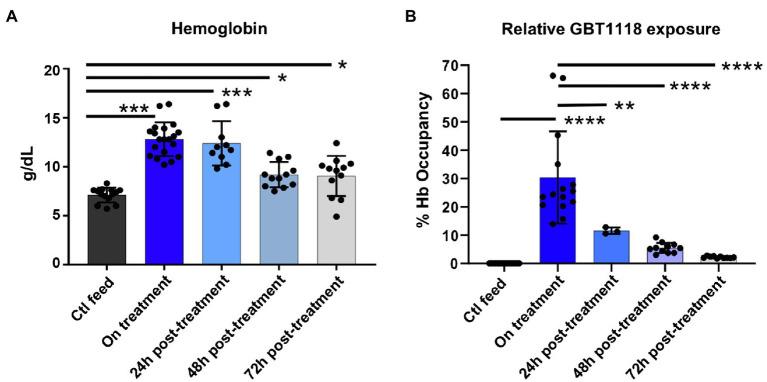
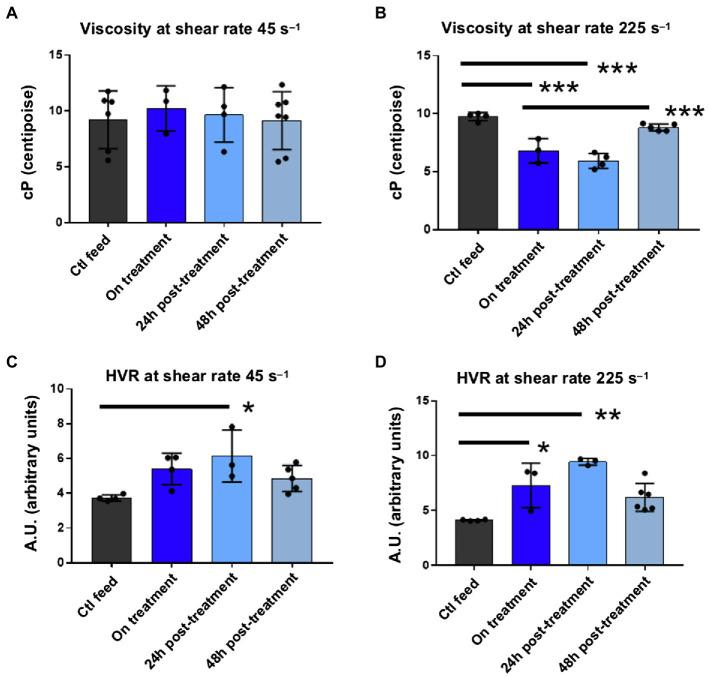
In sickle cell disease (SCD), higher whole blood viscosity is a risk factor for vaso-occlusive crisis, avascular necrosis, and proliferative retinopathy. Blood viscosity is strongly impacted by hemoglobin (Hb) levels and red blood cell (RBC) deformability. Voxelotor is a hemoglobin S (HbS) polymerization inhibitor with anti-sickling properties that increases the Hb affinity for oxygen, thereby reducing HbS polymerization. In clinical trials, voxelotor increased Hb by an average of 1g/dl, creating concern that this rise in Hb could increase viscosity, particularly when the drug was cleared. To investigate this potential rebound hyperviscosity effect, we treated SCD mice with GBT1118, a voxelotor analog, and stopped the treatment to determine the effect on blood viscosity and RBC deformability under a range of oxygen concentrations. GBT1118 treatment increased Hb, improved RBC deformability by increasing the elongation index under normoxic (EI) and hypoxic conditions (EI), and decreased the point of sickling (PoS) without increasing blood viscosity. The anti-sickling effects and improvement of RBC deformability balanced the effect of increased Hb such that there was no increase in blood viscosity. Forty-eight hours after ceasing GBT1118, Hb declined from the rise induced by treatment, viscosity did not increase, and EI remained elevated compared to control animals. Hb and PoS were not different from control animals, suggesting a return to native oxygen affinity and clearance of the drug. RBC deformability did not return to baseline, suggesting some residual rheological improvement. These data suggest that concerns regarding viscosity rise above pre-treatment levels upon sudden cessation of voxelotor are not warranted.
在镰状细胞病(SCD)中,全血粘度升高是血管闭塞性危象、无血管性坏死和增殖性视网膜病变的危险因素。血液粘度受血红蛋白(Hb)水平和红细胞(RBC)变形性的强烈影响。伏洛托珠单抗是一种具有抗镰变特性的血红蛋白S(HbS)聚合抑制剂,可增加Hb对氧气的亲和力,从而减少HbS聚合。在临床试验中,伏洛托珠单抗使Hb平均升高1g/dl,这引发了人们对Hb升高可能会增加粘度的担忧,尤其是在药物清除时。为了研究这种潜在的反弹性高粘度效应,我们用伏洛托珠单抗类似物GBT1118治疗SCD小鼠,并停止治疗以确定在一系列氧浓度下对血液粘度和RBC变形性的影响。GBT1118治疗可增加Hb,通过在常氧(EI)和低氧条件下增加伸长指数(EI)来改善RBC变形性,并降低镰变点(PoS),而不会增加血液粘度。抗镰变作用和RBC变形性的改善平衡了Hb升高的影响,因此血液粘度没有增加。停止GBT1118治疗48小时后,Hb从治疗引起的升高水平下降,粘度没有增加,与对照动物相比,EI仍然升高。Hb和PoS与对照动物没有差异,表明恢复到天然氧亲和力并清除了药物。RBC变形性没有恢复到基线水平,表明流变学有一些残留改善。这些数据表明,对于突然停止使用伏洛托珠单抗后粘度升至治疗前水平以上的担忧是没有必要的。
 Zotero 插件