
老年人感染 HIV 后接种 COVID-19 疫苗后抗 SARS-CoV-2 刺突蛋白免疫原性的定性评估(QUASI)。
Qualitative assessment of anti-SARS-CoV-2 spike protein immunogenicity (QUASI) after COVID-19 vaccination in older people living with HIV.
机构信息
Section of Infectious Diseases, Yale University School of Medicine, New Haven, Connecticut, USA.
Yale AIDS Program, Yale University School of Medicine, New Haven, Connecticut, USA.
出版信息
HIV Med. 2022 Feb;23(2):178-185. doi: 10.1111/hiv.13188. Epub 2021 Oct 10.
OBJECTIVES
Effective and safe COVID-19 vaccines have been developed and have resulted in decreased incidence and severity of severe acute respiratory syndrome coronavirus 2 (SARS-CoV-2) infection and can decrease secondary transmission. However, there are concerns about dampened immune responses to COVID-19 vaccination among immunocompromised patients, including people living with HIV (PLWH), which may blunt the vaccine's efficacy and durability of protection. This study aimed to assess the qualitative SARS-CoV-2 vaccine immunogenicity among PLWH after vaccination.
METHODS
We conducted targeted COVID-19 vaccination (all received BNT162b2 vaccine) of PLWH (aged ≥ 55 years per state guidelines) at Yale New Haven Health System and established a longitudinal survey to assess their qualitative antibody responses at 3 weeks after the first vaccination (and prior to receipt of the second dose of the COVID-19 vaccine) (visit 1) and at 2-3 weeks after the second vaccination (visit 2) but excluded patients with prior COVID-19 infection. Our goal was to assess vaccine-induced immunity in the population we studied. Qualitative immunogenicity testing was performed using Healgen COVID-19 anti-Spike IgG/IgM rapid testing. Poisson regression with robust standard errors was used to determine factors associated with a positive IgG response.
RESULTS
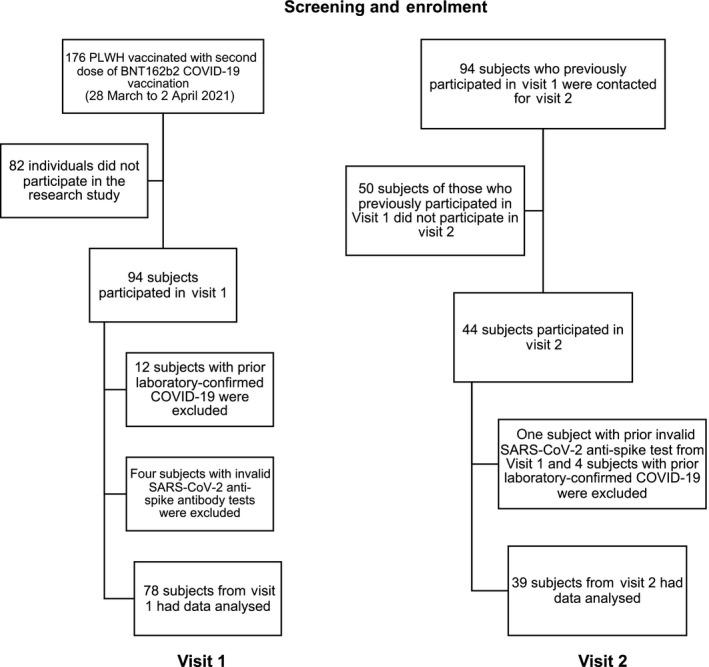
At visit 1, 45 of 78 subjects (57.7%) tested positive for SARS-CoV-2 anti-Spike IgG after the first dose of COVID-19 vaccine. Thirty-nine subjects returned for visit 2. Of these, 38 had positive IgG (97.5%), including 20 of 21 subjects (95.2%) with an initial negative anti-Spike IgG. Our bivariate analysis suggested that participants on an antiretroviral regimen containing integrase strand transfer inhibitors [relative risk (RR) = 1.81, 95% confidence interval (CI): 0.92-3.56, p = 0.085] were more likely to seroconvert after the first dose of the COVID-19 vaccine, while those with a CD4 count < 500 cells/μL (RR = 0.59, 95% CI: 0.33-1.05, p = 0.071), and those diagnosed with cancer or another immunosuppressive condition (RR = 0.49, 95% CI: 0.18-1.28, p = 0.15) may have been less likely to seroconvert after the first dose of the COVID-19 vaccine. The direction of these associations was similar in the multivariate model, although none of these findings reached statistical significance (RR = 1.71, 95% CI: 0.90-3.25, p = 0.10; RR = 0.68, 95% CI: 0.39-1.19, p = 0.18; RR = 0.50, 95% CI: 0.19-1.33, p = 0.16). With regard to immunogenicity, we were able to record very high rates of new seroconversion following the second dose of the COVID-19 vaccine.
CONCLUSIONS
Our study suggests that completing a two-dose series of BNT162b2 vaccine is critical for PLWH given suboptimal seroconversion rates after the first dose and subsequent improved seroconversion rates after the second dose.
目的
有效的 COVID-19 疫苗已经研发出来,并且已经降低了严重急性呼吸综合征冠状病毒 2(SARS-CoV-2)感染的发病率和严重程度,并且可以减少二次传播。然而,人们担心免疫功能低下的患者(包括 HIV 感染者[PLWH])对 COVID-19 疫苗的免疫反应会减弱,这可能会削弱疫苗的疗效和保护的持久性。本研究旨在评估 PLWH 在接种 COVID-19 疫苗后的定性 SARS-CoV-2 疫苗免疫原性。
方法
我们在耶鲁纽黑文卫生系统对符合条件的 PLWH(根据州指南年龄≥55 岁)进行了有针对性的 COVID-19 疫苗接种(均接种 BNT162b2 疫苗),并建立了一项纵向调查,以评估他们在第一次接种后 3 周(在接种第二剂 COVID-19 疫苗之前)(第 1 次就诊)和第二次接种后 2-3 周(第 2 次就诊)的定性抗体反应,但不包括既往 COVID-19 感染的患者。我们的目标是评估我们研究人群中的疫苗诱导免疫。定性免疫原性测试使用 Healgen COVID-19 抗刺突 IgG/IgM 快速测试进行。使用稳健标准误差的泊松回归来确定与 IgG 阳性反应相关的因素。
结果
在第 1 次就诊时,78 名患者中有 45 名(57.7%)在接受第一剂 COVID-19 疫苗后 SARS-CoV-2 抗刺突 IgG 检测呈阳性。39 名患者返回进行第 2 次就诊。其中,38 名患者 IgG 阳性(97.5%),包括 21 名患者中的 20 名(95.2%)最初 IgG 抗刺突阴性。我们的单变量分析表明,接受包含整合酶链转移抑制剂的抗逆转录病毒方案的患者(RR=1.81,95%置信区间[CI]:0.92-3.56,p=0.085)在接种第一剂 COVID-19 疫苗后更有可能发生血清转换,而那些 CD4 计数<500 个/μL 的患者(RR=0.59,95%CI:0.33-1.05,p=0.071)和那些被诊断患有癌症或其他免疫抑制性疾病的患者(RR=0.49,95%CI:0.18-1.28,p=0.15)在接种第一剂 COVID-19 疫苗后更有可能发生血清转换。这些关联在多变量模型中的方向相似,尽管这些发现均无统计学意义(RR=1.71,95%CI:0.90-3.25,p=0.10;RR=0.68,95%CI:0.39-1.19,p=0.18;RR=0.50,95%CI:0.19-1.33,p=0.16)。至于免疫原性,我们能够记录到在接受第二剂 COVID-19 疫苗后非常高的新血清转化率。
结论
我们的研究表明,对于 PLWH 来说,完成两剂 BNT162b2 疫苗接种至关重要,因为第一剂接种后的血清转化率较低,第二剂接种后血清转化率有所提高。
 Zotero 插件