
三阴性乳腺癌远处转移中PD-L1/SP142免疫组化与肿瘤浸润淋巴细胞(TILs)的观察者间一致性:一项概念验证研究。代表国际免疫肿瘤生物标志物工作组的报告。
Interobserver Agreement of PD-L1/SP142 Immunohistochemistry and Tumor-Infiltrating Lymphocytes (TILs) in Distant Metastases of Triple-Negative Breast Cancer: A Proof-of-Concept Study. A Report on Behalf of the International Immuno-Oncology Biomarker Working Group.
作者信息
Van Bockstal Mieke R, Cooks Maxine, Nederlof Iris, Brinkhuis Mariël, Dutman Annemiek, Koopmans Monique, Kooreman Loes, van der Vegt Bert, Verhoog Leon, Vreuls Celine, Westenend Pieter, Kok Marleen, van Diest Paul J, Nauwelaers Inne, Laudus Nele, Denkert Carsten, Rimm David, Siziopikou Kalliopi P, Ely Scott, Zardavas Dimitrios, Roberts Mustimbo, Floris Giuseppe, Hartman Johan, Acs Balazs, Peeters Dieter, Bartlett John M S, Dequeker Els, Salgado Roberto, Giudici Fabiola, Michiels Stefan, Horlings Hugo, van Deurzen Carolien H M
机构信息
Department of Pathology, Cliniques Universitaires Saint-Luc, 1200 Brussels, Belgium.
Department of Pathology, Erasmus Medical Center Cancer Institute, 3015 GD Rotterdam, The Netherlands.
出版信息
Cancers (Basel). 2021 Sep 29;13(19):4910. doi: 10.3390/cancers13194910.
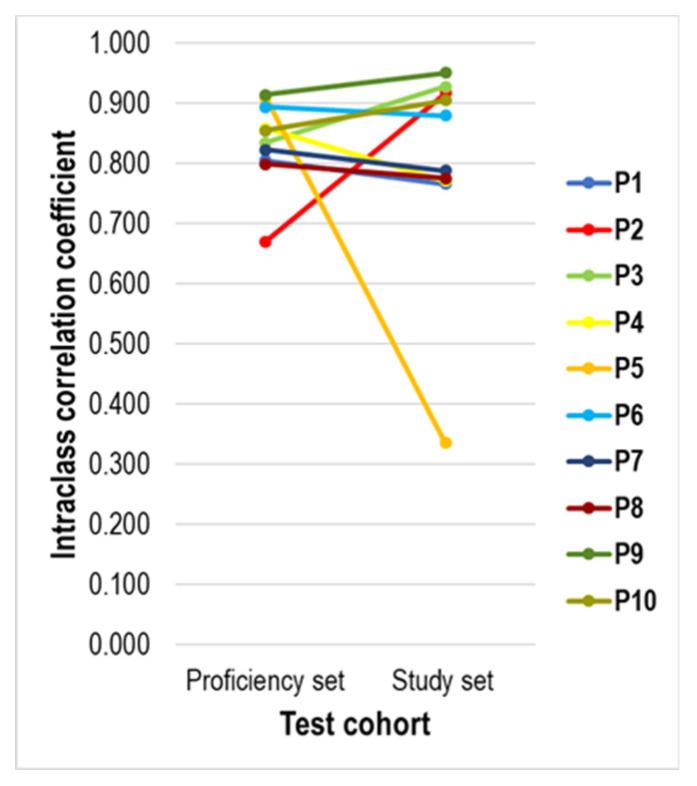
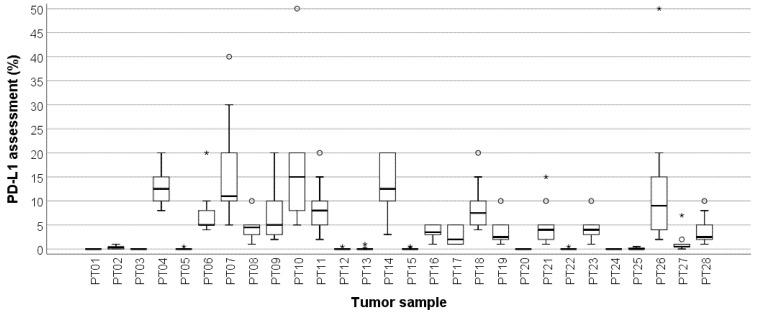
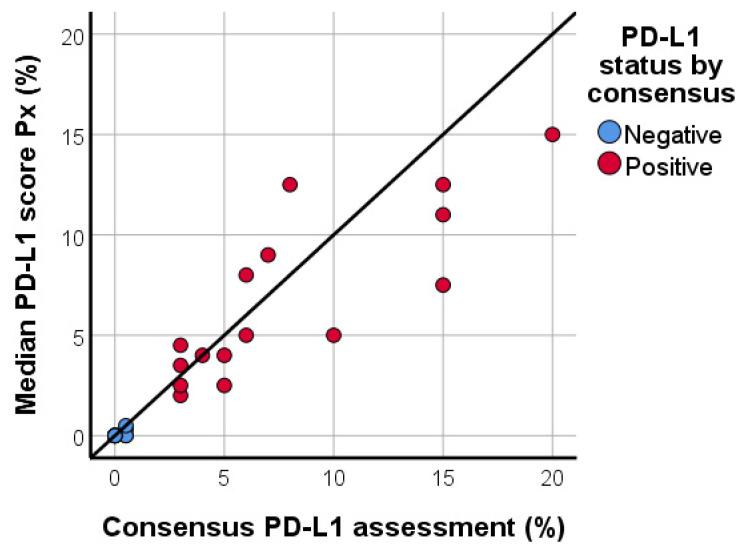
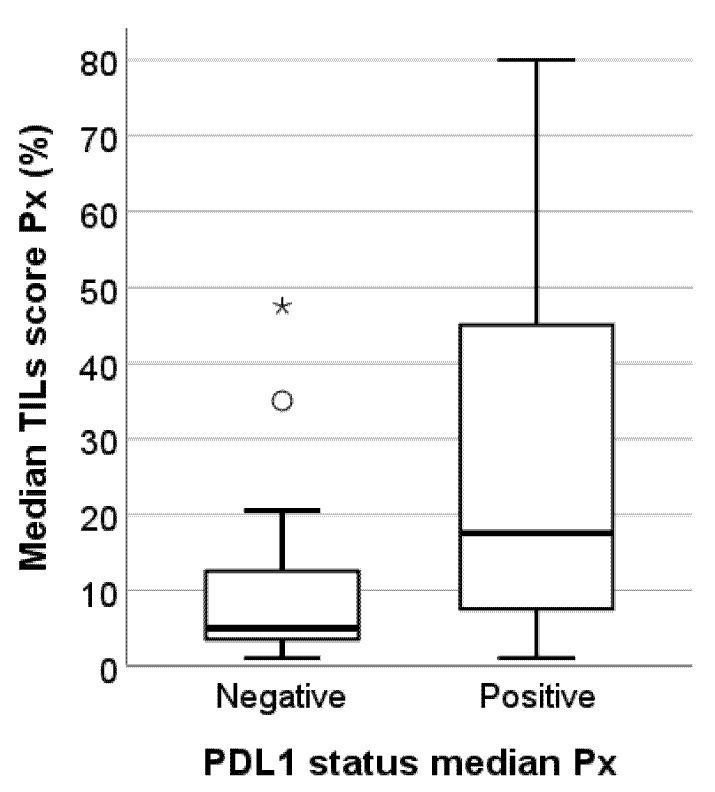
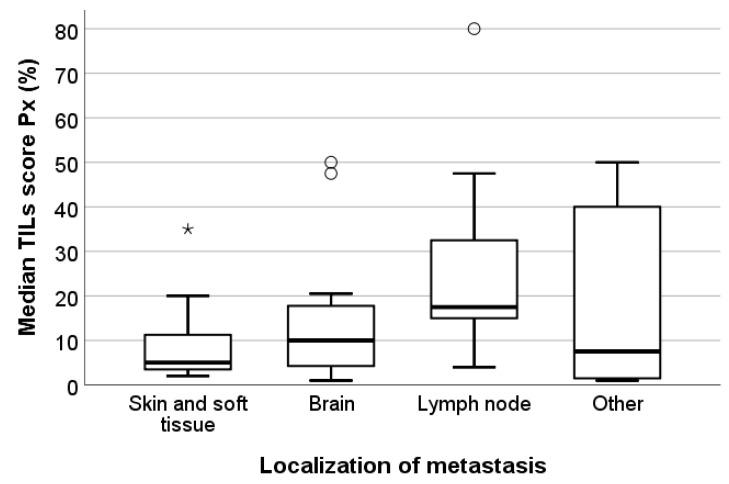
Patients with advanced triple-negative breast cancer (TNBC) benefit from treatment with atezolizumab, provided that the tumor contains ≥1% of PD-L1/SP142-positive immune cells. Numbers of tumor-infiltrating lymphocytes (TILs) vary strongly according to the anatomic localization of TNBC metastases. We investigated inter-pathologist agreement in the assessment of PD-L1/SP142 immunohistochemistry and TILs. Ten pathologists evaluated PD-L1/SP142 expression in a proficiency test comprising 28 primary TNBCs, as well as PD-L1/SP142 expression and levels of TILs in 49 distant TNBC metastases with various localizations. Interobserver agreement for PD-L1 status (positive vs. negative) was high in the proficiency test: the corresponding scores as percentages showed good agreement with the consensus diagnosis. In TNBC metastases, there was substantial variability in PD-L1 status at the individual patient level. For one in five patients, the chance of treatment was essentially random, with half of the pathologists designating them as positive and half negative. Assessment of PD-L1/SP142 and TILs as percentages in TNBC metastases showed poor and moderate agreement, respectively. Additional training for metastatic TNBC is required to enhance interobserver agreement. Such training, focusing on metastatic specimens, seems worthwhile, since the same pathologists obtained high percentages of concordance (ranging from 93% to 100%) on the PD-L1 status of primary TNBCs.
晚期三阴性乳腺癌(TNBC)患者可从阿特珠单抗治疗中获益,前提是肿瘤中含有≥1%的PD-L1/SP142阳性免疫细胞。肿瘤浸润淋巴细胞(TILs)的数量因TNBC转移灶的解剖定位而有很大差异。我们调查了病理学家之间在评估PD-L1/SP142免疫组化和TILs方面的一致性。十位病理学家在一项能力验证测试中评估了28例原发性TNBC的PD-L1/SP142表达,以及49例不同部位远处TNBC转移灶的PD-L1/SP142表达和TILs水平。在能力验证测试中,观察者间对PD-L1状态(阳性与阴性)的一致性较高:相应的百分比评分与共识诊断显示出良好的一致性。在TNBC转移灶中,个体患者水平的PD-L1状态存在很大差异。对于五分之一的患者,治疗机会基本是随机的,一半的病理学家将其判定为阳性,另一半判定为阴性。在TNBC转移灶中,将PD-L1/SP142和TILs评估为百分比时,一致性分别较差和中等。需要对转移性TNBC进行额外培训以提高观察者间的一致性。这种针对转移标本的培训似乎是值得的,因为同一位病理学家在原发性TNBC的PD-L1状态上获得了较高的一致性百分比(从93%到100%)。
 Zotero 插件