
细胞摄取纳米颗粒的变异性来源。
Sources of variability in nanoparticle uptake by cells.
机构信息
Groningen Research Institute of Pharmacy, University of Groningen, A. Deusinglaan 1, 9713 AV Groningen, The Netherlands.
出版信息
Nanoscale. 2021 Oct 28;13(41):17530-17546. doi: 10.1039/d1nr04690j.
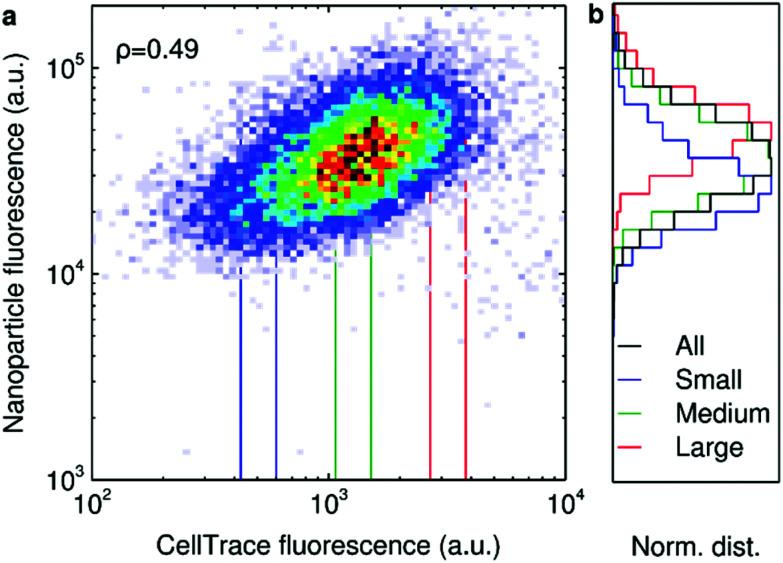
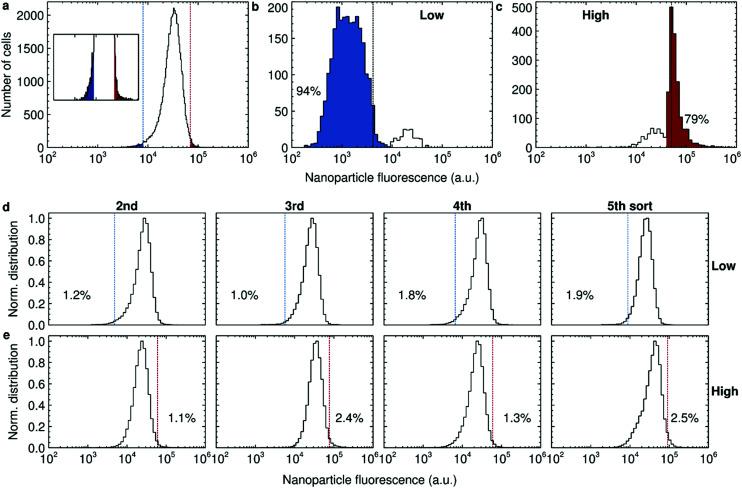
Understanding how nano-sized objects are taken up by cells is important for applications within medicine (nanomedicine), as well as to avoid unforeseen hazard due to nanotechnology (nanosafety). Even within the same cell population, one typically observes a large cell-to-cell variability in nanoparticle uptake, raising the question of the underlying cause(s). Here we investigate cell-to-cell variability in polystyrene nanoparticle uptake by HeLa cells, with generalisations of the results to silica nanoparticles and liposomes, as well as to A549 and primary human umbilical vein endothelial cells. We show that uptake of nanoparticles is correlated with cell size within a cell population, thereby reproducing and generalising previous reports highlighting the role of cell size in nanoparticle uptake. By repeatedly isolating (using fluorescence-activated cell sorting) the cells that take up the most and least nanoparticles, respectively, and performing RNA sequencing on these cells separately, we examine the underlying gene expression that contributes to high and low polystyrene nanoparticle accumulation in HeLa cells. We can thereby show that cell size is not the sole driver of cell-to-cell variability, but that other cellular characteristics also play a role. In contrast to cell size, these characteristics are more specific to the object (nanoparticle or protein) being taken up, but are nevertheless highly heterogeneous, complicating their detailed identification. Overall, our results highlight the complexity underlying the cellular features that determine nanoparticle uptake propensity.
了解纳米大小的物体如何被细胞吸收对于医学应用(纳米医学)很重要,同时也有助于避免纳米技术(纳米安全性)带来的意外危害。即使在同一细胞群体中,通常也会观察到纳米颗粒摄取的细胞间存在很大的变异性,这就提出了潜在原因的问题。在这里,我们研究了聚苯乙烯纳米颗粒被 HeLa 细胞摄取的细胞间变异性,并将结果推广到了二氧化硅纳米颗粒和脂质体,以及 A549 和原代人脐静脉内皮细胞。我们表明,纳米颗粒的摄取与细胞群体中的细胞大小相关,从而再现和概括了以前的报告,这些报告强调了细胞大小在纳米颗粒摄取中的作用。我们通过反复分离(使用荧光激活细胞分选)分别摄取最多和最少纳米颗粒的细胞,并对这些细胞分别进行 RNA 测序,研究了导致 HeLa 细胞中聚苯乙烯纳米颗粒高和低积累的潜在基因表达。我们可以证明细胞大小不是细胞间变异性的唯一驱动因素,而是其他细胞特征也起作用。与细胞大小相反,这些特征与被摄取的物体(纳米颗粒或蛋白质)更相关,但仍然高度异质,这使得它们的详细鉴定变得复杂。总体而言,我们的研究结果强调了决定纳米颗粒摄取倾向的细胞特征背后的复杂性。

 Zotero 插件