
细胞治疗在大鼠后肢缺血模型中生物材料支架内的血管生成作用。
Angiogenic effects of cell therapy within a biomaterial scaffold in a rat hind limb ischemia model.
机构信息
Department of Histology and Embryology, Faculty of Veterinary Medicine, Urmia University, Urmia, Iran.
Clinical Tuberculosis and Epidemiology Research Center, National Research Institute of Tuberculosis and Lung Diseases, Shahid Beheshti University of Medical Sciences, Tehran, Iran.
出版信息
Sci Rep. 2021 Oct 15;11(1):20545. doi: 10.1038/s41598-021-99579-0.
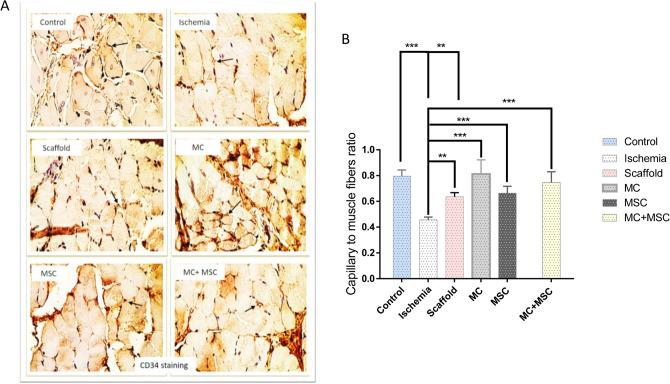
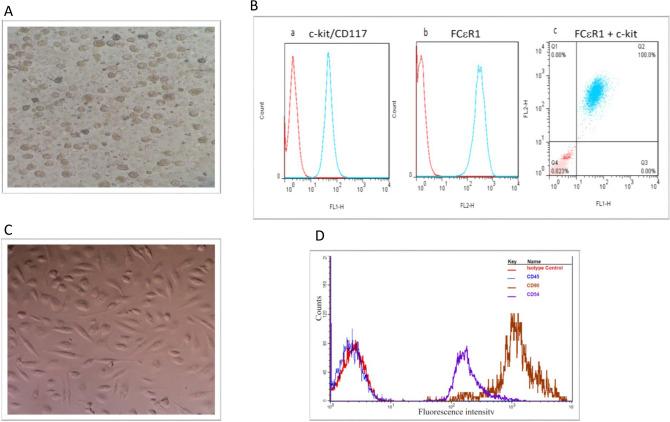
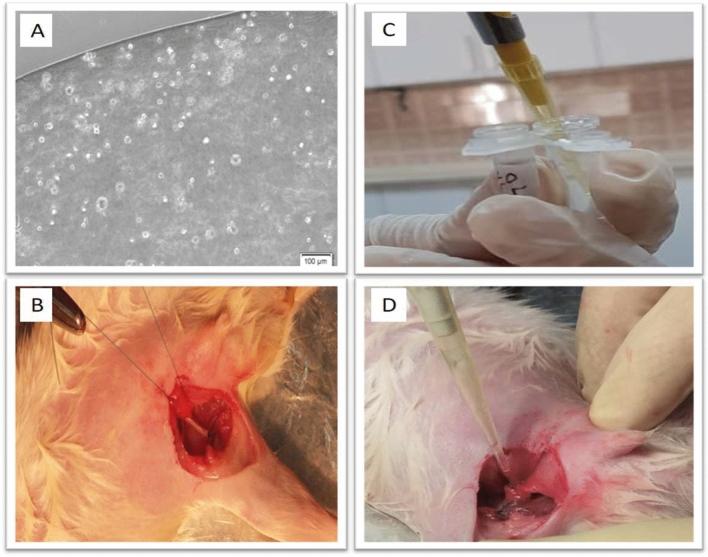
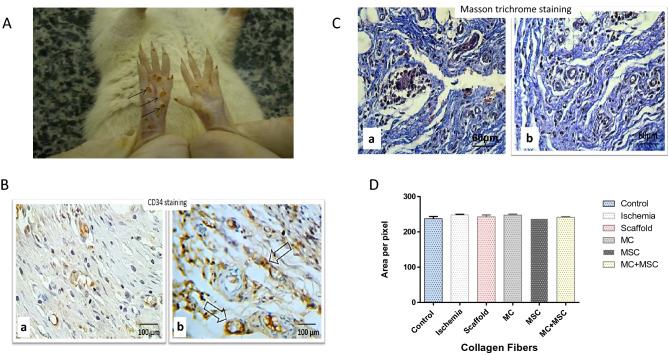
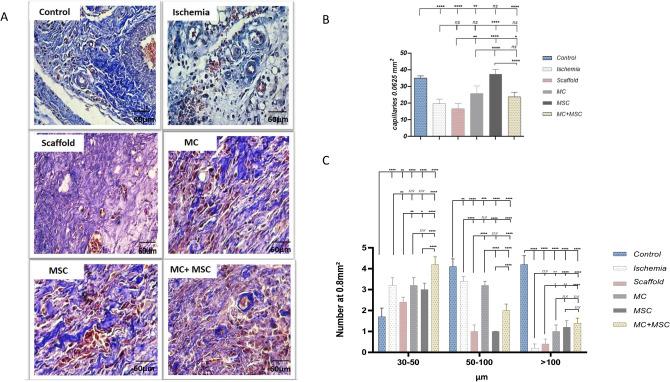
Critical limb ischemia (CLI) is a life- and limb-threatening condition affecting 1-10% of humans worldwide with peripheral arterial disease. Cellular therapies, such as bone marrow-derived mesenchymal stem cells (MSCs) have been used for the treatment of CLI. However, little information is available regarding the angiogenic potency of MSCs and mast cells (MC) in angiogenesis. The aim of this study was to evaluate the ability of MCs and MSCs to induce angiogenesis in a rat model of ischemic hind limb injury on a background of a tissue engineered hydrogel scaffold. Thirty rats were randomly divided into six control and experimental groups as follows: (a) Control healthy (b) Ischemic positive control with right femoral artery transection, (c) ischemia with hydrogel scaffold, (d) ischemia with hydrogel plus MSC, (e) ischemia with hydrogel plus MC and (f) ischemia with hydrogel plus MSC and MCs. 10 of each cell type, isolated from bone marrow stroma, was injected into the transected artery used to induce hind limb ischemia. The other hind limb served as a non-ischemic control. After 14 days, capillary density, vascular diameter, histomorphometry and immunohistochemistry at the transected location and in gastrocnemius muscles were evaluated. Capillary density and number of blood vessels in the region of the femoral artery transection in animals receiving MSCs and MCs was increased compared to control groups (P < 0.05). Generally the effect of MCs and MSCs was similar although the combined MC/MSC therapy resulted in a reduced, rather than enhanced, effect. In the gastrocnemius muscle, immunohistochemical and histomorphometric observation showed a great ratio of capillaries to muscle fibers in all the cell-receiving groups (P < 0.05). The data indicates that the combination of hydrogel and cell therapy generates a greater angiogenic potential at the ischemic site than cell therapy or hydrogels alone.
严重肢体缺血(CLI)是一种危及生命和肢体的疾病,影响全球 1-10%的外周动脉疾病患者。细胞疗法,如骨髓间充质干细胞(MSCs)已被用于 CLI 的治疗。然而,关于 MSCs 和肥大细胞(MC)在血管生成中的血管生成潜能的信息很少。本研究旨在评估 MC 和 MSCs 在组织工程水凝胶支架背景下诱导缺血性后肢损伤大鼠模型中血管生成的能力。30 只大鼠随机分为 6 个对照组和实验组,如下所示:(a)健康对照组(b)股动脉横断的缺血阳性对照组,(c)水凝胶支架组,(d)水凝胶+MSC 组,(e)水凝胶+MC 组,(f)水凝胶+MSC 和 MC 组。从骨髓基质中分离出 10 种每种细胞类型,注入用于诱导后肢缺血的横断动脉。另一只后肢作为非缺血对照组。14 天后,评估了横断位置和比目鱼肌的毛细血管密度、血管直径、组织形态计量学和免疫组织化学。与对照组相比,接受 MSC 和 MC 的动物的毛细血管密度和股动脉横断部位的血管数量增加(P<0.05)。一般来说,MC 和 MSCs 的作用相似,尽管联合 MC/MSC 治疗导致作用减弱,而不是增强。在比目鱼肌中,免疫组织化学和组织形态计量学观察显示,所有接受细胞治疗的组中的毛细血管与肌肉纤维的比例都很高(P<0.05)。数据表明,水凝胶和细胞治疗的联合比单独的细胞治疗或水凝胶产生更大的缺血部位的血管生成潜力。
 Zotero 插件