
肢体远隔缺血后处理血清抑制 fMLP 触发的大鼠中性粒细胞的激活和活性氧的释放。
Serum of limb remote ischemic postconditioning inhibits fMLP-triggered activation and reactive oxygen species releasing of rat neutrophils.
机构信息
Department of Pharmacology of Chinese Materia Medica, School of Traditional Chinese Pharmacy, China Pharmaceutical University, Nanjing, People's Republic of China.
State Key Laboratory of Natural Products, Jiangsu Key Laboratory of TCM Evaluation and Translational Research, Department of Chinese Material Medica, School of Traditional Chinese Pharmacy, China Pharmaceutical University, Nanjing, People's Republic of China.
出版信息
Redox Rep. 2021 Dec;26(1):176-183. doi: 10.1080/13510002.2021.1982515.
OBJECTIVES
The study explores the protective role of the peripheral serum of limb remote ischemic postconditioning (LRIP) in reducing the reactive oxygen species (ROS) levels and neutrophil activation, which are responsible for the deleterious reperfusion injury.
METHODS
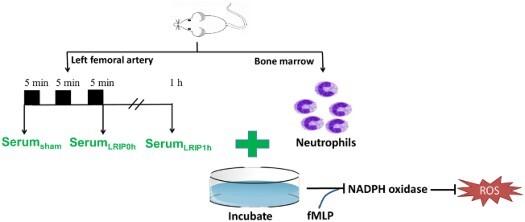
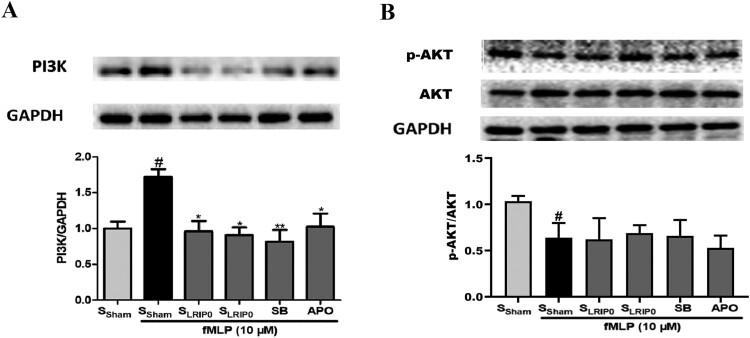
LRIP was induced in Sprague-Dawley rats by three cycles of 5 min occlusion /5 min reperfusion on the left hind limb. The blood samples were collected before LRIP or 0 and 1 h after LRIP (named Serum, Serum, Serum, respectively). The effects of LRIP serum on ROS level and neutrophils activation were determined. The expression of MyD88-TRAF6-MAPKs and PI3K/AKT pathways in neutrophils were examined.
RESULTS
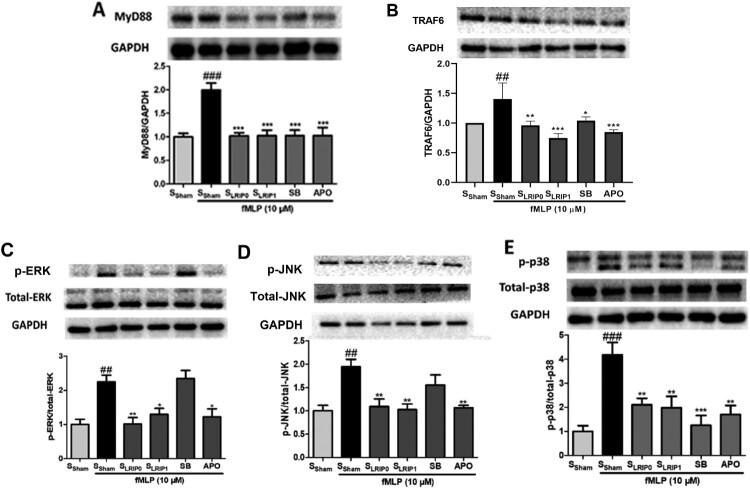
When compared with Serum, Serum and Serum significantly reduced the ROS released from neutrophils activated by fMLP. Meanwhile, the mRNA expression levels of NADPH oxidase subunit p22 and multiple ROS-producing related key proteins, such as NADPH oxidase subunit p47 ser 304, ser 345. MyD88, p-ERK, p-JNK and p-P38 expression of neutrophils were downregulated by Serum and Serum. Serum also downregulated p47 mRNA expression and tumor necrosis factor receptor-associated factor 6 (TRAF6) protein expression.
CONCLUSION
LRIP serum protects against ROS level and neutrophils activation involving the MyD88-TRAF6-MAPKs. This finding provides new insight into the understanding of LRIP mechanisms.
目的
本研究探讨肢体远程缺血后处理(LRIP)外周血清的保护作用,以降低活性氧(ROS)水平和中性粒细胞激活,这是导致有害再灌注损伤的原因。
方法
通过对左后肢进行 3 个 5 分钟闭塞/5 分钟再灌注周期来诱导 Sprague-Dawley 大鼠的 LRIP。在 LRIP 之前或 LRIP 后 0 和 1 小时采集血液样本(分别命名为 Serum、Serum、Serum)。测定 LRIP 血清对 ROS 水平和中性粒细胞激活的影响。检测中性粒细胞中 MyD88-TRAF6-MAPKs 和 PI3K/AKT 通路的表达。
结果
与 Serum 相比,Serum 和 Serum 显著降低了 fMLP 激活的中性粒细胞释放的 ROS。同时,血清和 Serum 下调了中性粒细胞 NADPH 氧化酶亚基 p22 和多个 ROS 产生相关关键蛋白(如 NADPH 氧化酶亚基 p47 丝氨酸 304、丝氨酸 345、MyD88、p-ERK、p-JNK 和 p-P38)的 mRNA 表达水平。血清还下调了 p47 mRNA 表达和肿瘤坏死因子受体相关因子 6(TRAF6)蛋白表达。
结论
LRIP 血清可防止 ROS 水平和中性粒细胞激活,涉及 MyD88-TRAF6-MAPKs。这一发现为理解 LRIP 机制提供了新的认识。



 Zotero 插件