
新辅助和辅助纳武单抗和利瑞鲁单抗治疗复发性可切除头颈部鳞状细胞癌患者。
Neoadjuvant and Adjuvant Nivolumab and Lirilumab in Patients with Recurrent, Resectable Squamous Cell Carcinoma of the Head and Neck.
机构信息
Department of Medical Oncology, Dana-Farber Cancer Institute, Boston, Massachusetts.
Department of Data Science, Dana-Farber Cancer Institute, Boston, Massachusetts.
出版信息
Clin Cancer Res. 2022 Feb 1;28(3):468-478. doi: 10.1158/1078-0432.CCR-21-2635. Epub 2021 Oct 19.
PURPOSE
Surgery often represents the best chance for disease control in locoregionally recurrent squamous cell carcinoma of the head and neck (SCCHN). We investigated dual immune-checkpoint inhibition [anti-PD-1, nivolumab (N), and anti-KIR, lirilumab (L)] before and after salvage surgery to improve disease-free survival (DFS).
PATIENTS AND METHODS
In this phase II study, patients received N (240 mg) + L (240 mg) 7 to 21 days before surgery, followed by six cycles of adjuvant N + L. Primary endpoint was 1-year DFS; secondary endpoints were safety, pre-op radiologic response, and overall survival (OS). Correlatives included tumor sequencing, PD-L1 scoring, and immunoprofiling.
RESULTS
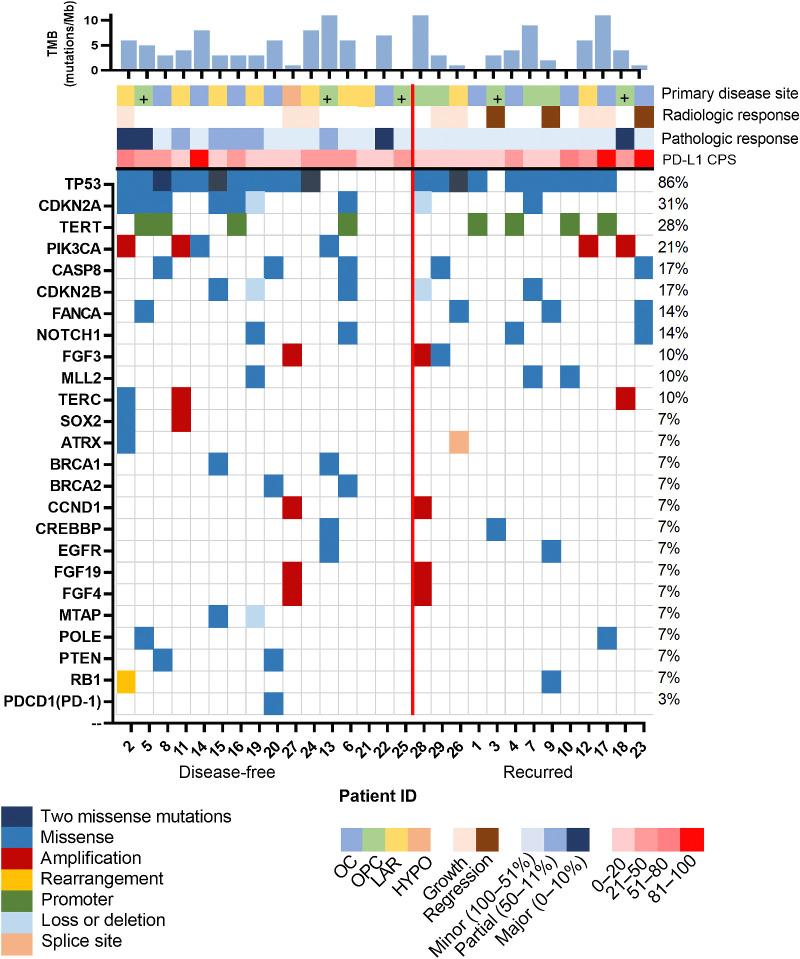
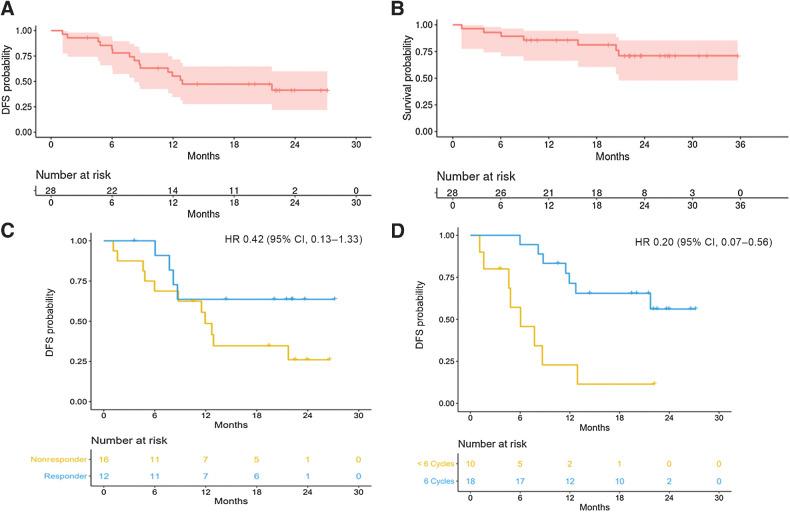
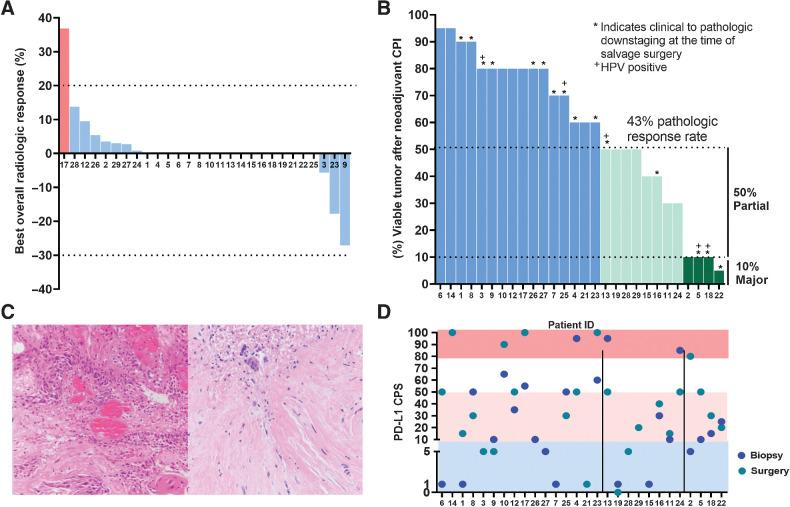
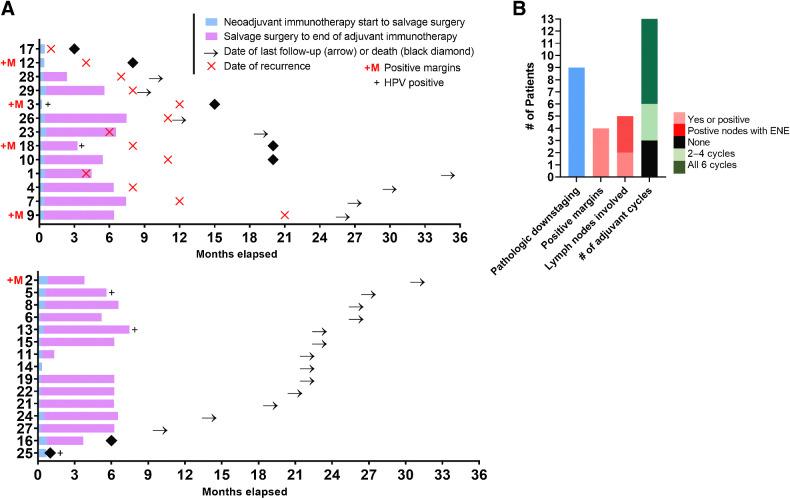
Among 28 patients, the median age was 66, 86% were smokers; primary site: 9 oral cavity, 9 oropharynx, and 10 larynx/hypopharynx; 96% had prior radiation. There were no delays to surgery. Grade 3+ adverse events: 11%. At the time of surgery, 96% had stable disease radiologically, one had progression. Pathologic response to N + L was observed in 43% (12/28): 4/28 (14%) major (tumor viability, TV ≤ 10%) and 8/28 (29%) partial (TV ≤ 50%). PD-L1 combined positive score (CPS) at surgery was similar regardless of pathologic response ( = 0.71). Thirteen (46%) recurred (loco-regional = 10, distant = 3). Five of 28 (18%) had positive margins, 4 later recurred. At median follow-up of 22.8 months, 1-year DFS was 55.2% (95% CI, 34.8-71.7) and 1-year OS was 85.7% (95% CI, 66.3-94.4). Two-year DFS and OS were 64% and 80% among pathologic responders.
CONCLUSIONS
(Neo)adjuvant N + L was well tolerated, with a 43% pathologic response rate. We observed favorable DFS and excellent 2-year OS among high-risk, previously treated patients exhibiting a pathologic response. Further evaluation of this strategy is warranted..
目的
手术通常是局部复发性头颈部鳞状细胞癌(SCCHN)疾病控制的最佳机会。我们研究了在挽救性手术前后双重免疫检查点抑制[抗 PD-1、nivolumab(N)和抗 KIR、lirilumab(L)]以改善无病生存(DFS)。
患者和方法
在这项 II 期研究中,患者在手术前 7 至 21 天接受 N(240mg)+L(240mg)治疗,然后接受六周期辅助 N+L 治疗。主要终点是 1 年 DFS;次要终点是安全性、术前影像学反应和总生存(OS)。相关性包括肿瘤测序、PD-L1 评分和免疫分析。
结果
在 28 例患者中,中位年龄为 66 岁,86%为吸烟者;原发部位:9 例口腔,9 例口咽,10 例喉/下咽;96%有既往放疗史。手术没有延误。3 级以上不良事件:11%。在手术时,96%的患者影像学上疾病稳定,1 例进展。N+L 的病理反应观察到 43%(28/28):4/28(14%)主要(肿瘤存活,TV≤10%)和 8/28(29%)部分(TV≤50%)。手术时的 PD-L1 联合阳性评分(CPS)与病理反应无关(=0.71)。13 例(46%)复发(局部=10,远处=3)。28 例中有 5 例(18%)切缘阳性,4 例随后复发。在 22.8 个月的中位随访中,1 年 DFS 为 55.2%(95%CI,34.8-71.7),1 年 OS 为 85.7%(95%CI,66.3-94.4)。病理反应者的 2 年 DFS 和 OS 分别为 64%和 80%。
结论
(新)辅助 N+L 耐受性良好,病理反应率为 43%。我们观察到在高危、既往治疗的患者中,DFS 结果良好,2 年 OS 优异,且表现出病理反应。需要进一步评估这种策略。
 Zotero 插件