
下段剖宫产术后鞘内注射芬太尼与超声引导下腹横肌平面阻滞镇痛效果的比较研究
Comparative Study of the Analgesic Efficacy of Intrathecal Fentanyl with Ultrasound-Guided Transversus Abdominis Plane Block after Lower Segment Cesarean Section.
作者信息
Nayak Nagalakshmi S, Kalpana K, Dhanpal Radhika, Tudu Lal Chand, Prakash Jay
机构信息
Department of Anaesthesia, Vydehi Institute of Medical Sciences and Research Centre, Bengaluru, Karnataka, India.
Department of Critical Care Medicine, Rajendra Institute of Medical Sciences, Ranchi, Jharkhand, India.
出版信息
Anesth Essays Res. 2021 Jan-Mar;15(1):101-106. doi: 10.4103/aer.aer_80_21. Epub 2021 Aug 30.
BACKGROUND
This study was conducted to compare the analgesic efficacy of intrathecal fentanyl with ultrasound-guided transversus abdominis plane (TAP) block after lower segment cesarean section. The objectives of the study were to compare the effects of subarachnoid fentanyl versus TAP block with respect to duration of postoperative analgesia, time for first analgesic request, total analgesic consumption in 24 h, time to first breastfeed and Apgar score at 1 and 5 min.
MATERIALS AND METHODS
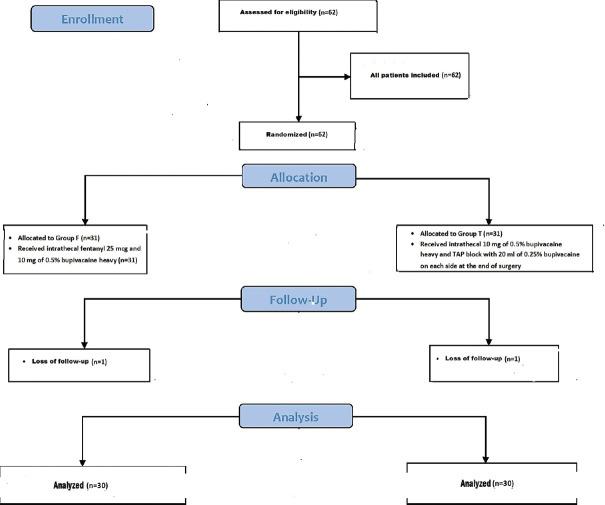
Sixty-two patients undergoing elective or emergency cesarean delivery were recruited for the study in a prospective, randomized, single-blind manner. The patients were randomly allocated to either intrathecal fentanyl group (Group F) or TAP block group (Group T) after determining the eligibility criteria. Group F patients received subarachnoid block with 10 mg of 0.5% bupivacaine heavy with 25 mcg of fentanyl. Group T patients received subarachnoid block with 10 mg of 0.5% bupivacaine heavy prior to surgery and at the end of surgery, they received TAP block with 0.25% bupivacaine 20 mL on each side.
RESULTS
Group T had significantly longer time for the first analgesic request (7.65 ± 1.23 h) than group F (4.10 ± 0.32 h). The total analgesic consumption in 24 h was significantly less in Group T (1.0 ± 0) than Group F (2.13 ± 0.34). The Visual Analogue Scale scores at rest and on movement were significantly less in Group T than Group F at all-time points. The Apgar score at 1 and 5 min and time to first breast feed were comparable between the two groups. The incidence of side effects was less in Group T.
CONCLUSION
This study indicated that ultrasound-guided TAP block has a better analgesic as well as safety profile compared to intrathecal fentanyl for cesarean delivery.
背景
本研究旨在比较腰麻下芬太尼与超声引导下腹横肌平面(TAP)阻滞用于下段剖宫产术后的镇痛效果。本研究的目的是比较蛛网膜下腔注射芬太尼与TAP阻滞在术后镇痛持续时间、首次镇痛需求时间、24小时总镇痛药物消耗量、首次母乳喂养时间以及1分钟和5分钟时的阿氏评分方面的效果。
材料与方法
采用前瞻性、随机、单盲的方式招募了62例行择期或急诊剖宫产的患者进行本研究。在确定入选标准后,将患者随机分为腰麻下芬太尼组(F组)或TAP阻滞组(T组)。F组患者接受含25μg芬太尼的10mg 0.5%重比重布比卡因的蛛网膜下腔阻滞。T组患者在手术前接受含10mg 0.5%重比重布比卡因的蛛网膜下腔阻滞,手术结束时,双侧各接受20mL 0.25%布比卡因的TAP阻滞。
结果
T组首次镇痛需求时间(7.65±1.23小时)显著长于F组(4.10±0.32小时)。T组24小时总镇痛药物消耗量(1.0±0)显著少于F组(2.13±0.34)。在所有时间点,T组静息和活动时的视觉模拟量表评分均显著低于F组。两组间1分钟和5分钟时的阿氏评分以及首次母乳喂养时间相当。T组副作用发生率较低。
结论
本研究表明,与腰麻下芬太尼用于剖宫产相比,超声引导下TAP阻滞具有更好的镇痛效果和安全性。
 Zotero 插件