
儿童和青少年肺部超短回波时间 MRI:与非增强 CT 及标准对比增强 T1w MRI 序列的比较。
Ultrashort echo time MRI of the lung in children and adolescents: comparison with non-enhanced computed tomography and standard post-contrast T1w MRI sequences.
机构信息
Department of Paediatric Radiology, Institute of Diagnostic and Interventional Radiology, Hannover Medical School, Carl-Neuberg-Str. 1, 30625, Hannover, Germany.
Medical Physics Group, Institute of Diagnostic and Interventional Radiology, Jena University Hospital, Friedrich-Schiller-University, Jena, Germany.
出版信息
Eur Radiol. 2022 Mar;32(3):1833-1842. doi: 10.1007/s00330-021-08236-7. Epub 2021 Oct 20.
OBJECTIVES
To compare the diagnostic value of ultrashort echo time (UTE) magnetic resonance imaging (MRI) for the lung versus the gold standard computed tomography (CT) and two T1-weighted MRI sequences in children.
METHODS
Twenty-three patients with proven oncologic disease (14 male, 9 female; mean age 9.0 + / - 5.4 years) received 35 low-dose CT and MRI examinations of the lung. The MRI protocol (1.5-T) included the following post-contrast sequences: two-dimensional (2D) incoherent gradient echo (GRE; acquisition with breath-hold), 3D volume interpolated GRE (breath-hold), and 3D high-resolution radial UTE sequences (performed during free-breathing). Images were evaluated by considering image quality as well as distinct diagnosis of pulmonary nodules and parenchymal areal opacities with consideration of sizes and characterisations.
RESULTS
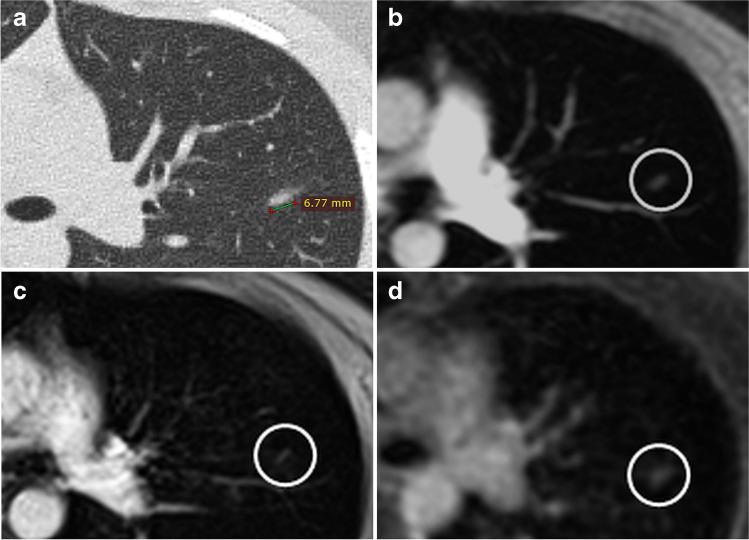
The UTE technique showed significantly higher overall image quality, better sharpness, and fewer artefacts than both other sequences. On CT, 110 pulmonary nodules with a mean diameter of 4.9 + / - 2.9 mm were detected. UTE imaging resulted in a significantly higher detection rate compared to both other sequences (p < 0.01): 76.4% (84 of 110 nodules) for UTE versus 60.9% (67 of 110) for incoherent GRE and 62.7% (69 of 110) for volume interpolated GRE sequences. The detection of parenchymal areal opacities by the UTE technique was also significantly higher with a rate of 93.3% (42 of 45 opacities) versus 77.8% (35 of 45) for 2D GRE and 80.0% (36 of 45) for 3D GRE sequences (p < 0.05).
CONCLUSION
The UTE technique for lung MRI is favourable in children with generally high diagnostic performance compared to standard T1-weighted sequences as well as CT. Key Points • Due to the possible acquisition during free-breathing of the patients, the UTE MRI sequence for the lung is favourable in children. • The UTE technique reaches higher overall image quality, better sharpness, and lower artefacts, but not higher contrast compared to standard post-contrast T1-weighted sequences. • In comparison to the gold standard chest CT, the detection rate of small pulmonary nodules small nodules ≤ 4 mm and subtle parenchymal areal opacities is higher with the UTE imaging than standard T1-weighted sequences.
目的
比较超短回波时间(UTE)磁共振成像(MRI)与金标准计算机断层扫描(CT)和两种 T1 加权 MRI 序列在儿童肺部诊断中的价值。
方法
23 例经证实患有肿瘤疾病的患者(男 14 例,女 9 例;平均年龄 9.0±5.4 岁)接受了 35 次低剂量 CT 和肺部 MRI 检查。MRI 方案(1.5-T)包括以下对比后序列:二维(2D)非相干梯度回波(GRE;带屏气的采集)、三维容积内插 GRE(屏气)和三维高分辨率径向 UTE 序列(在自由呼吸期间进行)。通过考虑图像质量以及肺结节和实质区域混浊的明确诊断,同时考虑大小和特征,对图像进行评估。
结果
UTE 技术的整体图像质量、锐利度和伪影均明显优于其他两种序列。在 CT 上,检测到 110 个平均直径为 4.9±2.9mm 的肺结节。UTE 成像的检测率明显高于其他两种序列(p<0.01):76.4%(110 个结节中的 84 个)比非相干 GRE 的 60.9%(110 个结节中的 67 个)和容积内插 GRE 序列的 62.7%(110 个结节中的 69 个)高。UTE 技术对实质区域混浊的检测率也明显更高,为 93.3%(45 个混浊中的 42 个),高于 2D GRE 的 77.8%(45 个混浊中的 35 个)和 3D GRE 序列的 80.0%(45 个混浊中的 36 个)(p<0.05)。
结论
与标准 T1 加权序列和 CT 相比,儿童肺部 UTE MRI 技术具有较高的诊断性能,一般来说是有利的。
关键点
• 由于患者在自由呼吸期间可能进行采集,因此肺部 UTE MRI 序列在儿童中是有利的。
• 与标准对比后 T1 加权序列相比,UTE 技术的整体图像质量更高、锐度更好、伪影更少,但对比度没有提高。
• 与金标准胸部 CT 相比,UTE 成像对小肺结节(≤4mm)和细微实质区域混浊的检出率高于标准 T1 加权序列。

 Zotero 插件