
超声触发的5-氨基乙酰丙酸可抑制同基因乳腺癌模型中的肿瘤增殖。
5-Aminolevulinic Acid Triggered by Ultrasound Halts Tumor Proliferation in a Syngeneic Model of Breast Cancer.
作者信息
Foglietta Federica, Gola Giulia, Biasibetti Elena, Capucchio Maria Teresa, Bruni Iside, Francovich Andrea, Durando Gianni, Serpe Loredana, Canaparo Roberto
机构信息
Department of Drug Science and Technology, University of Torino, 10125 Torino, Italy.
Histopathology Department CIBA, Istituto Zooprofilattico Sperimentale di Piemonte, Liguria e Valle d'Aosta, 10154 Torino, Italy.
出版信息
Pharmaceuticals (Basel). 2021 Sep 25;14(10):972. doi: 10.3390/ph14100972.
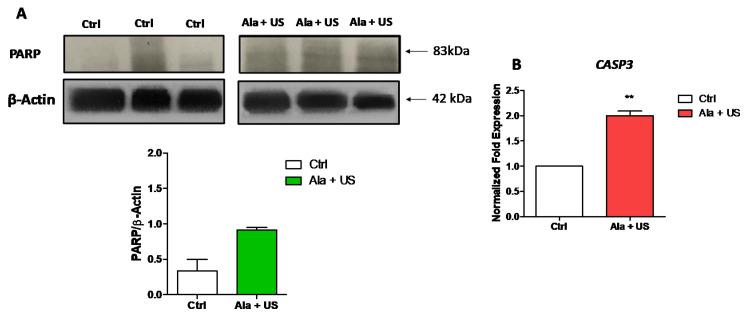
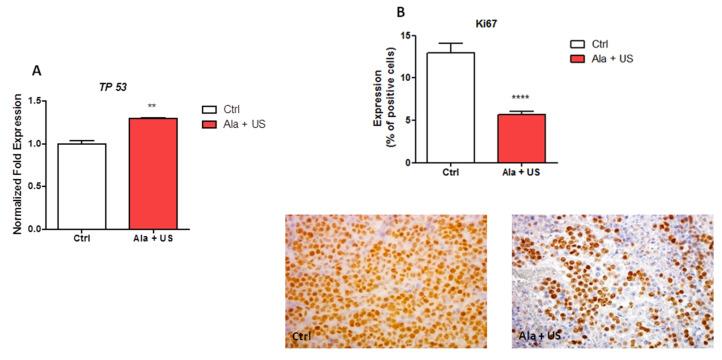
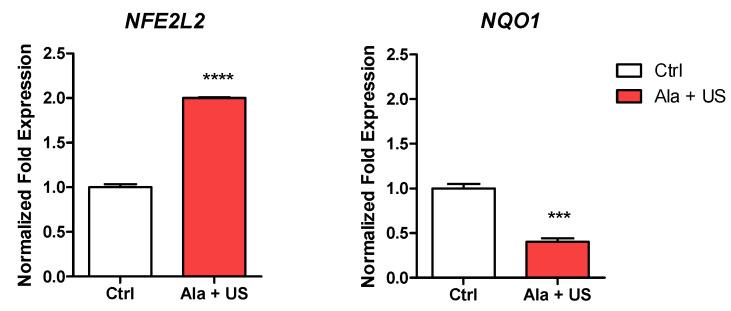
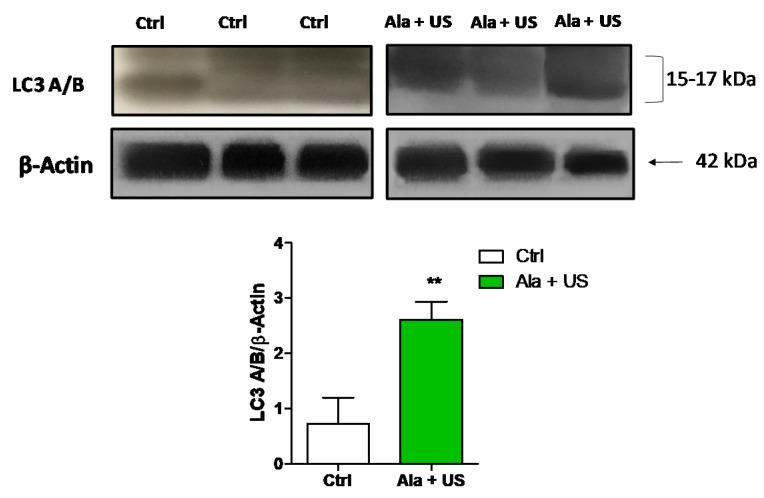
Sonodynamic therapy is a bimodal therapeutic approach in which a chemical compound and ultrasound (US) synergistically act to elicit oxidative damage, triggering cancer cell death. Despite encouraging results, mainly for anticancer treatment, sonodynamics is still far from having a clinical application. Therefore, to close the gap between the bench and bedside, more in vivo studies are needed. In this investigation, the combined effect of 5-aminolevulinic acid (Ala), a natural porphyrin precursor, plus exposure to US, was investigated in vivo on a syngeneic breast cancer model. Real-time RT-PCR, Western blotting, and immunohistochemistry assays were performed to evaluate the effect of sonodynamic treatment on the main cancer hallmarks. The sonodynamic-treated group had a significant reduction ( ≤ 0.0001) in tumor size compared to the untreated group, and the Ala- and US-only treated groups, where a strong decrease ( ≤ 0.0001) in Ki67 protein expression was the most relevant feature of sonodynamic-treated cancer tissues. Moreover, oxidative stress was confirmed as the pivotal driver of the anticancer effect through cell cycle arrest, apoptosis, and autophagy; thus, sonodynamics should be explored further for cancer treatment.
声动力疗法是一种双模态治疗方法,其中一种化合物与超声波(US)协同作用引发氧化损伤,从而导致癌细胞死亡。尽管取得了令人鼓舞的结果,主要是在抗癌治疗方面,但声动力疗法距离临床应用仍有很大差距。因此,为了弥合实验室研究与临床应用之间的差距,需要更多的体内研究。在本研究中,在同基因乳腺癌模型上对天然卟啉前体5-氨基乙酰丙酸(Ala)与超声照射的联合效应进行了体内研究。通过实时逆转录聚合酶链反应(RT-PCR)、蛋白质免疫印迹法和免疫组织化学分析来评估声动力治疗对主要癌症特征的影响。与未治疗组以及仅接受Ala和超声治疗的组相比,声动力治疗组的肿瘤大小显著减小(≤0.0001),其中Ki67蛋白表达的显著降低(≤0.0001)是声动力治疗的癌组织最显著的特征。此外,通过细胞周期阻滞、凋亡和自噬证实氧化应激是抗癌作用的关键驱动因素;因此,声动力疗法在癌症治疗方面应进一步探索。


 Zotero 插件