
1 型糖尿病与孕早期胎盘:高血糖对滋养细胞增殖、细胞周期调控因子和侵袭的影响。
Type 1 Diabetes Mellitus and the First Trimester Placenta: Hyperglycemia-Induced Effects on Trophoblast Proliferation, Cell Cycle Regulators, and Invasion.
机构信息
Department of Obstetrics and Gynecology, Medical University of Graz, 8036 Graz, Austria.
Division of Cell Biology, Histology and Embryology, Gottfried Schatz Research Centre for Cell Signaling, Metabolism and Ageing, Medical University of Graz, 8010 Graz, Austria.
出版信息
Int J Mol Sci. 2021 Oct 12;22(20):10989. doi: 10.3390/ijms222010989.
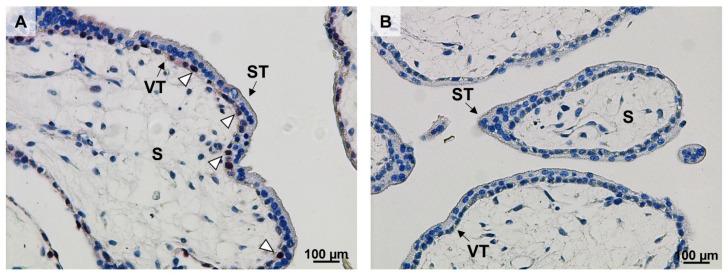
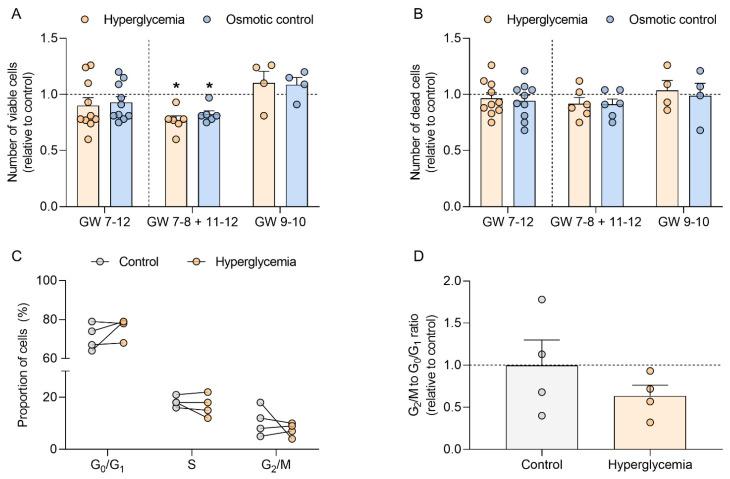
Type 1 diabetes mellitus (T1DM) is associated with reduced fetal growth in early pregnancy, but a contributing role of the placenta has remained elusive. Thus, we investigated whether T1DM alters placental development in the first trimester. Using a protein array, the level of 60 cell-cycle-related proteins was determined in human first trimester placental tissue (gestational week 5-11) from control ( = 11) and T1DM pregnancies ( = 12). Primary trophoblasts (gestational week 7-12, = 32) were incubated in the absence (control) or presence of hyperglycemia (25 mM D-glucose) and hyperosmolarity (5.5 mM D-glucose + 19.5 mM D-mannitol). We quantified the number of viable and dead trophoblasts (CASY Counter) and assessed cell cycle distribution (FACS) and trophoblast invasion using a transwell assay. T1DM was associated with a significant ( < 0.05) downregulation of Ki67 (-26%), chk1 (-25%), and p73 (-26%). The number of viable trophoblasts was reduced under hyperglycemia (-23%) and hyperosmolarity (-18%), whereas trophoblast invasion was increased only under hyperglycemia (+6%). Trophoblast cell death and cell cycle distribution remained unaffected. Collectively, our data demonstrate that hyperglycemia decreases trophoblast proliferation as a potential contributing factor to the reduced placental growth in T1DM in vivo.
1 型糖尿病(T1DM)与妊娠早期胎儿生长受限有关,但胎盘的作用仍不清楚。因此,我们研究了 T1DM 是否会改变妊娠早期的胎盘发育。使用蛋白质芯片,测定了来自对照(n = 11)和 T1DM 妊娠(n = 12)的人妊娠早期胎盘组织(妊娠 5-11 周)中 60 种细胞周期相关蛋白的水平。原代滋养层细胞(妊娠 7-12 周,n = 32)在无(对照)或存在高血糖(25 mM D-葡萄糖)和高渗(5.5 mM D-葡萄糖+19.5 mM D-甘露醇)的情况下孵育。我们用 CASY 计数器计数活细胞和死细胞的数量,并通过 Transwell 测定评估细胞周期分布(FACS)和滋养层侵袭。T1DM 与 Ki67(-26%)、chk1(-25%)和 p73(-26%)的显著下调有关(<0.05)。高血糖(-23%)和高渗(-18%)使活滋养层细胞数量减少,而仅在高血糖(+6%)下,滋养层侵袭增加。滋养层细胞死亡和细胞周期分布不受影响。总的来说,我们的数据表明,高血糖降低了滋养层的增殖,这可能是 T1DM 体内胎盘生长受限的一个潜在原因。


 Zotero 插件