
肝窦内皮细胞在健康与疾病中的清除功能
The Scavenger Function of Liver Sinusoidal Endothelial Cells in Health and Disease.
作者信息
Bhandari Sabin, Larsen Anett Kristin, McCourt Peter, Smedsrød Bård, Sørensen Karen Kristine
机构信息
Vascular Biology Research Group, Department of Medical Biology, University of Tromsø (UiT) - The Arctic University of Norway, Tromsø, Norway.
出版信息
Front Physiol. 2021 Oct 11;12:757469. doi: 10.3389/fphys.2021.757469. eCollection 2021.
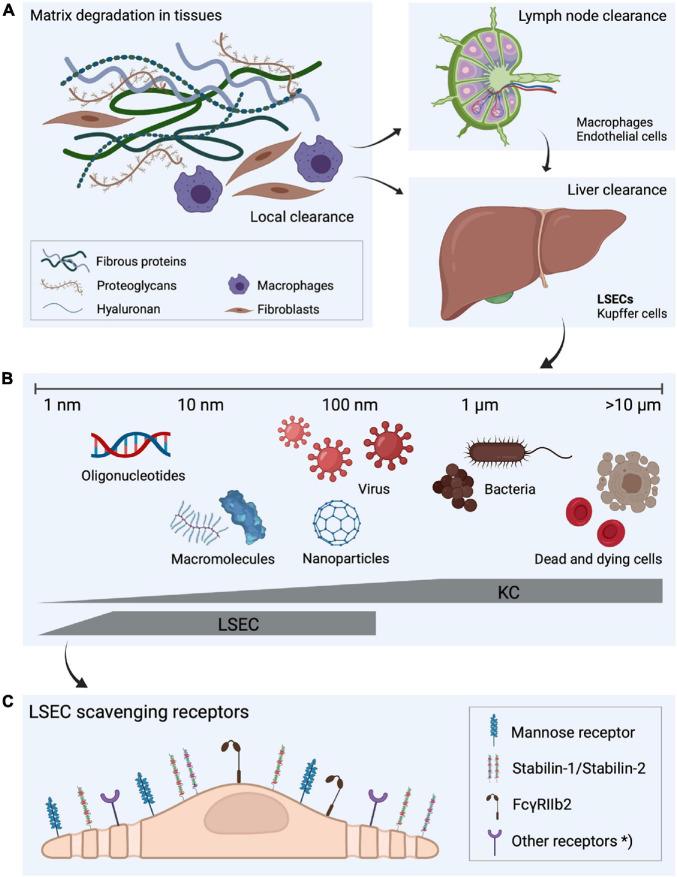
The aim of this review is to give an outline of the blood clearance function of the liver sinusoidal endothelial cells (LSECs) in health and disease. Lining the hundreds of millions of hepatic sinusoids in the human liver the LSECs are perfectly located to survey the constituents of the blood. These cells are equipped with high-affinity receptors and an intracellular vesicle transport apparatus, enabling a remarkably efficient machinery for removal of large molecules and nanoparticles from the blood, thus contributing importantly to maintain blood and tissue homeostasis. We describe here central aspects of LSEC signature receptors that enable the cells to recognize and internalize blood-borne waste macromolecules at great speed and high capacity. Notably, this blood clearance system is a silent process, in the sense that it usually neither requires or elicits cell activation or immune responses. Most of our knowledge about LSECs arises from studies in animals, of which mouse and rat make up the great majority, and some species differences relevant for extrapolating from animal models to human are discussed. In the last part of the review, we discuss comparative aspects of the LSEC scavenger functions and specialized scavenger endothelial cells (SECs) in other vascular beds and in different vertebrate classes. In conclusion, the activity of LSECs and other SECs prevent exposure of a great number of waste products to the immune system, and molecules with noxious biological activities are effectively "silenced" by the rapid clearance in LSECs. An undesired consequence of this avid scavenging system is unwanted uptake of nanomedicines and biologics in the cells. As the development of this new generation of therapeutics evolves, there will be a sharp increase in the need to understand the clearance function of LSECs in health and disease. There is still a significant knowledge gap in how the LSEC clearance function is affected in liver disease.
本综述的目的是概述肝窦内皮细胞(LSEC)在健康和疾病状态下的血液清除功能。LSEC排列在人类肝脏中数亿个肝血窦内,其位置得天独厚,能够监测血液成分。这些细胞配备有高亲和力受体和细胞内囊泡运输装置,形成了一个极为高效的机制,可从血液中清除大分子和纳米颗粒,从而对维持血液和组织内稳态起到重要作用。我们在此描述LSEC标志性受体的核心方面,这些受体使细胞能够以高速和高容量识别并内化血液中携带的废弃大分子。值得注意的是,这种血液清除系统是一个无声的过程,也就是说它通常既不需要也不会引发细胞激活或免疫反应。我们对LSEC的大多数了解来自于动物研究,其中小鼠和大鼠占了绝大多数,并且讨论了一些从动物模型推断到人类时相关的物种差异。在综述的最后部分,我们讨论了LSEC清除功能与其他血管床及不同脊椎动物类群中特化的清除内皮细胞(SEC)的比较方面。总之,LSEC和其他SEC的活性可防止大量废物暴露于免疫系统,具有有害生物活性的分子通过LSEC中的快速清除而被有效“沉默”。这种积极的清除系统的一个不良后果是细胞对纳米药物和生物制品的不必要摄取。随着新一代治疗药物的不断发展,了解LSEC在健康和疾病状态下的清除功能的需求将急剧增加。在肝脏疾病中LSEC清除功能如何受到影响方面,仍然存在重大的知识空白。


 Zotero 插件