
中性粒细胞胞外诱捕网在脓毒性凝血功能障碍患者中的作用及其与自噬的相互作用。
Effects of Neutrophil Extracellular Traps in Patients With Septic Coagulopathy and Their Interaction With Autophagy.
机构信息
Department of Critical Care Medicine, State Key Laboratory of Complex Severe and Rare Diseases, Peking Union Medical College Hospital, Chinese Academy of Medical Science and Peking Union Medical College, Beijing, China.
出版信息
Front Immunol. 2021 Oct 11;12:757041. doi: 10.3389/fimmu.2021.757041. eCollection 2021.
INTRODUCTION
Neutrophil extracellular traps (NETs) act as a critical trigger of inflammation and coagulation. We hypothesized that NETs are associated with septic hypercoagulability.
MATERIALS AND METHODS
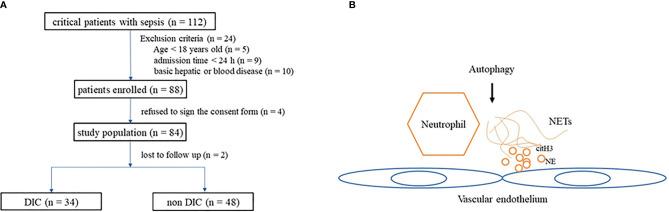
In total, 82 patients admitted with sepsis in the Department of Critical Care Medicine of Peking Union Medical College Hospital were enrolled between February 2017 and April 2018. Clinical and hematological parameters and thrombotic or hemorrhagic events were recorded. Blood samples were obtained to assess biomarkers of NET formation, including neutrophil elastase 2 (ELA2) and citrullinated histone H3, and endothelial-derived biomarker syndecan-1. Autophagy levels and their regulation pathway were also examined to explore their interaction with NETs.
RESULT
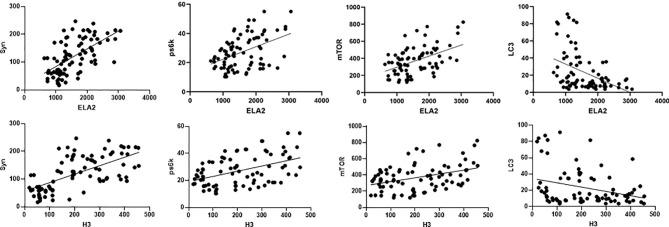
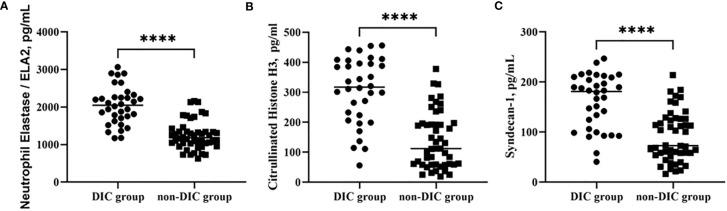
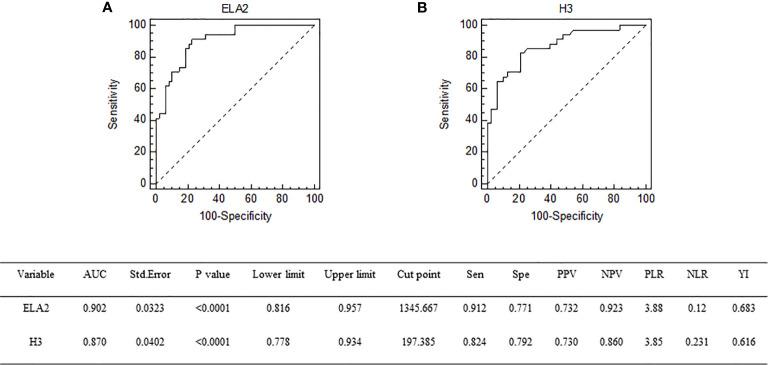
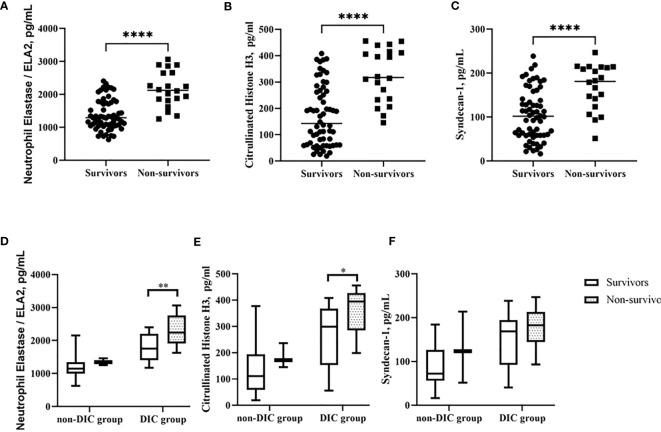
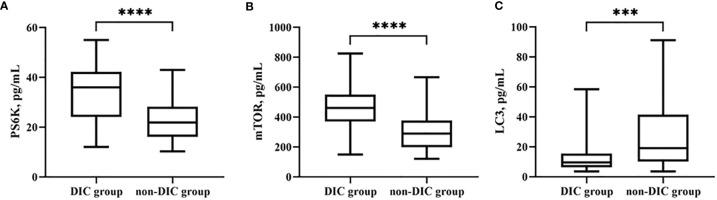
Sepsis patients with disseminated intravascular coagulation (DIC) showed significantly higher levels of NET formation [ELA2, 1,247 (86-625) vs. 2,039 (1,544-2,534), p < 0.0001; H3, 140 (47-233) vs. 307 (199-415), p < 0.0001]. NET formation was independently associated with DIC risk [ELA2, OR 1.0028, 95% CI, 1.0010-1.0045; H3, OR 1.0104, 95% CI, 1.0032-1.0176] and mortality [ELA2, HR 1.0014, 95% CI, 1.0004-1.0024; H3, HR 1.0056, 95% CI, 1.0008-1.0115]. The area under the curve value for ELA2 in predicting DIC occurrence was 0.902 (95% CI, 0.816-0.957), and that of H3 was 0.870 (95% CI, 0.778-0.934). Furthermore, biomarkers of NET formation, endothelial cells, and autophagy exhibited a significant correlation [ELA2 and Syn (r = 0.5985, p < 0.0001), LC3B (r = -0.4224, p < 0.0001); H3 and Syn (r = 0.6383, p < 0.0001), LC3B (r = -0.3005, p = 0.0061)].
CONCLUSION
Increased NET formation is significantly associated with sepsis-induced DIC incidence and mortality in sepsis patients, revealing a significant relationship with the autophagy pathway.
CLINICAL TRIAL REGISTRATION
chictr.org.cn, identifier ChiCTR-ROC-17010750.
介绍
中性粒细胞胞外诱捕网(NETs)作为炎症和凝血的关键触发因素。我们假设 NETs 与脓毒症高凝状态有关。
材料和方法
共纳入 2017 年 2 月至 2018 年 4 月在我院重症医学科因败血症住院的 82 例患者。记录临床和血液学参数以及血栓形成或出血事件。采集血样评估 NET 形成的生物标志物,包括中性粒细胞弹性蛋白酶 2(ELA2)和瓜氨酸化组蛋白 H3,以及内皮衍生的标志物 syndecan-1。还检查了自噬水平及其调控途径,以探讨其与 NETs 的相互作用。
结果
弥散性血管内凝血(DIC)的败血症患者 NET 形成水平明显升高[ELA2,1247(86-625)vs. 2039(1544-2534),p<0.0001;H3,140(47-233)vs. 307(199-415),p<0.0001]。NET 形成与 DIC 风险独立相关[ELA2,OR 1.0028,95%CI,1.0010-1.0045;H3,OR 1.0104,95%CI,1.0032-1.0176]和死亡率[ELA2,HR 1.0014,95%CI,1.0004-1.0024;H3,HR 1.0056,95%CI,1.0008-1.0115]。ELA2 预测 DIC 发生的曲线下面积值为 0.902(95%CI,0.816-0.957),H3 为 0.870(95%CI,0.778-0.934)。此外,NET 形成的生物标志物、内皮细胞和自噬之间存在显著相关性[ELA2 和 Syn(r=0.5985,p<0.0001),LC3B(r=-0.4224,p<0.0001);H3 和 Syn(r=0.6383,p<0.0001),LC3B(r=-0.3005,p=0.0061)]。
结论
NET 形成增加与败血症患者脓毒症诱导的 DIC 发生率和死亡率显著相关,与自噬途径有显著关系。
临床试验注册
chictr.org.cn,标识符 ChiCTR-ROC-17010750。
 Zotero 插件