
电子健康记录评估 6 项儿科 1 型糖尿病自我管理习惯的可行性及其与血糖控制结果的关系。
Feasibility of Electronic Health Record Assessment of 6 Pediatric Type 1 Diabetes Self-management Habits and Their Association With Glycemic Outcomes.
机构信息
Susan B. Meister Child Health Evaluation and Research Center (CHEAR), University of Michigan, Ann Arbor.
Pediatric Endocrinology, University of Michigan, Ann Arbor.
出版信息
JAMA Netw Open. 2021 Oct 1;4(10):e2131278. doi: 10.1001/jamanetworkopen.2021.31278.
IMPORTANCE
A low-burden electronic health record (EHR) workflow has been devised to systematize the collection and validation of 6 key diabetes self-management habits: (1) checks glucose at least 4 times/day or uses continuous glucose monitor (CGM); (2) gives at least 3 rapid-acting insulin boluses per day; (3) uses insulin pump; (4) delivers boluses before meals; (5) reviewed glucose data since last clinic visit, and (6) has changed insulin doses since the last clinic visit.
OBJECTIVE
To describe the performance of these habits and examine their association with hemoglobin A1c (HbA1c) levels and time in range (TIR).
DESIGN, SETTING, AND PARTICIPANTS: This cross-sectional study included individuals with known type 1 diabetes who were seen in a US pediatric diabetes clinic in 2019.
MAIN OUTCOMES AND MEASURES
Habit performance, total habit score (sum of 6 habits per person), HbA1c levels, and TIR.
RESULTS
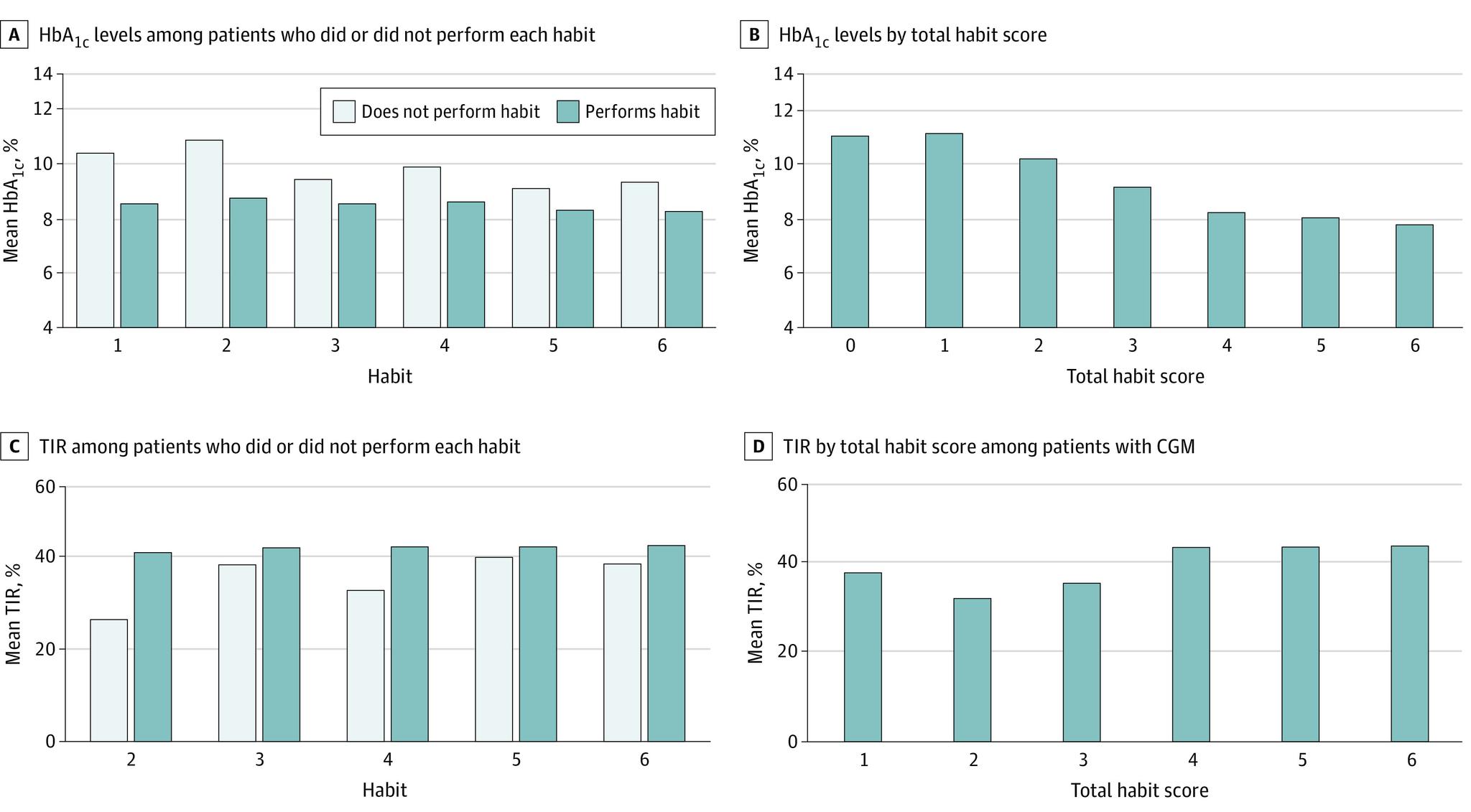
Of 1344 patients, 1212 (609 [50.2%] males; 66 [5.4%] non-Hispanic Black; 1030 [85.0%] non-Hispanic White; mean [SD] age, 15.5 [4.5] years) were included, of whom 654 (54.0%) were using CGM and had a TIR. Only 105 patients (8.7%) performed all 6 habits. Habit performance was lower among older vs younger patients (age ≥18 years vs ≤12 years: 17 of 411 [4.1%] vs 57 of 330 [17.3%]; P < .001), Black vs White patients (3 [4.5%] vs 95 [9.2%]; P < .001), those with public vs private insurance (14 of 271 [5.2%] vs 91 of 941 [9.7%]; P < .001), and those with lower vs higher parental education levels (<college degree vs ≥college degree: 35 of 443 [7.9%] vs 66 of 574 [11.5%]; P < .001). After adjustment for demographic characteristics and disease duration, for every 1-unit increase in total habit score, we found a mean (SE) 0.6% (0.05) decrease in HbA1c among all participants and a mean (SE) 2.86% (0.71) increase in TIR among those who used CGMs. Multiple regression models revealed that performing each habit was associated with a significantly lower HbA1c level (habit 1: -0.16% [95% CI, -1.91% to -1.37%]; habit 2: -1.01% [-1.34% to -0.69%]; habit 3: -0.71% [95% CI, -0.93% to -0.49%]; habit 4: -0.97% [95% CI, -1.21% to -0.73%]; habit 5: -0.44% [95% CI, -0.71% to -0.17%]; habit 6: -0.75% [95% CI, -0.96% to -0.53%]; all P < .001). There were differences in HbA1c according to race, insurance, and parental education, but these associations were attenuated with the inclusion of the 6 habits, which had more robust associations with HbA1c levels than the demographic characteristics.
CONCLUSIONS AND RELEVANCE
These findings suggest that a focus on increasing adherence to the 6 habits could be critical for improving disparities in glycemic outcomes; these metrics have been adopted by the Type 1 Diabetes Exchange Quality Improvement Collaborative for continuous quality improvement.
重要性
已经设计出一种低负担的电子健康记录 (EHR) 工作流程,以系统化收集和验证 6 项关键的糖尿病自我管理习惯:(1) 每天至少检查 4 次血糖或使用连续血糖监测仪 (CGM);(2) 每天至少给予 3 次速效胰岛素 boluses;(3) 使用胰岛素泵;(4) 在饭前给予 boluses;(5) 查看上次就诊以来的血糖数据,以及 (6) 自上次就诊以来改变胰岛素剂量。
目的
描述这些习惯的表现,并检查它们与糖化血红蛋白 (HbA1c) 水平和时间在范围内 (TIR) 的关联。
设计、地点和参与者:这项横断面研究包括在美国儿科糖尿病诊所就诊的已知 1 型糖尿病患者。
主要结果和措施
习惯表现、总习惯得分(每个人的 6 个习惯的总和)、HbA1c 水平和 TIR。
结果
在 1344 名患者中,有 1212 名(609 名 [50.2%] 男性;6 名 [5.4%] 非西班牙裔黑人;1030 名 [85.0%] 非西班牙裔白人;平均[标准差]年龄,15.5[4.5]岁)被纳入,其中 654 名(54.0%)正在使用 CGM 并具有 TIR。只有 105 名患者(8.7%)完成了所有 6 个习惯。年龄较大的患者(年龄≥18 岁与≤12 岁)的习惯表现较低(年龄≥18 岁的患者有 411 名 [4.1%],而年龄≤12 岁的患者有 330 名 [17.3%];P<0.001),黑人患者的表现低于白人患者(黑人患者有 3 名 [4.5%],白人患者有 95 名 [9.2%];P<0.001),公共保险患者的表现低于私人保险患者(公共保险患者有 271 名 [5.2%],私人保险患者有 941 名 [9.7%];P<0.001),父母教育水平较低的患者的表现低于父母教育水平较高的患者(父母教育水平较低的患者有 443 名 [7.9%],父母教育水平较高的患者有 574 名 [11.5%];P<0.001)。在调整了人口统计学特征和疾病持续时间后,我们发现,对于所有参与者,总习惯得分每增加 1 分,HbA1c 平均(SE)下降 0.6%(0.05),而在使用 CGM 的参与者中,TIR 平均(SE)增加 2.86%(0.71)。多元回归模型显示,执行每个习惯都与 HbA1c 水平显著降低相关(习惯 1:-0.16% [95%置信区间,-1.91% 至 -1.37%];习惯 2:-1.01% [-1.34% 至 -0.69%];习惯 3:-0.71% [95%置信区间,-0.93% 至 -0.49%];习惯 4:-0.97% [95%置信区间,-1.21% 至 -0.73%];习惯 5:-0.44% [95%置信区间,-0.71% 至 -0.17%];习惯 6:-0.75% [95%置信区间,-0.96% 至 -0.53%];所有 P<0.001)。HbA1c 水平因种族、保险和父母教育水平而异,但这些关联在纳入 6 个习惯后减弱,这些习惯与 HbA1c 水平的关联比人口统计学特征更具稳健性。
结论和相关性
这些发现表明,关注增加对 6 个习惯的依从性可能对改善血糖结果的差异至关重要;这些指标已被 1 型糖尿病交换质量改进合作组织采用,用于持续质量改进。
 Zotero 插件