
儿童全氟烷基物质暴露与免疫、过敏反应、感染及哮喘:流行病学研究综述
Perfluoroalkyl substances exposure and immunity, allergic response, infection, and asthma in children: review of epidemiologic studies.
作者信息
von Holst Haley, Nayak Pratibha, Dembek Zygmunt, Buehler Stephanie, Echeverria Diana, Fallacara Dawn, John Lisa
机构信息
Battelle Memorial Institute, 505 King Ave, Columbus, OH, 43201, USA.
出版信息
Heliyon. 2021 Oct 12;7(10):e08160. doi: 10.1016/j.heliyon.2021.e08160. eCollection 2021 Oct.
BACKGROUND
Increased exposure to perfluoroalkyl substances (PFAS) potentially affects infant and childhood health through immunosuppression. Given rapidly evolving research on PFAS, it is important to comprehensively examine the impact of PFAS exposure among the pediatric population as new research becomes available due to potential fragility of the developing immune system.
OBJECTIVES
This review assessed the effects of PFAS fetal, infant and childhood exposures upon the development of immune function during early life stages.
METHODS
Researchers completed a literature review, searching PubMed for human studies published since 2010 for PFAS and health outcomes among infants and children. Included articles incorporated key search terms in the title or abstract; non-research reports and non-English papers were excluded. The search identified 518 studies for possible inclusion. Following hands-on review, 34 were determined relevant. Subsequent analyses found 8 additional relevant articles, totaling 42 studies.
RESULTS
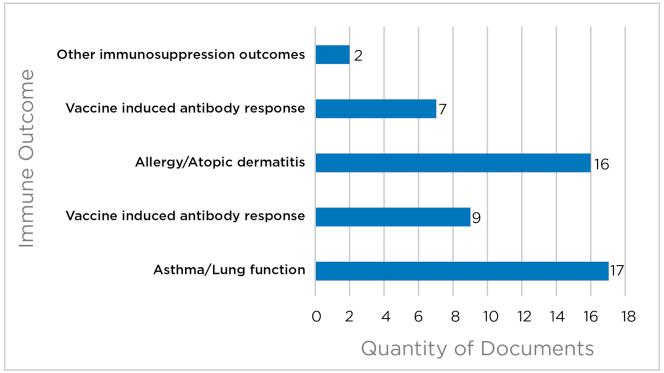
Major immune-related sequelae from PFAS exposures on infant and child health outcomes documented in recent literature include:• Strong indication of immunosuppression, with diminished childhood antibody response to vaccination, particularly with PFOA, PFOS and PFHxS exposures.• Some indication of increased risks of childhood infectious diseases/infections, particularly from PFOS exposures.• Limited indication of an effect of PFAS exposure on allergic reactions/allergen specific IgE antibodies.• Limited indication of an effect of PFAS exposure on atopic dermatitis (AD).• Limited indication of an effect of PFAS exposure on asthma and lung function.
CONCLUSION
This review summarizes recent findings of PFAS effects on infant and childhood immune health. Evidence of immunosuppression, diminished vaccine efficacy, and increased risk of infections, allergies, asthma and AD were described following , infant, and early childhood PFAS exposures. Further investigation is warranted to characterize PFAS exposure pathways and potential modes of action in relation to PFAS effects on the developing immune system. Incontrovertible proof of PFAS immunotoxic effects could optimally be obtained by a large prospective study cohort of mothers and children from infancy through school-age. Regular assessments of circulating antibodies and response to infant and childhood vaccines during growth years could prove invaluable.
背景
全氟烷基物质(PFAS)暴露增加可能通过免疫抑制影响婴幼儿及儿童健康。鉴于对PFAS的研究迅速发展,由于发育中的免疫系统可能较为脆弱,随着新研究的出现,全面审视PFAS暴露对儿科人群的影响十分重要。
目的
本综述评估了PFAS在胎儿期、婴儿期和儿童期的暴露对生命早期免疫功能发育的影响。
方法
研究人员完成了一项文献综述,在PubMed上搜索自2010年以来发表的关于PFAS与婴幼儿及儿童健康结局的人体研究。纳入的文章在标题或摘要中包含关键搜索词;排除非研究报告和非英文论文。搜索确定了518项可能纳入的研究。经过人工审阅,确定34项相关。随后的分析又发现了8篇相关文章,共计42项研究。
结果
近期文献记录的PFAS暴露对婴幼儿及儿童健康结局的主要免疫相关后遗症包括:
• 有强烈迹象表明存在免疫抑制,儿童对疫苗接种的抗体反应减弱,尤其是在接触全氟辛酸(PFOA)、全氟辛烷磺酸(PFOS)和全氟己烷磺酸(PFHxS)时。
• 有一些迹象表明儿童传染病/感染风险增加,尤其是在接触PFOS时。
• 关于PFAS暴露对过敏反应/过敏原特异性IgE抗体影响的迹象有限。
• 关于PFAS暴露对特应性皮炎(AD)影响的迹象有限。
• 关于PFAS暴露对哮喘和肺功能影响的迹象有限。
结论
本综述总结了PFAS对婴幼儿及儿童免疫健康影响的近期研究结果。描述了胎儿期、婴儿期和幼儿期PFAS暴露后免疫抑制、疫苗效力降低以及感染、过敏、哮喘和AD风险增加的证据。有必要进一步调查以确定PFAS暴露途径以及与PFAS对发育中免疫系统影响相关的潜在作用模式。通过对从婴儿期到学龄期的母婴进行大型前瞻性研究队列,有望获得PFAS免疫毒性作用的确凿证据。在成长过程中定期评估循环抗体以及对婴幼儿及儿童疫苗的反应可能会被证明具有极高价值。


 Zotero 插件