
吸入麻醉和异丙酚麻醉对老年非心脏手术患者术后认知功能障碍的影响:系统评价和荟萃分析。
Effects of inhalation and propofol anaesthesia on postoperative cognitive dysfunction in elderly noncardiac surgical patients: A systematic review and meta-analysis.
机构信息
Department of Anesthesiology, Chongqing University Cancer Hospital, Chongqing University, Chongqing, China.
出版信息
Medicine (Baltimore). 2021 Oct 29;100(43):e27668. doi: 10.1097/MD.0000000000027668.
BACKGROUND
Postoperative cognitive dysfunction (POCD) is a very common event in elderly noncardiac surgical patients. The effects of inhalational anaesthetics and propofol on the incidence of POCD and postoperative cognitive status at different time points after surgery are currently unclear.
METHODS
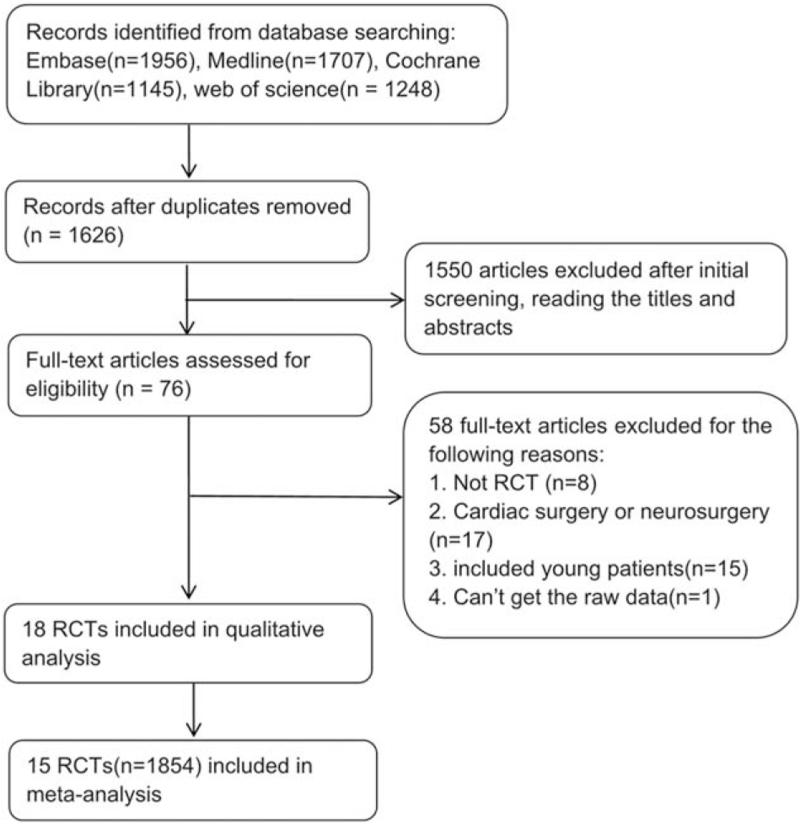
We searched the Embase, Medline, Cochrane Library, and Web of Science databases for randomized controlled trials (RCTs), in which inhalation anaesthesia and propofol anaesthesia were compared. The incidence of POCD or postoperative cognitive status was assessed in elderly patients undergoing noncardiac surgery.
RESULTS
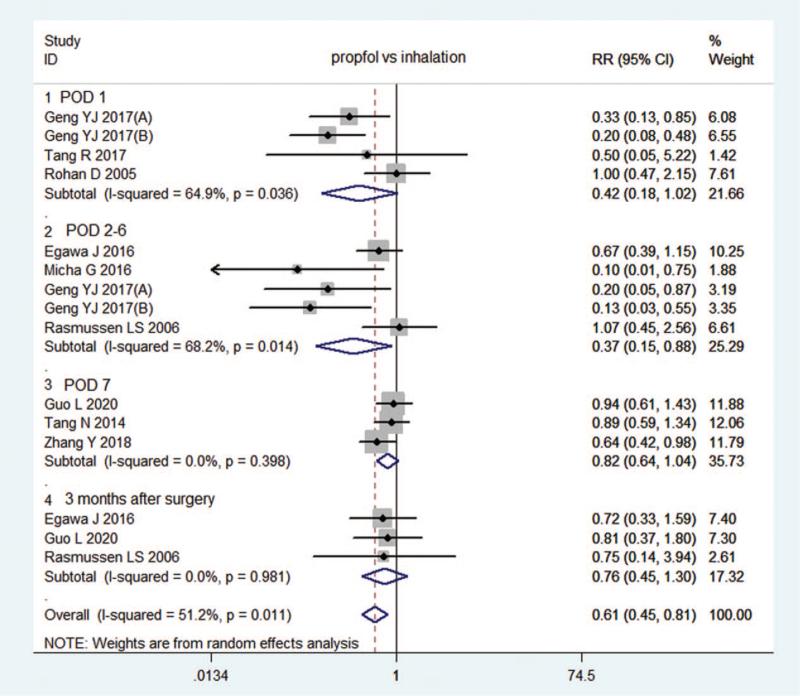
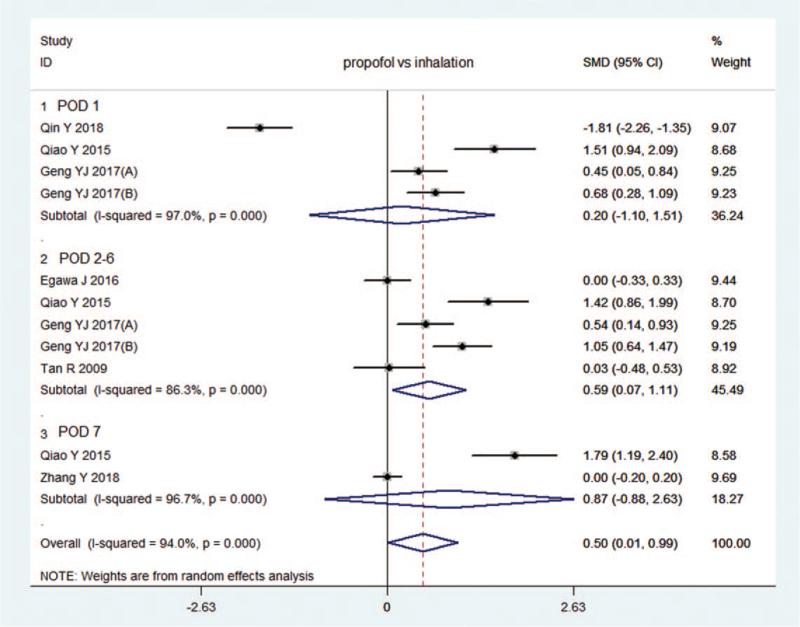
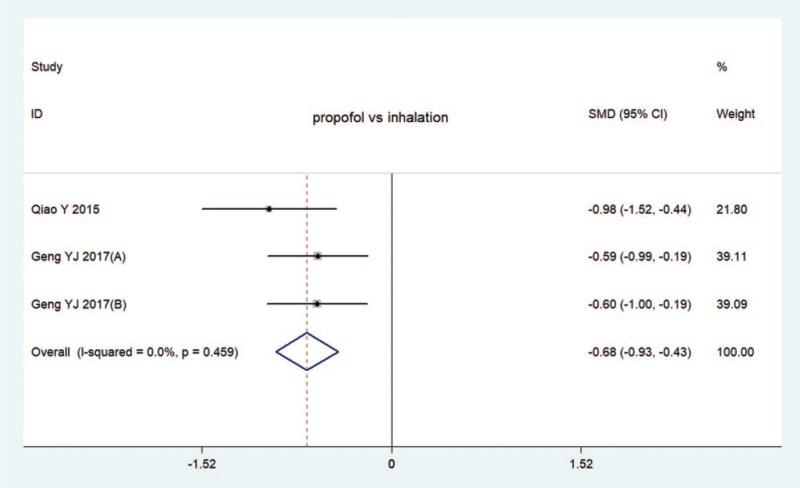
Fifteen RCTs with 1854 patients were included in this meta-analysis. The incidence of POCD on postoperative Days 2-6 after propofol anaesthesia was markedly lower than that after inhalation anaesthesia (risk ratio (RR): 0.37, 95% confidence interval (CI): 0.15-0.88, P = .025), and Mini-Mental State Examination (MMSE) scores after propofol anaesthesia were substantially higher than those after inhalation anaesthesia (standard mean difference (SMD): 0.59, 95% CI: 0.07-1.11, P = .026). The levels of interleukin-6 (IL-6) and tumour necrosis factor-α (TNF-α) were much lower after propofol anaesthesia than after inhalation anaesthesia (SMD: -2.027, 95% CI: -3.748- -0.307, P = .021; SMD: -0.68, 95% CI: -0.93- -0.43, P < .001).
CONCLUSIONS
The moderate evidence from this meta-analysis shows that, in elderly noncardiac surgical patients, propofol anaesthesia is superior to inhalation anaesthesia for attenuating of early POCD incidence, and low-level evidence shows that cognitive status is higher and systemic inflammation is less severe after propofol anaesthesia in the early days after surgery.
LIMITATIONS
The sample size was not sufficiently large for systemic inflammation, and the tools to identify POCD were not uniform in the included studies.
背景
术后认知功能障碍(POCD)是老年非心脏手术患者中非常常见的事件。目前尚不清楚吸入麻醉剂和异丙酚对不同时间点手术后 POCD 发生率和术后认知状态的影响。
方法
我们检索了 Embase、Medline、Cochrane 图书馆和 Web of Science 数据库中的随机对照试验(RCT),比较了吸入麻醉和异丙酚麻醉。评估了非心脏手术老年患者的 POCD 发生率或术后认知状态。
结果
本荟萃分析纳入了 15 项 RCT 和 1854 例患者。异丙酚麻醉后第 2-6 天 POCD 的发生率明显低于吸入麻醉(风险比(RR):0.37,95%置信区间(CI):0.15-0.88,P=0.025),异丙酚麻醉后简易精神状态检查(MMSE)评分明显高于吸入麻醉(标准化均数差(SMD):0.59,95%CI:0.07-1.11,P=0.026)。异丙酚麻醉后白细胞介素-6(IL-6)和肿瘤坏死因子-α(TNF-α)水平明显低于吸入麻醉(SMD:-2.027,95%CI:-3.748- -0.307,P=0.021;SMD:-0.68,95%CI:-0.93- -0.43,P < 0.001)。
结论
本荟萃分析的中等证据表明,在老年非心脏手术患者中,异丙酚麻醉可降低早期 POCD 发生率,且术后早期认知状态较高,全身炎症反应较轻。
局限性
本研究系统炎症的样本量不够大,且纳入研究中 POCD 的检测工具并不统一。


 Zotero 插件