
手机:至关重要的成瘾还是致命的成瘾?印度特伦甘纳邦本科医学生的手机使用模式及手机成瘾评估
Mobile Phones: Vital Addiction or Lethal Addiction? Mobile Phone Usage Patterns and Assessment of Mobile Addiction among Undergraduate Medical Students in Telangana, India.
作者信息
Jahagirdar Vinay, Rama Kaanthi, Soppari Pranavi, Kumar M Vijay
机构信息
Department of Internal Medicine, University of Missouri Kansas City School of Medicine, Kansas City, MO, USA.
Department of Community Medicine, Gandhi Medical College, Secunderabad, India.
出版信息
J Addict. 2021 Oct 20;2021:8750650. doi: 10.1155/2021/8750650. eCollection 2021.
BACKGROUND
Increased mobile phone usage among undergraduate medical students causes a detrimental effect on their health. The main focus of this study is to determine the pattern of mobile phone usage among undergraduate medical students in Hyderabad, India, and the detrimental effect on their health due to excess mobile use.
MATERIALS AND METHODS
A cross-sectional study was conducted among undergraduate medical students from various medical colleges in Hyderabad, India, from September 2020 to January 2021. Data were collected from 626 respondents using a semistructured, pretested questionnaire. Smartphone Addiction Scale-Short Version (SAS-SV) was used to assess the risk of smartphone addiction. Microsoft Excel and SAS were employed to analyze the data. Associations were examined using Fisher's exact test.
RESULTS
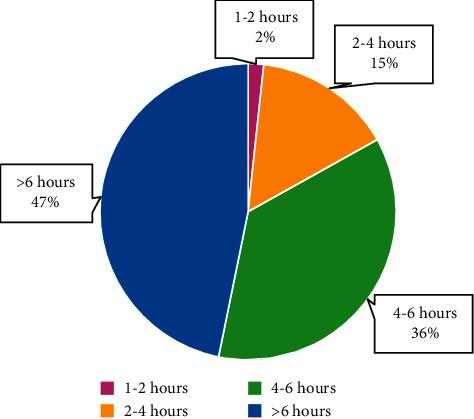
100% of the respondents were using mobiles, with 83.2% spending more than 4 hours on them. Only 22% reported that no mobile use during classes. Half (51.6%) admitted to keeping their mobiles close by while sleeping. 84.3% used social networking apps via their mobiles. Common symptoms arising from prolonged mobile usage included eye strain (67.9%), blurred vision (31.4%), and numbness or tingling in palms (30.9%). 52.70% of the respondents were at high risk of mobile addiction according to SAS-SV. Screen time more than 4 hours was associated with high risk of mobile addiction ( < 0.0001). Significant association was found between high risk of mobile addiction and eye strain ( < 0.0001), blurry vision (=0.0115), numbness/tingling in palms ( < 0.0001), and heat/tingling in the auditory area ( < 0.0001).
CONCLUSION
The study shows the alarming rate of risk of smartphone addiction among medical students. Students can be encouraged to assess their mobile addiction status and become aware of the issue. More research may be performed to develop standardized tools for early identification of mobile addiction and appropriate therapies for its rectification.
背景
本科医学生中手机使用量的增加对他们的健康产生了有害影响。本研究的主要重点是确定印度海得拉巴本科医学生的手机使用模式,以及过度使用手机对他们健康的有害影响。
材料与方法
2020年9月至2021年1月,在印度海得拉巴各医学院的本科医学生中进行了一项横断面研究。使用半结构化、经过预测试的问卷从626名受访者收集数据。使用智能手机成瘾量表简版(SAS-SV)评估智能手机成瘾风险。采用微软Excel和SAS分析数据。使用Fisher精确检验检查关联性。
结果
100%的受访者使用手机,其中83.2%在手机上花费超过4小时。只有22%的人报告上课期间不使用手机。一半(51.6%)的人承认睡觉时把手机放在身边。84.3%的人通过手机使用社交网络应用程序。长时间使用手机产生的常见症状包括眼睛疲劳(67.9%)、视力模糊(31.4%)和手掌麻木或刺痛(30.9%)。根据SAS-SV,52.70%的受访者有高度手机成瘾风险。屏幕使用时间超过4小时与高度手机成瘾风险相关(<0.0001)。在高度手机成瘾风险与眼睛疲劳(<0.0001)、视力模糊(=0.0115)、手掌麻木/刺痛(<0.0001)以及听觉区域发热/刺痛(<0.0001)之间发现了显著关联。
结论
该研究显示了医学生中智能手机成瘾风险的惊人比例。可以鼓励学生评估自己的手机成瘾状况并意识到这个问题。可以进行更多研究以开发用于早期识别手机成瘾的标准化工具及其纠正的适当疗法。

 Zotero 插件