
代谢组学分析在前列腺特异性抗原灰色区域内区分前列腺癌与良性前列腺增生。
Metabolomics Profiling Discriminates Prostate Cancer From Benign Prostatic Hyperplasia Within the Prostate-Specific Antigen Gray Zone.
作者信息
Xu Bei, Chen Yan, Chen Xi, Gan Lingling, Zhang Yamei, Feng Jiafu, Yu Lin
机构信息
Department of Clinical Laboratory, Mianyang Central Hospital, School of Medicine, University of Electronic Science and Technology of China, Mianyang, China.
Department of Clinical Pharmacy, Sichuan Cancer Hospital & Institute, Sichuan Cancer Center, School of Medicine, University of Electronic Science and Technology of China, Chengdu, China.
出版信息
Front Oncol. 2021 Oct 15;11:730638. doi: 10.3389/fonc.2021.730638. eCollection 2021.
OBJECTIVE
Prostate cancer (PCa) is the second most common male malignancy globally. Prostate-specific antigen (PSA) is an important biomarker for PCa diagnosis. However, it is not accurate in the diagnostic gray zone of 4-10 ng/ml of PSA. In the current study, the performance of serum metabolomics profiling in discriminating PCa patients from benign prostatic hyperplasia (BPH) individuals with a PSA concentration in the range of 4-10 ng/ml was explored.
METHODS
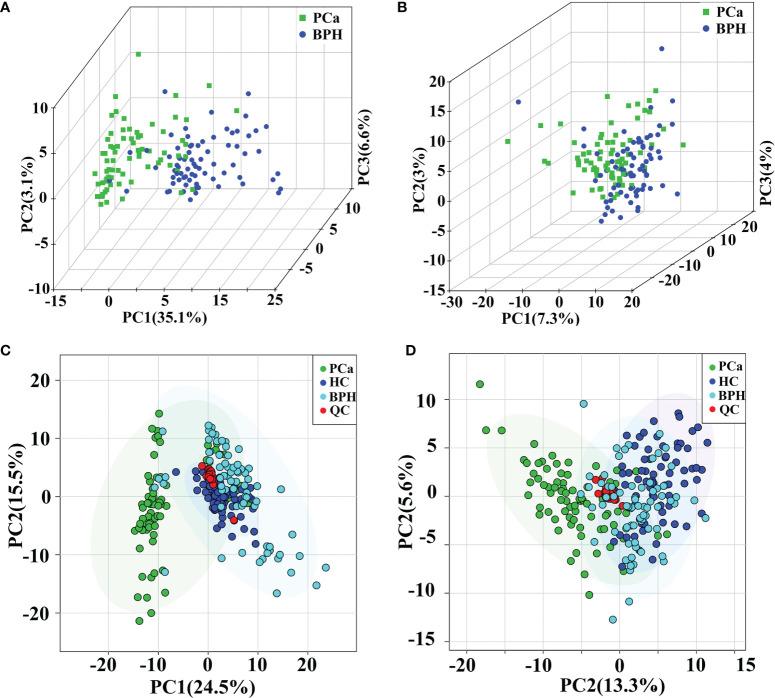
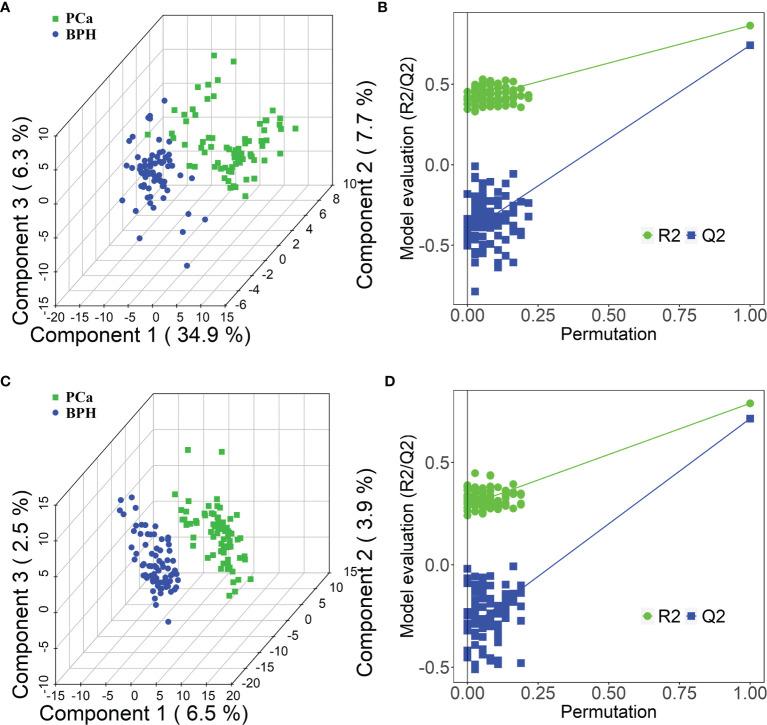
A total of 220 individuals, including patients diagnosed with PCa and BPH within PSA levels in the range of 4-10 ng/ml and healthy controls, were enrolled in the study. Liquid chromatography coupled with tandem mass spectrometry (LC-MS/MS)-based non-targeted metabolomics method was utilized to characterize serum metabolic profiles of participants. Principal component analysis (PCA) and partial least squares discriminant analysis (PLS-DA) methods were used for multivariate analysis. Receiver operating characteristic (ROC) curve analysis was performed to explore the diagnostic value of candidate metabolites in differentiating PCa from BPH. Correlation analysis was conducted to explore the relationship between serum metabolites and common clinically used fasting lipid profiles.
RESULTS
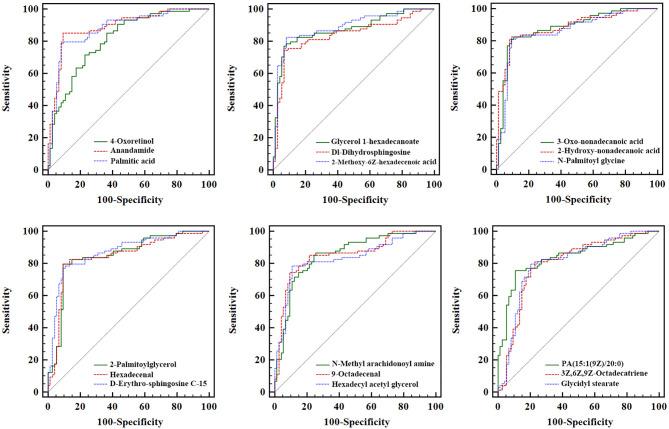
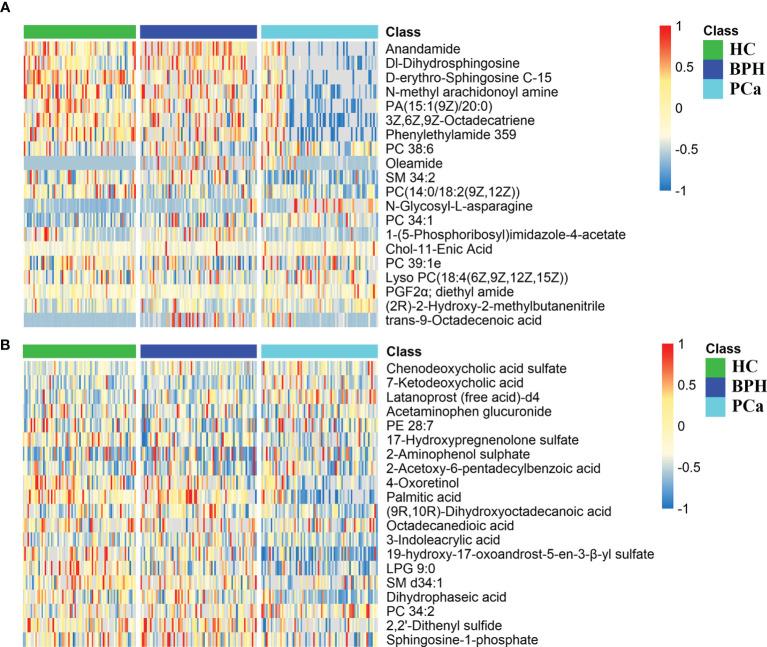
Several differential metabolites were identified. The top enriched pathways in PCa subjects such as glycerophospholipid and glycerolipid metabolisms were associated with lipid metabolism. Lipids and lipid-like compounds were the predominant metabolites within the top 50 differential metabolites selected using fold-change threshold >1.5 or <2/3, variable importance in projection (VIP) > 1, and Student's t-test threshold < 0.05. Eighteen lipid or lipid-related metabolites were selected including 4-oxoretinol, anandamide, palmitic acid, glycerol 1-hexadecanoate, dl-dihydrosphingosine, 2-methoxy-6-hexadecenoic acid, 3-oxo-nonadecanoic acid, 2-hydroxy-nonadecanoic acid, -palmitoyl glycine, 2-palmitoylglycerol, hexadecenal, d-erythro-sphingosine C-15, -methyl arachidonoyl amine, 9-octadecenal, hexadecyl acetyl glycerol, 1-(9-pentadecenoyl)-2-eicosanoyl-glycero-3-phosphate, 3,6,9-octadecatriene, and glycidyl stearate. Selected metabolites effectively discriminated PCa from BPH when PSA levels were in the range of 4-10 ng/ml (area under the curve (AUC) > 0.80). Notably, the 18 identified metabolites were negatively corrected with total cholesterol (TC), low-density lipoprotein cholesterol (LDL-C), and Apo-B levels in PCa patients; and some were negatively correlated with high-density lipoprotein cholesterol (HDL-C) and Apo-A levels. However, the metabolites were not correlated with triglycerides (TG).
CONCLUSION
The findings of the present study indicate that metabolic reprogramming, mainly lipid metabolism, is a key signature of PCa. The 18 lipid or lipid-associated metabolites identified in this study are potential diagnostic markers for differential diagnosis of PCa patients and BPH individuals within a PSA level in the gray zone of 4-10 ng/ml.
目的
前列腺癌(PCa)是全球第二常见的男性恶性肿瘤。前列腺特异性抗原(PSA)是PCa诊断的重要生物标志物。然而,在PSA水平为4 - 10 ng/ml的诊断灰色区域,其并不准确。在本研究中,探讨了血清代谢组学分析在鉴别PSA浓度为4 - 10 ng/ml的PCa患者与良性前列腺增生(BPH)个体中的表现。
方法
本研究共纳入220名个体,包括PSA水平在4 - 10 ng/ml范围内诊断为PCa和BPH的患者以及健康对照。采用基于液相色谱 - 串联质谱(LC-MS/MS)的非靶向代谢组学方法来表征参与者的血清代谢谱。主成分分析(PCA)和偏最小二乘判别分析(PLS-DA)方法用于多变量分析。进行受试者工作特征(ROC)曲线分析以探索候选代谢物在区分PCa和BPH中的诊断价值。进行相关性分析以探索血清代谢物与常用临床空腹血脂谱之间的关系。
结果
鉴定出了几种差异代谢物。PCa患者中富集程度最高的通路如甘油磷脂和甘油酯代谢与脂质代谢相关。在使用变化倍数阈值>1.5或<2/3、投影变量重要性(VIP)>1和学生t检验阈值<0.05选择的前50种差异代谢物中,脂质和类脂化合物是主要的代谢物。选择了18种脂质或脂质相关代谢物,包括4-氧视黄醇、花生四烯乙醇胺、棕榈酸、1-十六烷酸甘油酯、dl-二氢鞘氨醇、2-甲氧基-6-十六碳烯酸、3-氧代十九烷酸、2-羟基十九烷酸、棕榈酰甘氨酸、2-棕榈酰甘油、十六碳烯醛、d-赤藓糖鞘氨醇C-15、甲基花生四烯酰胺、9-十八碳烯醛、十六烷基乙酰甘油、1-(9-十五碳烯酰)-2-二十碳酰甘油-3-磷酸、3,6,9-十八碳三烯和硬脂酸缩水甘油酯。当PSA水平在4 - 10 ng/ml范围内时,所选代谢物能有效区分PCa和BPH(曲线下面积(AUC)>0.80)。值得注意的是,在PCa患者中,鉴定出的18种代谢物与总胆固醇(TC)、低密度脂蛋白胆固醇(LDL-C)和载脂蛋白B水平呈负相关;有些与高密度脂蛋白胆固醇(HDL-C)和载脂蛋白A水平呈负相关。然而,这些代谢物与甘油三酯(TG)无关。
结论
本研究结果表明,代谢重编程,主要是脂质代谢,是PCa的关键特征。本研究中鉴定出的18种脂质或脂质相关代谢物是在4 - 10 ng/ml灰色区域PSA水平下鉴别PCa患者和BPH个体的潜在诊断标志物。


 Zotero 插件