
持续性疟原虫感染增强了减少传播的免疫发展。
Persistent Plasmodium falciparum infections enhance transmission-reducing immunity development.
机构信息
Noguchi Memorial Institute for Medical Research, University of Ghana, Accra, Ghana.
University of Cape Coast, Cape Coast, Ghana.
出版信息
Sci Rep. 2021 Nov 1;11(1):21380. doi: 10.1038/s41598-021-00973-5.
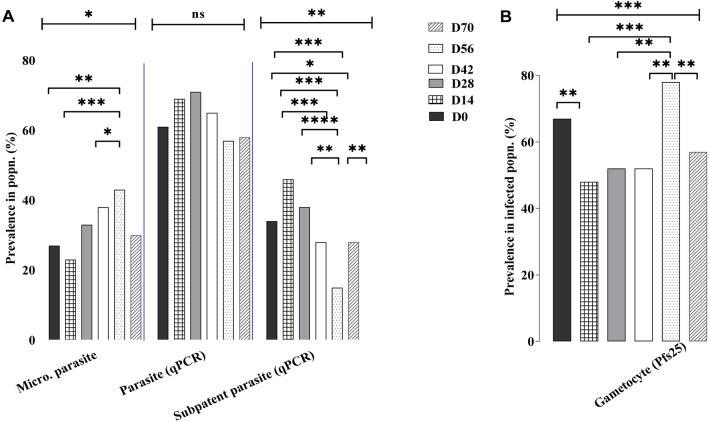
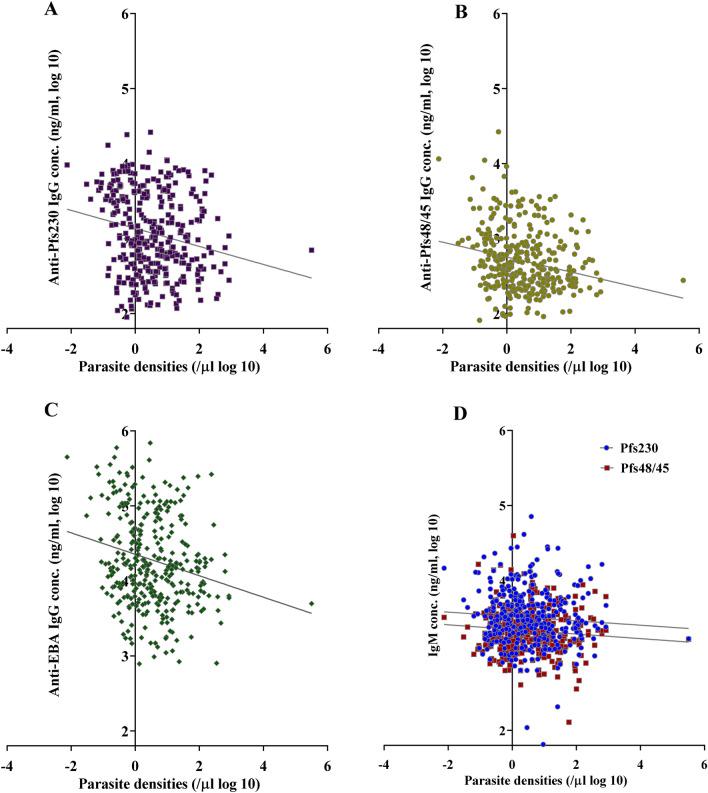
Subclinical infections that serve as reservoir populations to drive transmission remain a hurdle to malaria control. Data on infection dynamics in a geographical area is required to strategically design and implement malaria interventions. In a longitudinal cohort, we monitored Plasmodium falciparum infection prevalence and persistence, and anti-parasite immunity to gametocyte and asexual antigens for 10 weeks. Of the 100 participants, only 11 were never infected, whilst 16 had persistent infections detected by reverse transcriptase-quantitative polymerase chain reaction (RT-qPCR), and one participant had microscopic parasites at all visits. Over 70% of the participants were infected three or more times, and submicroscopic gametocyte prevalence was high, ≥ 48% of the parasite carriers. Naturally induced responses against recombinant Pfs48/45.6C, Pfs230proC, and EBA175RIII-V antigens were not associated with either infection status or gametocyte carriage, but the antigen-specific IgG titers inversely correlated with parasite and gametocyte densities consistent with partial immunity. Longitudinal analysis of gametocyte diversity indicated at least four distinct clones circulated throughout the study period. The high prevalence of children infected with distinct gametocyte clones coupled with marked variation in infection status at the individual level suggests ongoing transmission and should be targeted in malaria control programs.
亚临床感染作为传播的储备人群仍然是疟疾控制的一个障碍。需要在地理区域内获得有关感染动态的数据,以便战略性地设计和实施疟疾干预措施。在一项纵向队列研究中,我们监测了恶性疟原虫感染的流行率和持续时间,以及针对配子体和无性抗原的抗寄生虫免疫情况,共 10 周。在 100 名参与者中,仅有 11 人从未感染过,而 16 人通过逆转录定量聚合酶链反应(RT-qPCR)检测到持续感染,且有一名参与者在所有就诊时都有镜下寄生虫。超过 70%的参与者感染了 3 次或更多次,且亚临床配子体的流行率很高,≥48%的寄生虫携带者都携带配子体。针对重组 Pfs48/45.6C、Pfs230proC 和 EBA175RIII-V 抗原的自然诱导反应与感染状况或配子体携带无关,但抗原特异性 IgG 滴度与寄生虫和配子体密度呈负相关,这与部分免疫一致。配子体多样性的纵向分析表明,至少有四个不同的克隆在整个研究期间循环。高比例的儿童感染不同的配子体克隆,加上个体水平上感染状况的明显变化,表明存在持续传播,应成为疟疾控制规划的目标。



 Zotero 插件