
单药或联合贝伐单抗治疗复发性胶质母细胞瘤患者的马立佐米:I/II期临床试验数据。
Marizomib alone or in combination with bevacizumab in patients with recurrent glioblastoma: Phase I/II clinical trial data.
作者信息
Bota Daniela A, Mason Warren, Kesari Santosh, Magge Rajiv, Winograd Benjamin, Elias Ileana, Reich Steven D, Levin Nancy, Trikha Mohit, Desjardins Annick
机构信息
Chao Family Comprehensive Cancer Center and Departments of Neurology and Neurological Surgery, University of California, Irvine, California, USA.
Princess Margaret Cancer Centre, Toronto, Ontario, Canada.
出版信息
Neurooncol Adv. 2021 Oct 2;3(1):vdab142. doi: 10.1093/noajnl/vdab142. eCollection 2021 Jan-Dec.
BACKGROUND
This phase I/II trial in patients with recurrent glioblastoma (GBM) evaluates the safety and preliminary efficacy of marizomib, an irreversible pan-proteasome inhibitor that crosses the blood-brain barrier.
METHODS
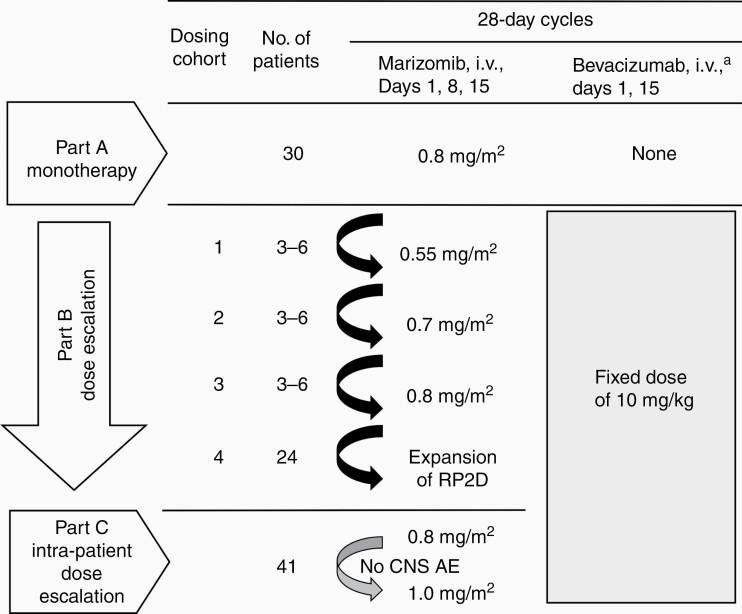
Part A assessed the safety and efficacy of marizomib monotherapy. In Part B, escalating doses of marizomib (0.5-0.8 mg/m) in combination with bevacizumab were evaluated. Part C explored intra-patient dose escalation of marizomib (0.8-1.0 mg/m) for the combination.
RESULTS
In Part A, 30 patients received marizomib monotherapy. The most common AEs were fatigue (66.7%), headache (46.7%), hallucination (43.3%), and insomnia (43.3%). One patient (3.3%) achieved a partial response. In Part B, the recommended phase II dose of marizomib was 0.8 mg/m when combined with bevacizumab 10 mg/kg. In Part C, dose escalation to 1.0 mg/m was not tolerated. Pooled analysis of 67 patients treated with marizomib ≤0.8 mg/m and bevacizumab showed a nonoverlapping safety profile consistent with the known safety profile of each agent: the most common grade ≥3 AEs were hypertension (16.4%), confusion (13.4%), headache (10.4%), and fatigue (10.4%). The overall response rate was 34.3%, including 2 patients with complete response. Six-month progression-free survival was 29.8%; median overall survival was 9.1 months.
CONCLUSIONS
The safety profile of marizomib as monotherapy and in combination with bevacizumab was consistent with previous observations that marizomib crosses the blood-brain barrier. Preliminary efficacy did not demonstrate a meaningful benefit of the addition of marizomib to bevacizumab for the treatment of recurrent GBM.
背景
这项针对复发性胶质母细胞瘤(GBM)患者的I/II期试验评估了marizomib(一种可穿越血脑屏障的不可逆泛蛋白酶体抑制剂)的安全性和初步疗效。
方法
A部分评估了marizomib单药治疗的安全性和疗效。在B部分,评估了递增剂量的marizomib(0.5 - 0.8 mg/m²)与贝伐单抗联合使用的情况。C部分探索了marizomib(0.8 - 1.0 mg/m²)在联合治疗中的患者内剂量递增。
结果
在A部分,30名患者接受了marizomib单药治疗。最常见的不良事件为疲劳(66.7%)、头痛(46.7%)、幻觉(43.3%)和失眠(43.3%)。1名患者(3.3%)达到部分缓解。在B部分,marizomib与10 mg/kg贝伐单抗联合使用时,推荐的II期剂量为0.8 mg/m²。在C部分,剂量递增至1.0 mg/m²无法耐受。对67名接受≤0.8 mg/m² marizomib和贝伐单抗治疗的患者进行的汇总分析显示,其安全性特征与每种药物已知的安全性特征一致且不重叠:最常见的≥3级不良事件为高血压(16.4%)、意识模糊(13.4%)、头痛(10.4%)和疲劳(10.4%)。总缓解率为34.3%,包括2名完全缓解患者。6个月无进展生存率为29.8%;中位总生存期为9.1个月。
结论
marizomib单药治疗及与贝伐单抗联合使用的安全性特征与之前观察到的marizomib可穿越血脑屏障的结果一致。初步疗效未显示在贝伐单抗治疗复发性GBM中添加marizomib有显著益处。

 Zotero 插件