
辅助性T细胞17免疫反应与癌症之间的关系。
Relationship between Th17 immune response and cancer.
作者信息
Marques Hanna Santos, de Brito Breno Bittencourt, da Silva Filipe Antônio França, Santos Maria Luísa Cordeiro, de Souza Júlio César Braga, Correia Thiago Macêdo Lopes, Lopes Luana Weber, Neres Nayara Silva de Macêdo, Dórea Rafael Santos Dantas Miranda, Dantas Anna Carolina Saúde, Morbeck Lorena Lôbo Brito, Lima Iasmin Souza, de Almeida Amanda Alves, Dias Maiara Raulina de Jesus, de Melo Fabrício Freire
机构信息
Campus Vitória da Conquista, Universidade Estadual do Sudoeste da Bahia, Vitória da Conquista 45083-900, Bahia, Brazil.
Instituto Multidisciplinar em Saúde, Universidade Federal da Bahia, Vitória da Conquista 45029-094, Bahia, Brazil.
出版信息
World J Clin Oncol. 2021 Oct 24;12(10):845-867. doi: 10.5306/wjco.v12.i10.845.
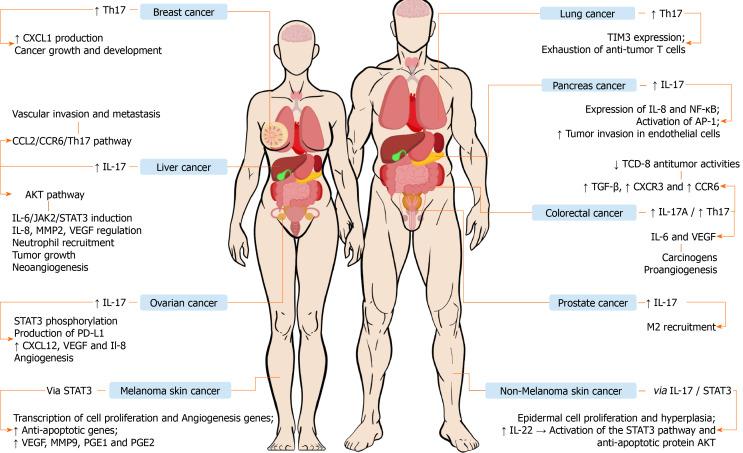
Cancer is the second leading cause of death worldwide and epidemiological projections predict growing cancer mortality rates in the next decades. Cancer has a close relationship with the immune system and, although Th17 cells are known to play roles in the immune response against microorganisms and in autoimmunity, studies have emphasized their roles in cancer pathogenesis. The Th17 immune response profile is involved in several types of cancer including urogenital, respiratory, gastrointestinal, and skin cancers. This type of immune response exerts pro and antitumor functions through several mechanisms, depending on the context of each tumor, including the protumor angiogenesis and exhaustion of T cells and the antitumor recruitment of T cells and neutrophils to the tumor microenvironment. Among other factors, the paradoxical behavior of Th17 cells in this setting has been attributed to its plasticity potential, which makes possible their conversion into other types of T cells such as Th17/Treg and Th17/Th1 cells. Interleukin (IL)-17 stands out among Th17-related cytokines since it modulates pathways and interacts with other cell profiles in the tumor microenvironment, which allow Th17 cells to prevail in tumors. Moreover, the IL-17 is able to mediate pro and antitumor processes that influence the development and progression of various cancers, being associated with variable clinical outcomes. The understanding of the relationship between the Th17 immune response and cancer as well as the singularities of carcinogenic processes in each type of tumor is crucial for the identification of new therapeutic targets.
癌症是全球第二大致死原因,流行病学预测显示,未来几十年癌症死亡率将不断上升。癌症与免疫系统密切相关,虽然已知辅助性T细胞17(Th17细胞)在针对微生物的免疫反应及自身免疫中发挥作用,但研究已强调其在癌症发病机制中的作用。Th17免疫反应特征涉及多种类型的癌症,包括泌尿生殖系统癌、呼吸道癌、胃肠道癌和皮肤癌。这种免疫反应通过多种机制发挥促肿瘤和抗肿瘤功能,具体取决于每种肿瘤的背景情况,包括促肿瘤血管生成和T细胞耗竭,以及T细胞和中性粒细胞向肿瘤微环境的抗肿瘤募集。在其他因素中,Th17细胞在这种情况下的矛盾行为归因于其可塑性潜能,这使得它们有可能转化为其他类型的T细胞,如Th17/调节性T细胞(Treg)和Th17/辅助性T细胞1(Th1细胞)。白细胞介素(IL)-17在与Th17相关的细胞因子中尤为突出,因为它调节肿瘤微环境中的信号通路并与其他细胞特征相互作用,从而使Th17细胞在肿瘤中占优势。此外,IL-17能够介导影响各种癌症发生发展和进程的促肿瘤和抗肿瘤过程,并与不同的临床结果相关。了解Th17免疫反应与癌症之间的关系以及每种肿瘤致癌过程的特殊性对于确定新的治疗靶点至关重要。

 Zotero 插件