Ahmanson Translational Theranostics Division, Department of Molecular and Medical Pharmacology, David Geffen School of Medicine, UCLA, Los Angeles, California;
Jonsson Comprehensive Cancer Center, UCLA, Los Angeles, California.
J Nucl Med. 2022 Jul;63(7):1021-1026. doi: 10.2967/jnumed.121.262426. Epub 2021 Nov 5.
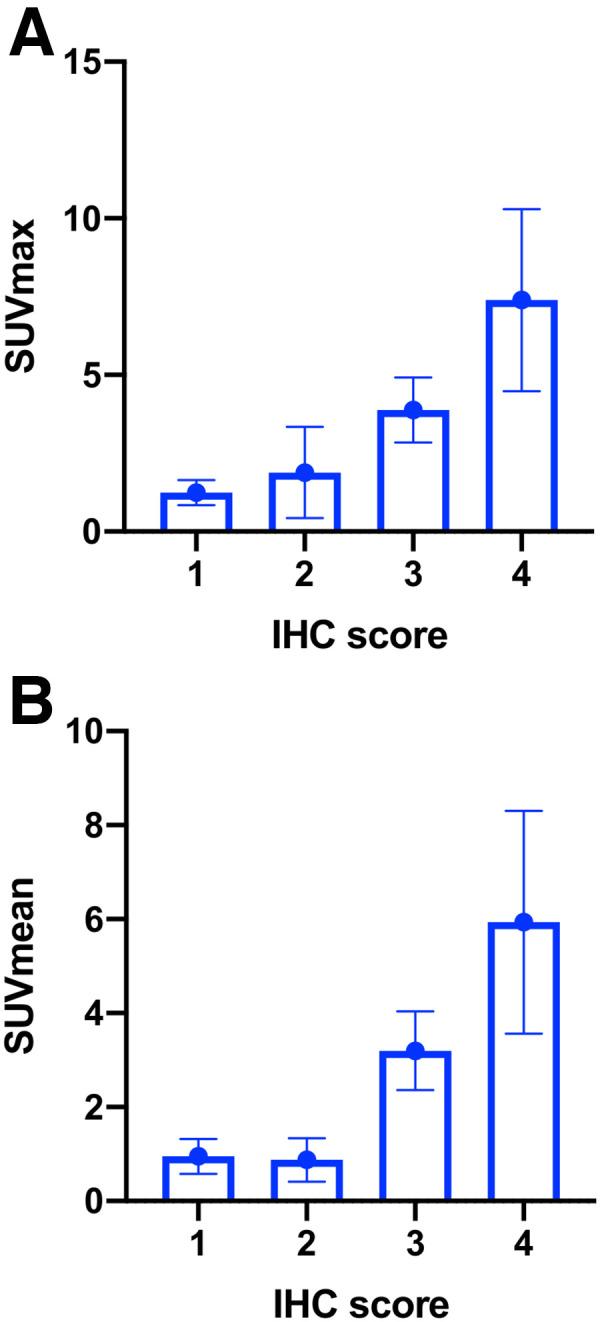
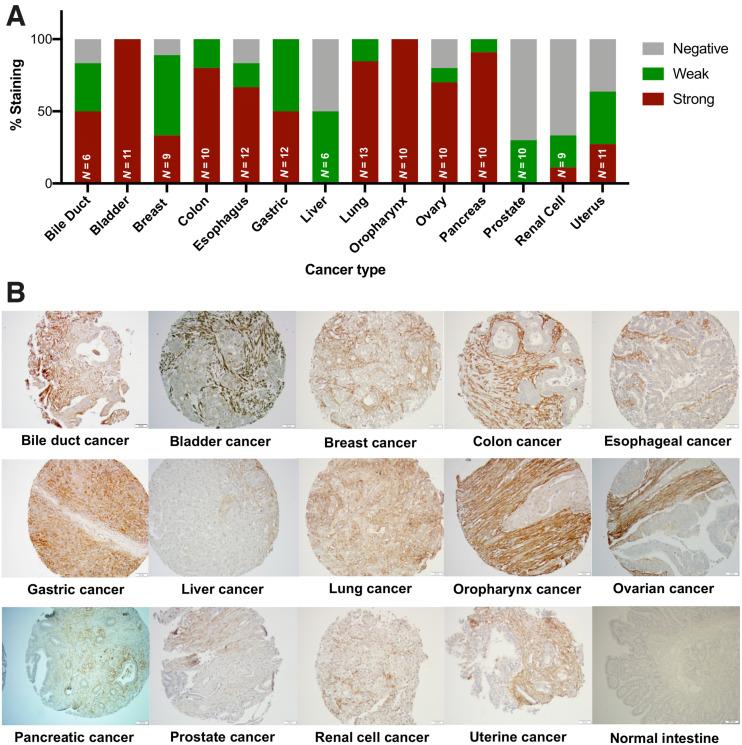
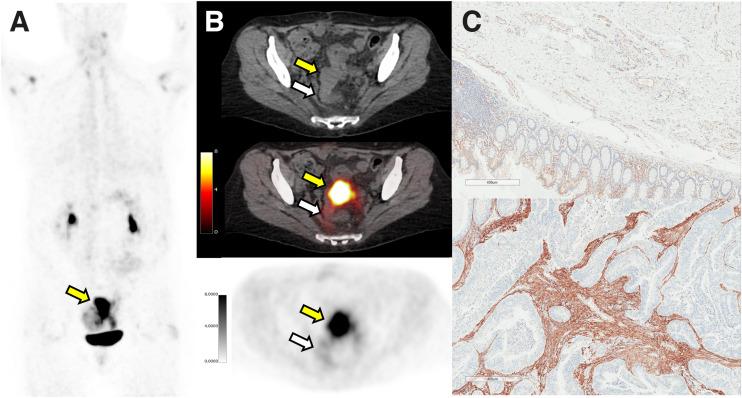
Fibroblast activation protein (FAP)-expressing cancer-associated fibroblasts confer treatment resistance and promote metastasis and immunosuppression. Because FAP is overexpressed in many cancers, radiolabeled molecules targeting FAP are studied for their use as pancancer theranostic agents. This study aimed to establish the spectrum of FAP expression across various cancers by immunohistochemistry and to explore whether Ga FAP inhibitor (FAPi)-46 PET biodistribution faithfully reflects FAP expression from resected cancer and non-cancer specimens. We conducted a FAP expression screening using immunohistochemistry on a pancancer human tissue microarray (141 patients, 14 different types of cancer) and an interim analysis of a prospective exploratory imaging trial in cancer patients. Volunteer patients underwent 1 whole-body Ga-FAPi-46 PET/CT scan and, subsequently, surgical resection of their primary tumor or metastasis. Ga-FAPi-46 PET SUV and SUV was correlated with FAP immunohistochemistry score in cancer and tumor-adjacent non-cancer tissues for each patient. FAP was expressed across all 14 cancer types on tissue microarray with variable intensity and frequency, ranging from 25% to 100% (mean, 76.6% ± 25.3%). Strong FAP expression was observed in 50%-100% of cancers of the bile duct, bladder, colon, esophagus, stomach, lung, oropharynx, ovary, and pancreas. Fifteen patients with various cancer types (colorectal [ = 4], head and neck [ = 3], pancreas [ = 2], breast [ = 2], stomach [ = 1], esophagus [ = 2], and uterus [ = 1]) underwent surgery after their Ga-FAPi-46 PET/CT scan within a mean interval of 16.1 ± 14.4 d. Ga-FAPi-46 SUVs and immunohistochemistry scores were higher in cancer than in tumor-adjacent non-cancer tissue: mean SUV 7.7 versus 1.6 ( < 0.001), mean SUV 6.2 versus 1.0 ( < 0.001), and mean FAP immunohistochemistry score 2.8 versus 0.9 ( < 0.001). FAP immunohistochemistry scores strongly correlated with Ga-FAPi 46 SUV and SUV: = 0.781 (95% CI, 0.376-0.936; < 0.001) and = 0.783 (95% CI, 0.379-0.936; < 0.001), respectively. In this interim analysis of a prospective exploratory imaging trial, Ga-FAPi-46 PET biodistribution across multiple cancers strongly correlated with FAP tissue expression. These findings support further exploration of FAPi PET as a pancancer imaging biomarker for FAP expression and as a stratification tool for FAP-targeted therapies.
成纤维细胞激活蛋白 (FAP)-表达的癌相关成纤维细胞赋予治疗抵抗性,并促进转移和免疫抑制。由于 FAP 在许多癌症中过表达,因此研究了放射性标记的针对 FAP 的分子,将其用作泛癌治疗诊断剂。本研究旨在通过免疫组织化学来确定各种癌症中 FAP 的表达谱,并探讨 Ga FAP 抑制剂 (FAPi)-46 PET 生物分布是否忠实地反映了切除的癌症和非癌症标本中的 FAP 表达。我们使用免疫组织化学对一个泛癌症人类组织微阵列(141 名患者,14 种不同类型的癌症)进行了 FAP 表达筛选,并对癌症患者的前瞻性探索性成像试验进行了中期分析。志愿者患者接受了 1 次全身 Ga-FAPi-46 PET/CT 扫描,随后对原发性肿瘤或转移灶进行了手术切除。对于每位患者,将 Ga-FAPi-46 PET SUV 和 SUV 与癌症和肿瘤相邻非癌组织中的 FAP 免疫组织化学评分相关联。在组织微阵列上,FAP 在所有 14 种癌症类型中均有表达,其强度和频率不同,范围为 25%-100%(平均值,76.6%±25.3%)。在胆管、膀胱、结肠、食管、胃、肺、口咽、卵巢和胰腺的癌症中观察到 50%-100%的强烈 FAP 表达。15 名患有各种癌症类型(结直肠癌[=4]、头颈部癌症[=3]、胰腺癌[=2]、乳腺癌[=2]、胃癌[=1]、食管癌[=2]和子宫癌[=1])的患者在 Ga-FAPi-46 PET/CT 扫描后平均间隔 16.1±14.4 d 进行了手术。与肿瘤相邻的非癌组织相比,Ga-FAPi-46 SUV 和免疫组织化学评分在癌症中更高:平均 SUV 7.7 与 1.6(<0.001),平均 SUV 6.2 与 1.0(<0.001),和平均 FAP 免疫组织化学评分 2.8 与 0.9(<0.001)。FAP 免疫组织化学评分与 Ga-FAPi 46 SUV 和 SUV 强烈相关: =0.781(95%CI,0.376-0.936;<0.001)和 =0.783(95%CI,0.379-0.936;<0.001)。在这项前瞻性探索性成像试验的中期分析中,Ga-FAPi-46 PET 在多种癌症中的生物分布与 FAP 组织表达强烈相关。这些发现支持进一步探索 FAPi PET 作为 FAP 表达的泛癌成像生物标志物,以及作为 FAP 靶向治疗的分层工具。


 Zotero 插件