
老年人在 COVID-19 大流行前后的抑郁、焦虑和感知掌控症状:来自阿姆斯特丹纵向老龄化研究的结果。
Symptoms of depression, anxiety, and perceived mastery in older adults before and during the COVID-19 pandemic: Results from the Longitudinal Aging Study Amsterdam.
机构信息
Department of Internal Medicine, Section of Geriatric Medicine, Amsterdam Public Health Research Institute, Amsterdam UMC, University of Amsterdam, Amsterdam, the Netherlands.
Department of Internal Medicine, Section of Geriatric Medicine, Amsterdam Public Health Research Institute, Amsterdam UMC, University of Amsterdam, Amsterdam, the Netherlands; Faculty of Health, Amsterdam University of Applied Sciences, Amsterdam, the Netherlands.
出版信息
J Psychosom Res. 2021 Dec;151:110656. doi: 10.1016/j.jpsychores.2021.110656. Epub 2021 Oct 30.
OBJECTIVE
Governmental measures to protect older adults from COVID-19 are hypothesized to cause anxiety and depression. Previous studies are heterogeneous and showed small effects. This study aims to assess depressive and anxiety symptoms and perceived mastery just after the first wave of the COVID-19 pandemic compared to previous years in community-dwelling older adults and to identify potential risk groups according to the comprehensive geriatric assessment framework.
METHODS
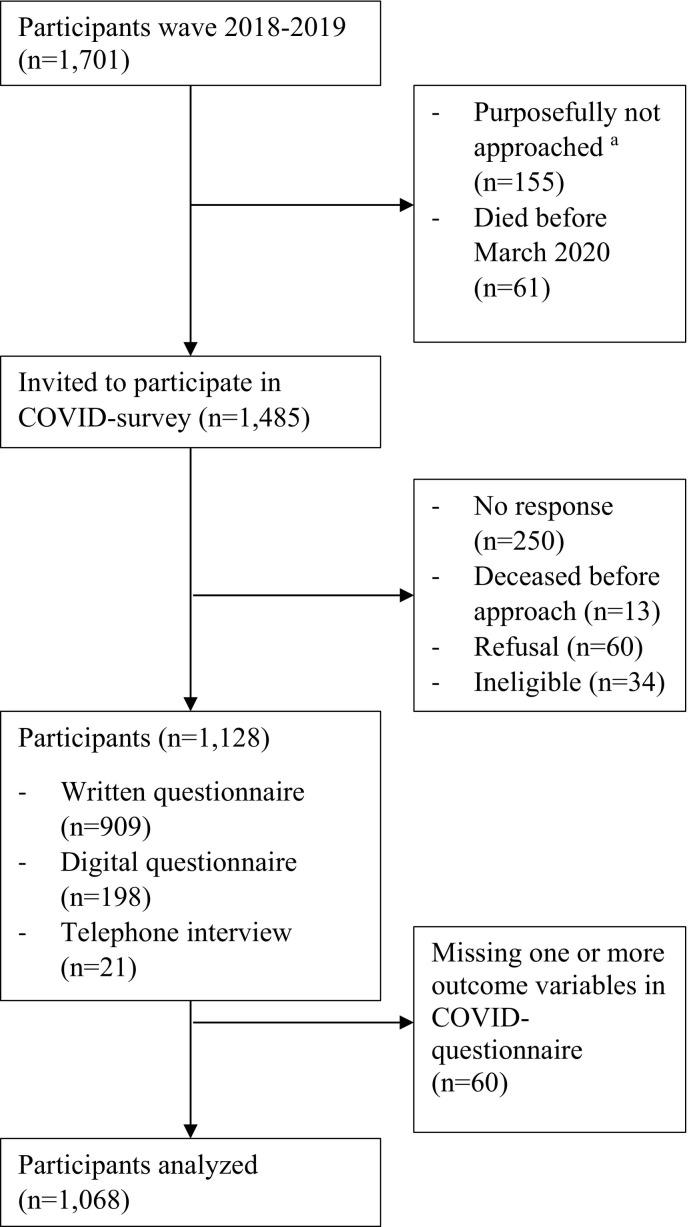
Data were used from 1068 Dutch older adults (aged 55-93 at baseline in 2011-2013) participating in the Longitudinal Aging Study Amsterdam, including 4 follow-ups spanning 9 years. Depressive symptoms, anxiety symptoms and feelings of mastery were assessed with the short Center for Epidemiologic Studies Depression scale (CES-D-10), the Hospital Anxiety Depression Scale - Anxiety subscale (HADS-A) and the Pearlin Mastery Scale. Linear mixed regression was used to compare outcomes in June-August 2020 to previous years and to examine predictors to identify risk groups.
RESULTS
Slight increases in CES-D-10 (1.37, 95% Confidence interval [CI] 1.12;1.62), HADS-A (0.74, 95% CI 0.56;0.94) and mastery (1.10, 95% CI 0.88;1.31) occurred during the COVID year compared to previous years. Older adults with functional limitations or with frailty showed a smaller increase in feelings of mastery in the COVID-year.
CONCLUSION
Our results suggest limited mental health effects on older adults from the first COVID-19 wave. Older adults have perhaps better coping strategies than younger adults, or preventive measures did not have extensive consequences for the daily life of older adults. Further monitoring of depression, anxiety and perceived mastery is recommended.
目的
政府保护老年人免受 COVID-19 影响的措施被假设会导致焦虑和抑郁。先前的研究存在异质性,且显示出较小的影响。本研究旨在评估社区居住的老年人在 COVID-19 大流行第一波期间与前几年相比的抑郁和焦虑症状以及感知掌控力,并根据全面老年评估框架确定潜在的风险群体。
方法
本研究使用了来自 1068 名荷兰老年人(基线年龄为 55-93 岁,在 2011-2013 年)的数据,这些老年人参加了阿姆斯特丹纵向老龄化研究,包括 4 次随访,跨度为 9 年。使用短版流行病学研究抑郁量表(CES-D-10)、医院焦虑抑郁量表-焦虑分量表(HADS-A)和皮尔林掌控量表评估抑郁症状、焦虑症状和掌控感。线性混合回归用于比较 2020 年 6 月至 8 月的结果与前几年的结果,并探讨预测因素以确定风险群体。
结果
与前几年相比,在 COVID 年期间,CES-D-10(1.37,95%置信区间 [CI] 1.12;1.62)、HADS-A(0.74,95% CI 0.56;0.94)和掌控感(1.10,95% CI 0.88;1.31)略有增加。在 COVID 年,有功能障碍或衰弱的老年人对掌控感的增强较小。
结论
我们的研究结果表明,COVID-19 大流行第一波对老年人的心理健康影响有限。与年轻人相比,老年人可能有更好的应对策略,或者预防措施对老年人的日常生活没有产生广泛影响。建议进一步监测抑郁、焦虑和感知掌控力。

 Zotero 插件