
绿色空间质量与健康:系统评价。
Green Space Quality and Health: A Systematic Review.
机构信息
School of Population Health, University of New South Wales, Sydney, NSW 2033, Australia.
Population Wellbeing and Environment Research Lab (PowerLab), Wollongong, NSW 2522, Australia.
出版信息
Int J Environ Res Public Health. 2021 Oct 20;18(21):11028. doi: 10.3390/ijerph182111028.
(1) Background: As cities densify, researcher and policy focus is intensifying on which green space types and qualities are important for health. We conducted a systematic review to examine whether particular green space types and qualities have been shown to provide health benefits and if so, which specific types and qualities, and which health outcomes. (2) Methods: We searched five databases from inception up to June 30, 2021. We included all studies examining a wide range of green space characteristics on various health outcomes. (3) Results: 68 articles from 59 studies were found, with a high degree of heterogeneity in study designs, definitions of quality and outcomes. Most studies were cross-sectional, ecological or cohort studies. Environment types, vegetation types, and the size and connectivity of green spaces were associated with improved health outcomes, though with contingencies by age and gender. Health benefits were more consistently observed in areas with greater tree canopy, but not grassland. The main outcomes with evidence of health benefits included allergic respiratory conditions, cardiovascular conditions and psychological wellbeing. Both objectively and subjectively measured qualities demonstrated associations with health outcomes. (4) Conclusion: Experimental studies and longitudinal cohort studies will strengthen current evidence. Evidence was lacking for needs-specific or culturally-appropriate amenities and soundscape characteristics. Qualities that need more in-depth investigation include indices that account for forms, patterns, and networks of objectively and subjectively measured green space qualities.
(1) 背景:随着城市密度的增加,研究人员和政策制定者越来越关注哪些绿色空间类型和质量对健康重要。我们进行了系统评价,以检验特定的绿色空间类型和质量是否具有健康益处,如果有,哪些是具体的类型和质量,以及哪些健康结果。
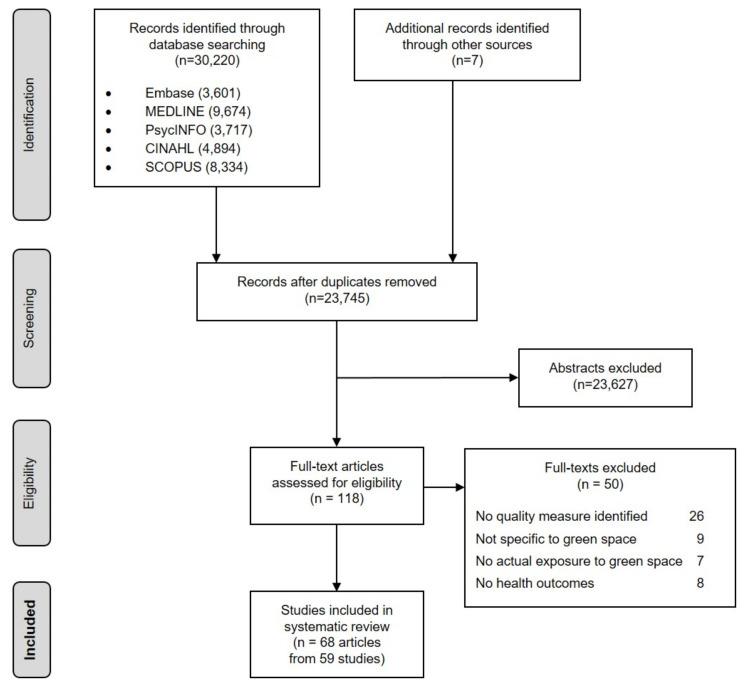
(2) 方法:我们从创建开始到 2021 年 6 月 30 日搜索了五个数据库。我们纳入了所有研究广泛的绿色空间特征对各种健康结果的研究。
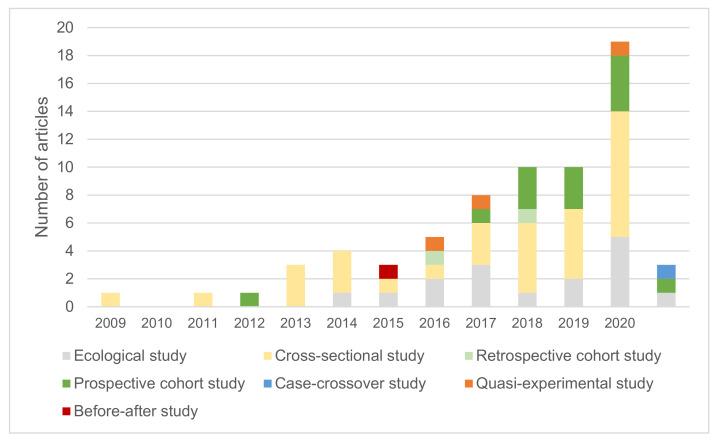
(3) 结果:从 59 项研究中找到了 68 篇文章,研究设计、质量和结果的定义存在很大的异质性。大多数研究是横断面、生态学或队列研究。环境类型、植被类型以及绿色空间的大小和连通性与改善健康结果有关,但与年龄和性别有关。在树冠较大的区域,健康益处更为明显,但在草地则不然。具有健康益处证据的主要结果包括过敏性呼吸道疾病、心血管疾病和心理健康。客观和主观测量的质量都与健康结果有关。
(4) 结论:实验研究和纵向队列研究将加强当前的证据。针对特定需求或文化适宜的设施和声音景观特征的证据不足。需要更深入调查的质量包括考虑客观和主观测量的绿色空间质量的形式、模式和网络的指标。
 Zotero 插件