
生物分子凝聚物的特征和大小要求是什么,以及它们对含有 RNA 的凝聚物有什么影响?
What are the distinguishing features and size requirements of biomolecular condensates and their implications for RNA-containing condensates?
机构信息
Molecular Medicine Program, The Hospital for Sick Children, Toronto, Ontario M5G 0A4, Canada.
Department of Biochemistry, University of Toronto, Toronto, Ontario M5S 1A8, Canada.
出版信息
RNA. 2022 Jan;28(1):36-47. doi: 10.1261/rna.079026.121. Epub 2021 Nov 12.
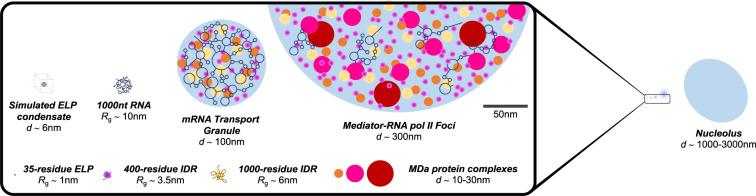
Exciting recent work has highlighted that numerous cellular compartments lack encapsulating lipid bilayers (often called "membraneless organelles"), and that their structure and function are central to the regulation of key biological processes, including transcription, RNA splicing, translation, and more. These structures have been described as "biomolecular condensates" to underscore that biomolecules can be significantly concentrated in them. Many condensates, including RNA granules and processing bodies, are enriched in proteins and nucleic acids. Biomolecular condensates exhibit a range of material states from liquid- to gel-like, with the physical process of liquid-liquid phase separation implicated in driving or contributing to their formation. To date, in vitro studies of phase separation have provided mechanistic insights into the formation and function of condensates. However, the link between the often micron-sized in vitro condensates with nanometer-sized cellular correlates has not been well established. Consequently, questions have arisen as to whether cellular structures below the optical resolution limit can be considered biomolecular condensates. Similarly, the distinction between condensates and discrete dynamic hub complexes is debated. Here we discuss the key features that define biomolecular condensates to help understand behaviors of structures containing and generating RNA.
最近令人兴奋的研究工作强调了许多细胞区室缺乏封装脂质双层(通常称为“无膜细胞器”),它们的结构和功能对于调节关键的生物过程至关重要,包括转录、RNA 剪接、翻译等。这些结构被描述为“生物分子凝聚物”,以强调生物分子可以在其中显著浓缩。许多凝聚物,包括 RNA 颗粒和处理体,富含蛋白质和核酸。生物分子凝聚物表现出从液态到凝胶状的一系列物质状态,液-液相分离的物理过程被认为是其形成的驱动力或促成因素。迄今为止,体外相分离研究为凝聚物的形成和功能提供了机制上的见解。然而,通常在体外观察到的微米级凝聚物与纳米级细胞相关物之间的联系尚未得到很好的建立。因此,人们提出了一个问题,即在光学分辨率极限以下的细胞结构是否可以被认为是生物分子凝聚物。同样,凝聚物和离散动态枢纽复合物之间的区别也存在争议。在这里,我们讨论了定义生物分子凝聚物的关键特征,以帮助理解含有和产生 RNA 的结构的行为。
 Zotero 插件