
关于中国东部癌症患者对 COVID-19 疫苗的了解、态度、接受程度及其接种意愿的预测因素:一项横断面调查。
Knowledge about, attitude and acceptance towards, and predictors of intention to receive the COVID-19 vaccine among cancer patients in Eastern China: A cross-sectional survey.
机构信息
School of Traditional Chinese Medicine, Naval Medical University, Shanghai 200433, China; Department of Integrative Oncology, Changhai Hospital, Naval Medical University, Shanghai 200433, China.
Department of Integrative Oncology, Changhai Hospital, Naval Medical University, Shanghai 200433, China.
出版信息
J Integr Med. 2022 Jan;20(1):34-44. doi: 10.1016/j.joim.2021.10.004. Epub 2021 Oct 26.
OBJECTIVE
The coronavirus disease 2019 (COVID-19) pandemic has had a serious impact on health all over the world. Cancer patient, whose immunity is often compromised, faces a huge challenge. Currently, some COVID-19 vaccines are being developed and applied on general population; however, whether cancer patients should take COVID-19 vaccine remains unknown. Our study aimed to explore the knowledge, attitude, acceptance, and predictors of intention to receive the COVID-19 vaccine among cancer patients in Eastern China.
METHODS
A cross-sectional study was conducted in Eastern China from June 17th to September 3rd, 2021. Patients were selected using a convenience sampling method. A self-report questionnaire was developed to assess knowledge about the COVID-19 vaccine, attitude towards the vaccine and acceptance of the vaccine; following a review of similar studies previously published in the scientific literature, multivariate logistic regression analysis was used to determine the predictors associated with COVID-19 vaccine acceptance.
RESULTS
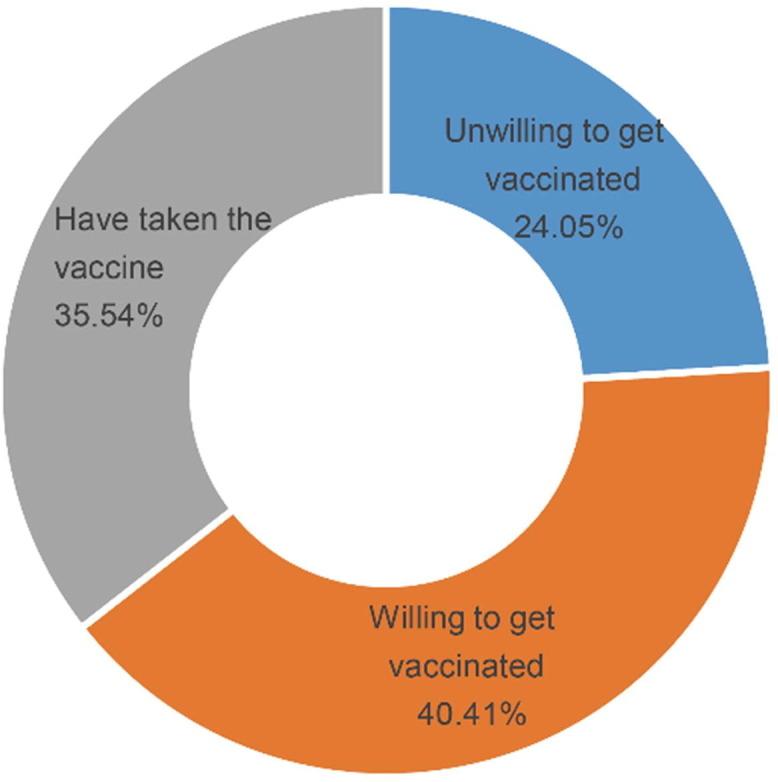
A total of 2158 cancer patients were enrolled in this study. The rate of vaccine hesitancy was 24.05% (519/2158); further, among the participants of vaccine acceptance, 767 had taken COVID-19 vaccine (35.54%), and 872 were willing to get vaccinated (40.01%). A total of 24 variables including demographic characteristics, clinical status of cancer, impact of COVID-19 pandemic on study participants, patients' knowledge about the COVID-19 vaccine, and attitude towards the vaccine, had significant differences between the "vaccine hesitancy" population and "vaccine acceptance" population. Multivariate logistic regression analysis indicated that parameters including alcohol consumption (odds ratio [OR] = 1.849; 95% confidence interval [CI]: 1.375-2.488; P-reference [P-Ref] < 0.001 vs non-drinkers), income impacted by COVID-19 pandemic (OR = 1.930, 2.037 and 2.688 for mild, moderate, and severe impact, respectively; all P-Ref < 0.01 vs no impact), knowledge of how the vaccine was developed (OR = 1.616; 95% CI: 1.126-2.318; P-Ref = 0.009 vs unknown), believing in the safety of the vaccine (OR = 1.502; 95% CI: 1.024-2.203; P-Ref = 0.038 vs denying the safety of vaccine), willingness to pay for the vaccine (OR = 3.042; 95% CI: 2.376-3.894; P-Ref < 0.001 vs unwilling), and willingness to recommend families and friends to get vaccinated (OR = 2.744; 95% CI: 1.759-4.280; P-Ref < 0.001 vs do not recommend) were contributors to vaccine acceptance. While such as being retired (OR = 0.586; 95% CI: 0.438-0.784; P-Ref < 0.001 vs unemployed), undergoing multiple therapies of cancer (OR = 0.408; 95% CI: 0.221-0.753; P-Ref = 0.004 vs no ongoing treatment), and worrying that the vaccine might deteriorate the prognosis of cancer (OR = 0.393; 95% CI: 0.307-0.504; P-Ref < 0.001 vs might not) were contributors to vaccine hesitancy.
CONCLUSION
This study provided preliminary estimates of the rates of vaccine acceptance and vaccine hesitancy among cancer patients in Eastern China. The intention to receive the COVID-19 vaccine was impacted by factors such as patient occupation, alcohol consumption, and some parts of knowledge about and attitude towards COVID-19 vaccine. It is recommended to develop individualized vaccination plans that meet the healthcare needs of cancer patients.
目的
2019 年冠状病毒病(COVID-19)大流行对全球健康造成了严重影响。癌症患者的免疫力通常较弱,面临着巨大的挑战。目前,一些 COVID-19 疫苗正在开发并应用于普通人群;然而,癌症患者是否应该接种 COVID-19 疫苗仍不清楚。我们的研究旨在探索中国东部地区癌症患者对 COVID-19 疫苗的知识、态度、接受程度和接种意愿的预测因素。
方法
2021 年 6 月 17 日至 9 月 3 日,在中国东部进行了一项横断面研究。采用便利抽样法选择患者。制定了一份自我报告问卷,以评估患者对 COVID-19 疫苗的知识、对疫苗的态度和对疫苗的接受程度;在回顾了先前发表在科学文献中的类似研究后,采用多变量逻辑回归分析来确定与 COVID-19 疫苗接种接受程度相关的预测因素。
结果
共纳入 2158 例癌症患者。疫苗犹豫率为 24.05%(519/2158);在接受疫苗接种的参与者中,767 人已接种 COVID-19 疫苗(35.54%),872 人愿意接种疫苗(40.01%)。共有 24 个变量,包括人口统计学特征、癌症临床状况、COVID-19 大流行对研究参与者的影响、患者对 COVID-19 疫苗的知识和对疫苗的态度,在“疫苗犹豫”人群和“疫苗接受”人群之间存在显著差异。多变量逻辑回归分析表明,包括饮酒(比值比 [OR] = 1.849;95%置信区间 [CI]:1.375-2.488;P-参考值 [P-Ref] <0.001 与不饮酒者相比)、受 COVID-19 大流行影响的收入(轻度、中度和重度影响的 OR 分别为 1.930、2.037 和 2.688;所有 P-Ref <0.01 与无影响相比)、对疫苗研发过程的了解(OR = 1.616;95%CI:1.126-2.318;P-Ref = 0.009 与未知相比)、相信疫苗的安全性(OR = 1.502;95%CI:1.024-2.203;P-Ref = 0.038 与否认疫苗的安全性相比)、愿意支付疫苗费用(OR = 3.042;95%CI:2.376-3.894;P-Ref <0.001 与不愿意相比)和愿意推荐家人和朋友接种疫苗(OR = 2.744;95%CI:1.759-4.280;P-Ref <0.001 与不推荐相比)是接受疫苗的原因。而退休(OR = 0.586;95%CI:0.438-0.784;P-Ref <0.001 与失业相比)、接受多种癌症治疗(OR = 0.408;95%CI:0.221-0.753;P-Ref = 0.004 与无治疗相比)和担心疫苗可能恶化癌症预后(OR = 0.393;95%CI:0.307-0.504;P-Ref <0.001 与可能不会相比)是疫苗犹豫的原因。
结论
本研究初步估计了中国东部地区癌症患者对 COVID-19 疫苗的接种意愿和疫苗犹豫率。接受 COVID-19 疫苗的意愿受到患者职业、饮酒和对 COVID-19 疫苗的部分知识和态度等因素的影响。建议制定满足癌症患者医疗保健需求的个体化疫苗接种计划。
 Zotero 插件