
低收入和中等收入国家小农户畜牧生产对儿童营养的益处与风险
Benefits and Risks of Smallholder Livestock Production on Child Nutrition in Low- and Middle-Income Countries.
作者信息
Chen Dehao, Mechlowitz Karah, Li Xiaolong, Schaefer Nancy, Havelaar Arie H, McKune Sarah L
机构信息
Department of Environmental and Global Health, College of Public Health and Health Professions, University of Florida, Gainesville, FL, United States.
Emerging Pathogens Institute, University of Florida, Gainesville, FL, United States.
出版信息
Front Nutr. 2021 Oct 27;8:751686. doi: 10.3389/fnut.2021.751686. eCollection 2021.
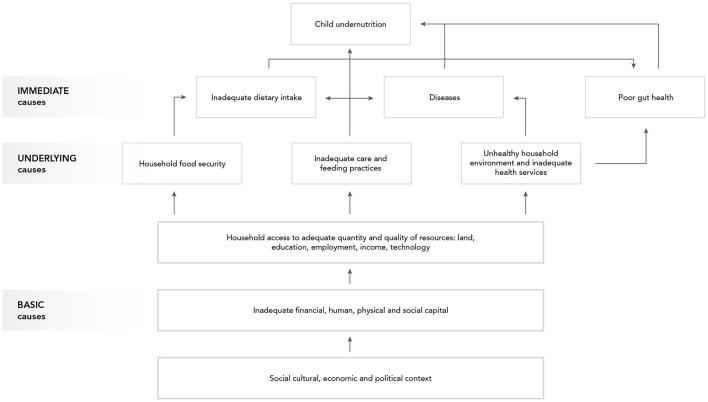
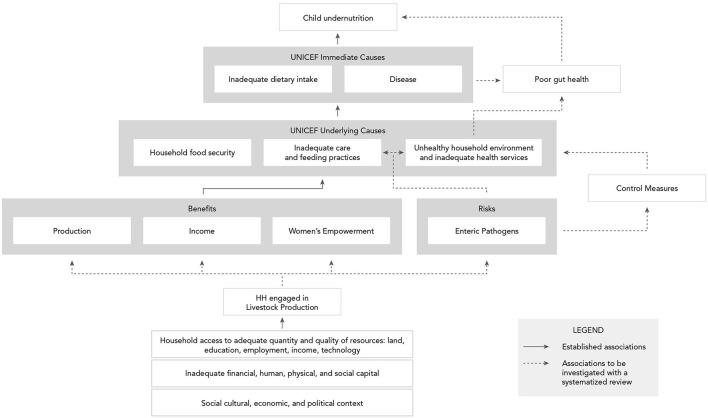
Livestock production may improve nutritional outcomes of pregnant women and children by increasing household income, availability of nutrient-dense foods, and women's empowerment. Nevertheless, the relationship is complex, and the nutritional status of children may be impaired by presence of or proximity to livestock and their pathogens. In this paper, we review the benefits and risks of livestock production on child nutrition. Evidence supports the nutritional benefits of livestock farming through income, production, and women's empowerment. Increasing animal source food consumption requires a combination of efforts, including improved animal management so that herd size is adequate to meet household income needs and consumption and addressing sociocultural and gendered norms. Evidence supports the inclusion of behavior change communication strategies into livestock production interventions to facilitate the sustainability of nutritional benefits over time, particularly interventions that engage women and foster dimensions of women's empowerment. In evaluating the risks of livestock production, evidence indicates that a broad range of enteric pathogens may chronically infect the intestines of children and, in combination with dietary deficits, may cause environmental enteric dysfunction (EED), a chronic inflammation of the gut. Some of the most important pathogens associated with EED are zoonotic in nature with livestock as their main reservoir. Very few studies have aimed to understand which livestock species contribute most to colonization with these pathogens, or how to reduce transmission. Control at the point of exposure has been investigated in a few studies, but much less effort has been spent on improving animal husbandry practices, which may have additional benefits. There is an urgent need for dedicated and long-term research to understand which livestock species contribute most to exposure of young children to zoonotic enteric pathogens, to test the potential of a wide range of intervention methods, to assess their effectiveness in randomized trials, and to assure their broad adaptation and sustainability. This review highlights the benefits and risks of livestock production on child nutrition. In addition to identifying research gaps, findings support inclusion of poor gut health as an immediate determinant of child undernutrition, expanding the established UNICEF framework which includes only inadequate diet and disease.
畜牧业生产可以通过增加家庭收入、提供营养丰富的食物以及增强妇女权能来改善孕妇和儿童的营养状况。然而,这种关系很复杂,儿童的营养状况可能会因接触家畜及其病原体或与之接近而受到损害。在本文中,我们回顾了畜牧业生产对儿童营养的益处和风险。有证据支持畜牧业养殖通过收入、生产和妇女赋权带来的营养益处。增加动物源食物的消费需要综合努力,包括改善动物管理,使畜群规模足以满足家庭收入需求和消费,并解决社会文化和性别规范问题。有证据支持将行为改变沟通策略纳入畜牧业生产干预措施,以促进营养益处的长期可持续性,特别是那些让妇女参与并促进妇女赋权的干预措施。在评估畜牧业生产的风险时,有证据表明,多种肠道病原体可能长期感染儿童肠道,并与饮食不足共同导致环境性肠道功能障碍(EED),即肠道的慢性炎症。一些与EED相关的最重要病原体本质上是人畜共患的,家畜是其主要宿主。很少有研究旨在了解哪些家畜物种对这些病原体的定植贡献最大,或者如何减少传播。在一些研究中已经对接触点的控制进行了调查,但在改善畜牧 practices方面投入的精力要少得多,而这可能会带来额外的好处。迫切需要进行专门的长期研究,以了解哪些家畜物种对幼儿接触人畜共患肠道病原体的贡献最大,测试各种干预方法的潜力,在随机试验中评估其有效性,并确保其广泛应用和可持续性。本综述强调了畜牧业生产对儿童营养的益处和风险。除了找出研究差距外,研究结果支持将肠道健康不佳作为儿童营养不良的直接决定因素纳入其中,从而扩展了仅包括饮食不足和疾病的既定联合国儿童基金会框架。
 Zotero 插件