
墨西哥移民在代谢综合征方面是否具有健康优势?审视人口统计学、社会经济和健康行为特征的作用。
Mexican immigrant health advantage in metabolic syndrome? Examining the contributions of demographic, socioeconomic, and health behavior characteristics.
作者信息
Carabello Maria, Wolfson Julia A
机构信息
Department of Health Management and Policy, University of Michigan - School of Public Health, Ann Arbor, MI, USA.
Department of Sociology, University of Michigan, Ann Arbor, MI, USA.
出版信息
SSM Popul Health. 2021 Oct 1;16:100932. doi: 10.1016/j.ssmph.2021.100932. eCollection 2021 Dec.
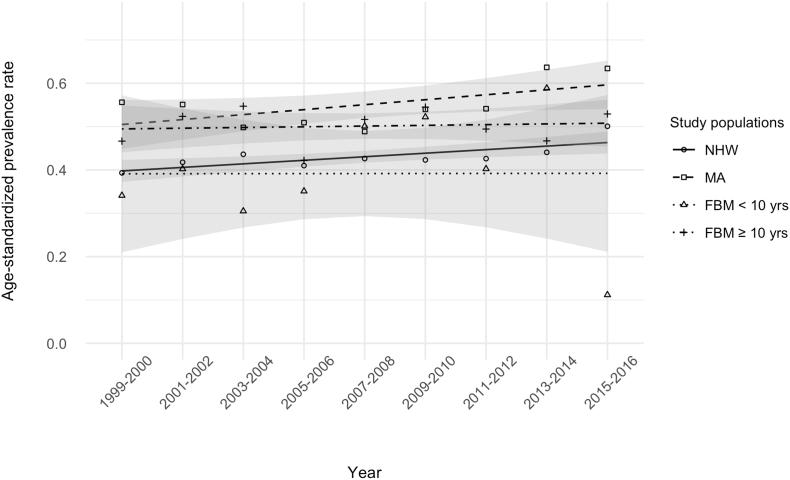
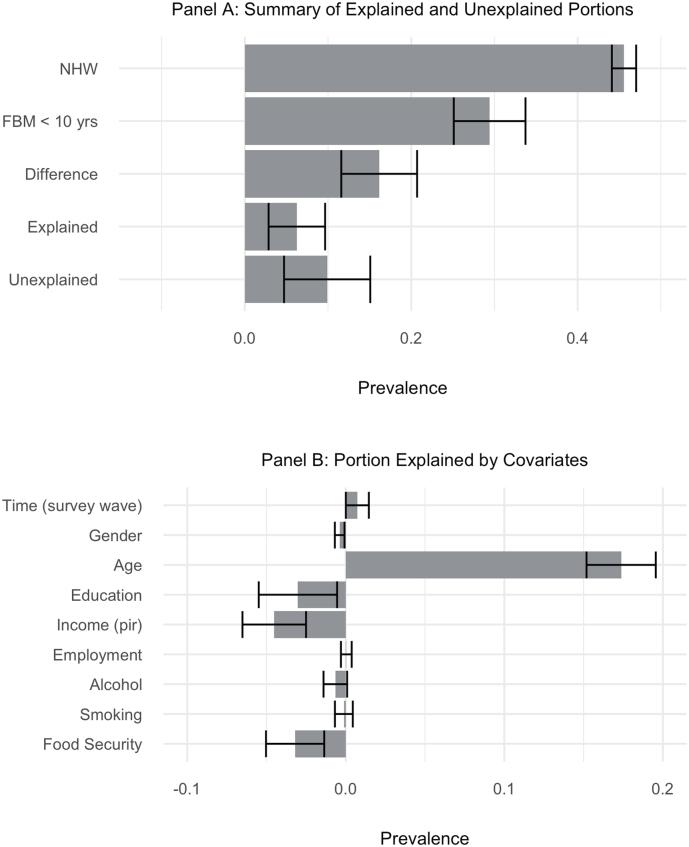
Although Mexican immigrants to the United States (US) have historically held health and mortality advantages over US-born groups, evolving population dynamics in Mexico paired with shifts in Mexico-US immigration patterns and policy regimes have raised new concerns about the metabolic health of recent cohorts of Mexican immigrants. Using a nationally representative sample of adults aged 20-years and older (n = 10,833) from the National Health and Nutrition Examination Study (NHANES, 1999-2016), we assess and seek to explain differences in metabolic syndrome (MetS) risk by race-ethnicity, country of origin, and duration of residence in the US and evaluate whether recent Mexican immigrants continue to exhibit a metabolic health advantage. We decompose the difference in MetS prevalence between US-born whites (45.5%) and recent Mexican immigrants (29.5%) to determine how demographic, socioeconomic, and health behavior characteristics contribute to the patterning of metabolic health. Findings reveal that recent Mexican immigrants hold a metabolic health advantage over all groups, which is accounted for by their younger age structure. Yet recent Mexican immigrants would retain a sizable age-adjusted MetS advantage if they were to achieve parity with US-born whites on education, income, and food security. To ensure that newly-arrived Mexican immigrants continue to experience historically favorable health and mortality prospects, modest policy changes could offer health-promoting protections in the form of increased economic and food security, as well as improved educational opportunities for younger immigrants.
尽管从历史上看,墨西哥裔美国移民比在美国出生的群体拥有更健康的身体状况和更低的死亡率,但墨西哥不断变化的人口动态,再加上墨西哥与美国之间移民模式和政策制度的转变,引发了人们对墨西哥新移民群体代谢健康的新担忧。我们利用国家健康与营养检查调查(NHANES,1999 - 2016)中具有全国代表性的20岁及以上成年人样本(n = 10,833),评估并试图解释按种族、族裔、原籍国以及在美国的居住时长划分的代谢综合征(MetS)风险差异,并评估近期墨西哥移民是否继续展现出代谢健康优势。我们剖析了在美国出生的白人(45.5%)和近期墨西哥移民(29.5%)之间MetS患病率的差异,以确定人口统计学、社会经济和健康行为特征如何影响代谢健康模式。研究结果显示,近期墨西哥移民在所有群体中具有代谢健康优势,这归因于他们更年轻的年龄结构。然而,如果近期墨西哥移民在教育、收入和食品安全方面与在美国出生的白人达到同等水平,他们仍将保持相当大的年龄调整后的MetS优势。为确保新抵达的墨西哥移民继续享有历来良好的健康状况和死亡率前景,适度的政策调整可以通过增加经济和食品安全以及为年轻移民提供更好的教育机会等形式,提供促进健康的保障。

 Zotero 插件