
盐酸羟考酮(强阿片类药物)与对乙酰氨基酚和可待因复方制剂(弱阿片类药物)治疗手术治疗后亚急性骨折疼痛的有效性:一项随机临床试验。
Effectiveness of Oxycodone Hydrochloride (Strong Opioid) vs Combination Acetaminophen and Codeine (Mild Opioid) for Subacute Pain After Fractures Managed Surgically: A Randomized Clinical Trial.
机构信息
University of New South Wales, South Western Sydney Clinical School, Sydney, Australia.
Whitlam Orthopaedic Research Centre, Liverpool, New South Wales, Australia.
出版信息
JAMA Netw Open. 2021 Nov 1;4(11):e2134988. doi: 10.1001/jamanetworkopen.2021.34988.
IMPORTANCE
Patients with a surgically managed fracture are commonly discharged from the hospital with a strong opioid prescription, but limited evidence exists to support this practice.
OBJECTIVE
To test the hypothesis that strong opioids provide greater analgesia than mild opioids over the first week postdischarge from hospital after fracture surgical treatment.
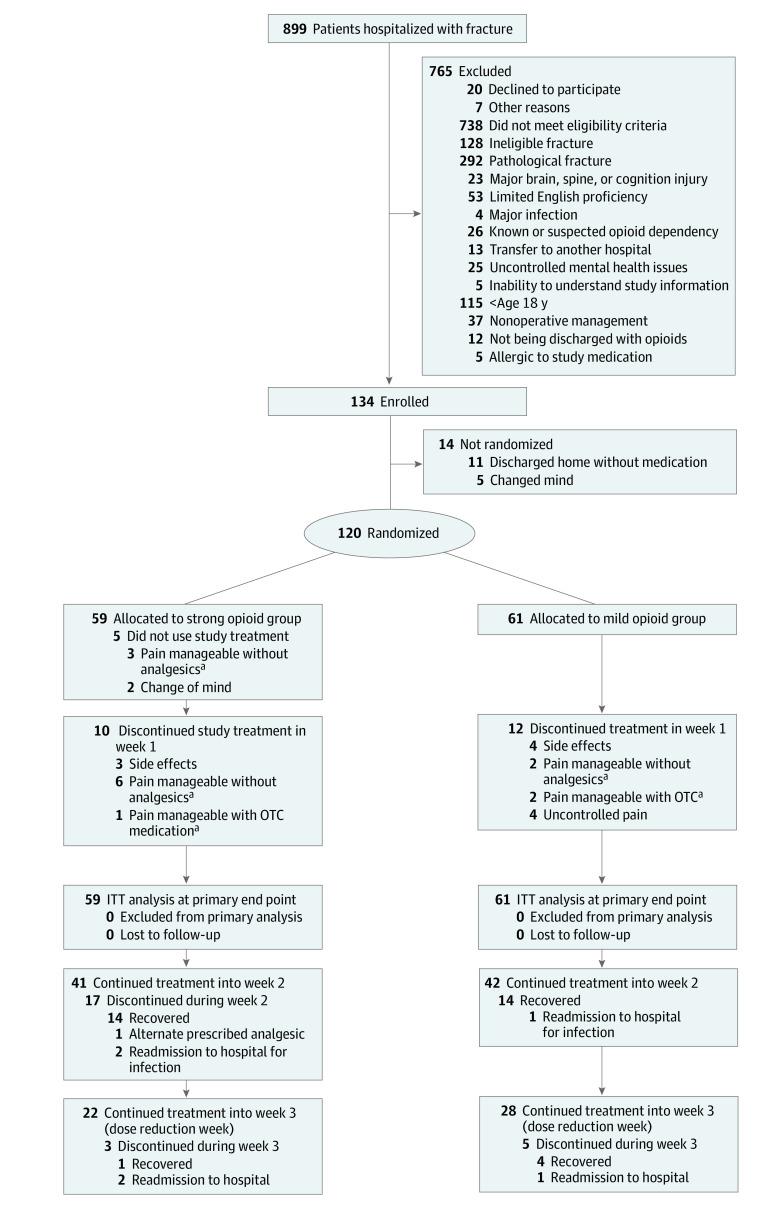
DESIGN, SETTING, AND PARTICIPANTS: This double-blind, superiority, randomized clinical trial was conducted at a single-center, major trauma hospital in Sydney, Australia. Participants were inpatients who had sustained an acute nonpathological facture of a long bone or the pelvis, patella, calcaneus, or talus who were treated with surgical fixation and enrolled from July 27, 2016, to August 22, 2017. Data were analyzed from June through October 2018.
INTERVENTIONS
Initiation at discharge of oxycodone hydrochloride 5 mg of 10 mg (ie, 1 or 2 tablets) or combination acetaminophen and codeine 500 mg and 8 mg or 1000 mg and 16 mg (ie, 1 or 2 tablets) 4 times daily for a maximum duration of 3 weeks.
MAIN OUTCOMES AND MEASURES
The primary outcome was the mean of daily pain scores collected during week 1 of treatment measured using the Numerical Pain Rating Scale (NRS). Participants were asked to rate their mean pain over the previous 24 hours daily using an NRS score from 0 to 10, with 0 representing no pain and 10 representing the worst pain imaginable. The key secondary outcomes were EuroQol 5-Dimension 5-Level Questionnaire (EQ-5D-5L) responses, worst pain, medication adverse events, global perceived effect, and return to work.
RESULTS
A total of 120 patients with 1 or more acute orthopedic fractures requiring surgical fixation were randomized, including 59 patients in the strong-opioid group (43 [72.9%] men; mean [SD] age, 36.0 [14.1] years; mean oral morphine equivalent for days 1-7 of 32.9 mg) and 61 patients in the mild opioid group (47 [77.1%] men; mean [SD] age, 38.2 [13.5] years; mean oral morphine equivalent for days 1-7 of 5.5 mg). From days 1 to 7 postdischarge, the mean daily NRS mean pain score was 4.04 (95% Cl, 3.67 to 4.41) in the strong opioid group and 4.54 (95% Cl, 4.17 to 4.90) in the mild opioid group. The between-group difference of the primary outcome was not statistically significant (-0.50 [95% Cl, -1.11 to 0.12]; P = .11) despite a 6-fold increased dose of opioids being delivered in the strong opioid group.
CONCLUSIONS AND RELEVANCE
This study found that treatment with strong opioid medication subacutely was not superior to treatment with milder medication for treatment of pain among patients with surgically managed orthopedic fractures. These findings suggest that ongoing first-line strong opioid use after discharge from the hospital should not be supported.
TRIAL REGISTRATION
Australia New Zealand Clinical Trial Registry No.: ACTRN12616000941460.
重要性
接受手术治疗骨折的患者通常会在出院时被开具强效阿片类药物处方,但支持这种做法的证据有限。
目的
检验假设,即在骨折手术后出院后的第一周内,与使用弱阿片类药物相比,使用强阿片类药物可提供更大的镇痛效果。
设计、地点和参与者:这是一项在澳大利亚悉尼一家单一中心、主要创伤医院进行的双盲、优效性、随机临床试验。参与者为因急性非病理性长骨或骨盆、髌骨、跟骨或距骨骨折而接受手术固定治疗的住院患者,于 2016 年 7 月 27 日至 2017 年 8 月 22 日入组。数据于 2018 年 6 月至 10 月进行分析。
干预措施
出院时给予盐酸羟考酮 5 毫克或 10 毫克(即 1 或 2 片)或复方对乙酰氨基酚和可待因 500 毫克和 8 毫克或 1000 毫克和 16 毫克(即 1 或 2 片),每日 4 次,最多持续 3 周。
主要结局和测量指标
主要结局是治疗第 1 周期间每日疼痛评分的平均值,使用数字疼痛评分量表(NRS)进行测量。参与者每天使用 NRS 评分(0 到 10,0 代表无痛,10 代表可想象到的最严重疼痛)报告他们过去 24 小时的平均疼痛。关键次要结局是欧洲五维健康量表 5 维度问卷(EQ-5D-5L)应答、最差疼痛、药物不良反应、总体感觉效果和重返工作岗位。
结果
共纳入 120 例需手术固定的急性骨科骨折患者,其中 59 例患者(43 例[72.9%]男性;平均[SD]年龄 36.0[14.1]岁;第 1 至 7 天的口服吗啡当量为 32.9 毫克)接受强阿片类药物治疗,61 例患者(47 例[77.1%]男性;平均[SD]年龄 38.2[13.5]岁;第 1 至 7 天的口服吗啡当量为 5.5 毫克)接受弱阿片类药物治疗。从出院后第 1 天到第 7 天,强阿片类药物组的平均每日 NRS 平均疼痛评分(95%CI,3.67 至 4.41)为 4.04,弱阿片类药物组为 4.54(95%CI,4.17 至 4.90)。主要结局的组间差异无统计学意义(-0.50[95%CI,-1.11 至 0.12];P=0.11),尽管强阿片类药物组的阿片类药物剂量增加了 6 倍。
结论和相关性
本研究发现,亚急性使用强阿片类药物治疗与使用弱阿片类药物治疗手术治疗的骨折患者的疼痛相比没有优势。这些发现表明,不应该支持术后在医院继续一线使用强阿片类药物。
试验注册
澳大利亚和新西兰临床试验注册中心:ACTRN12616000941460。
 Zotero 插件