
临床颈部症状与磁共振成像评估颈椎间盘退变的各种指标之间的关联。
Associations between clinical neck symptoms and various evaluations ofcervical intervertebral disc degeneration by magnetic resonance imaging.
机构信息
Department of Orthopaedic Surgery, Fukushima Medical University School of Medicine.
出版信息
Fukushima J Med Sci. 2021 Dec 21;67(3):107-118. doi: 10.5387/fms.2021-20. Epub 2021 Nov 20.
PURPOSE
Magnetic resonance imaging (MRI) is widely used to evaluate intervertebral disc degeneration. Recently, various evaluations of cervical disc degeneration using MRI have been conducted, but there is no gold standard. The purpose of this study was to compare the reproducibilities of previously reported classifications for evaluating cervical disc degeneration by MRI and their associations with clinical symptoms.
PARTICIPANTS AND METHODS
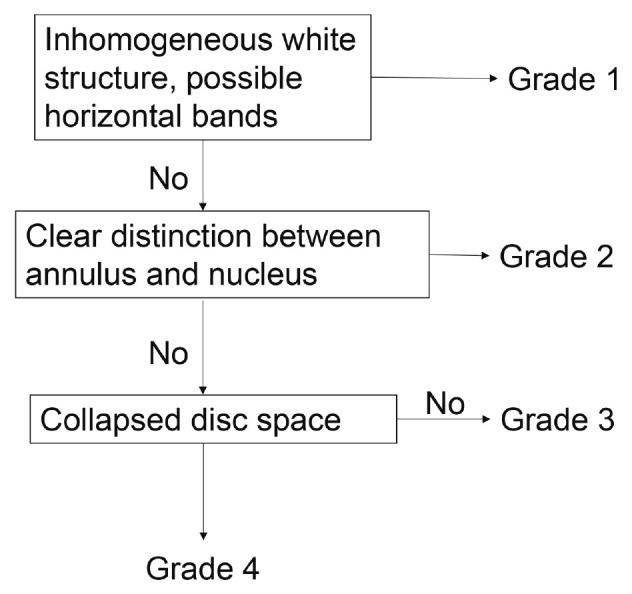
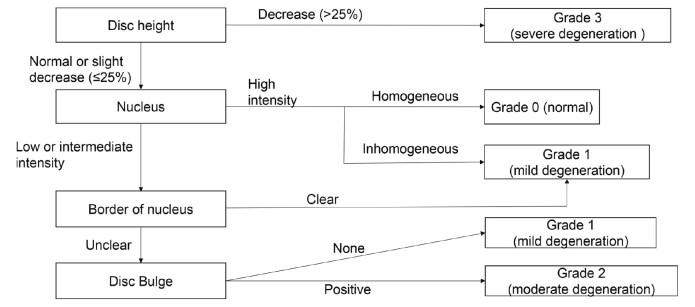
A total of 582 subjects underwent conventional MRI of the cervical spine. Disc degeneration was assessed in each intervertebral disc from C2/3 to C7/T1 using five different classifications: Matsumoto's grading system, Miyazaki's grading system, Nakashima's grading system, Jacobs' grading system, and Suzuki's grading system. MR images of 30 participants were used, and Cohen's kappa coefficient of agreement of each classification was calculated for intra-observer and inter-observer reliabilities. These five classifications of disc degeneration and changes of vertebral endplates were measured, and associations with clinical symptoms were assessed.
RESULTS
Kappa (κ) values of intra-observer agreement were higher for Jacobs' classification, whereas those of inter-observer agreement were higher for Nakashima's and Jacobs' classifications than for other classifications. The prevalences of neck pain and shoulder stiffness were 27.4% and 41.9%, respectively. There were no associations for any classifications of disc degeneration and Modic types with neck pain or shoulder stiffness. Only the presence of Schmorl's nodes was associated with neck pain.
CONCLUSION
At present, there is no specific classification for cervical disc degeneration associated with clinical symptoms. Vertebral endplate changes might be associated with clinical symptoms. It may be necessary to create a new classification for better reproducibility of the evaluation of cervical disc degeneration.
目的
磁共振成像(MRI)广泛用于评估椎间盘退变。最近,对颈椎间盘退变进行了各种 MRI 评估,但尚无金标准。本研究旨在比较先前报道的用于评估颈椎间盘退变的 MRI 分类的可重复性及其与临床症状的相关性。
参与者和方法
共有 582 名受试者接受了颈椎常规 MRI 检查。使用五种不同的分类方法评估 C2/3 至 C7/T1 各椎间盘中的椎间盘退变:松本分级系统、宫城分级系统、中岛分级系统、雅可比分级系统和铃木分级系统。使用 30 名参与者的 MRI 图像,计算每个分类的观察者内和观察者间一致性的 Cohen's kappa 系数。测量椎间盘退变和终板变化的这五种分类,并评估与临床症状的相关性。
结果
观察者内一致性的κ值雅各布斯分类更高,而观察者间一致性的κ值中岛和雅各布斯分类更高,其他分类更高。颈痛和肩部僵硬的患病率分别为 27.4%和 41.9%。任何椎间盘退变分类和 Modic 类型与颈痛或肩部僵硬均无相关性。只有 Schmorl 结节的存在与颈痛相关。
结论
目前,尚无与临床症状相关的颈椎间盘退变的特定分类。椎体终板变化可能与临床症状相关。可能需要创建新的分类以更好地重现颈椎间盘退变的评估。

 Zotero 插件