
.
.
作者信息
Humphrey Toby J L, James Glen, Wittbrodt Eric T, Zarzuela Donna, Hiemstra Thomas F
机构信息
Department of Medicine, University of Cambridge, Cambridge, UK.
Global Medical Affairs, AstraZeneca, Cambridge, UK.
出版信息
Clin Kidney J. 2021 Jan 30;14(10):2203-2212. doi: 10.1093/ckj/sfab029. eCollection 2021 Oct.
BACKGROUND
Users of guideline-recommended renin-angiotensin-aldosterone system (RAAS) inhibitors may experience disruptions to their treatment, e.g. due to hyperkalaemia, hypotension or acute kidney injury. The risks associated with treatment disruption have not been comprehensively assessed; therefore, we evaluated the risk of adverse clinical outcomes in RAAS inhibitor users experiencing treatment disruptions in a large population-wide database.
METHODS
This exploratory, retrospective analysis utilized data from the UK's Clinical Practice Research Datalink, linked to Hospital Episodes Statistics and the Office for National Statistics databases. Adults (≥18 years) with first RAAS inhibitor use (defined as angiotensin-converting enzyme inhibitors or angiotensin receptor blockers) between 1 January 2009 and 31 December 2014 were eligible for inclusion. Time to the first occurrence of adverse clinical outcomes [all-cause mortality, all-cause hospitalization, cardiac arrhythmia, heart failure hospitalization, cardiac arrest, advancement in chronic kidney disease (CKD) stage and acute kidney injury] was compared between RAAS inhibitor users with and without interruptions or cessations to treatment during follow-up. Associations between baseline characteristics and adverse clinical outcomes were also assessed.
RESULTS
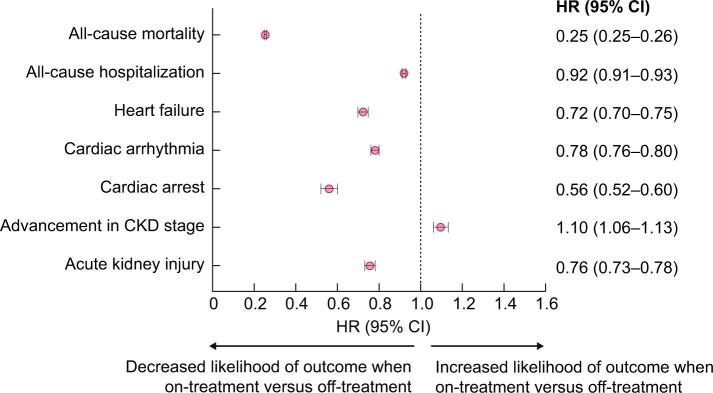
Among 434 027 RAAS inhibitor users, the risk of the first occurrence of all clinical outcomes, except advancement in CKD stage, was 8-75% lower in patients without interruptions or cessations versus patients with interruptions/cessations. Baseline characteristics independently associated with increased risk of clinical outcomes included increasing age, smoking, CKD, diabetes and heart failure.
CONCLUSIONS
These findings highlight the need for effective management of factors associated with RAAS inhibitor interruptions or cessations in patients for whom guideline-recommended RAAS inhibitor treatment is indicated.
背景
指南推荐使用肾素 - 血管紧张素 - 醛固酮系统(RAAS)抑制剂的患者可能会经历治疗中断,例如由于高钾血症、低血压或急性肾损伤。与治疗中断相关的风险尚未得到全面评估;因此,我们在一个大型全人群数据库中评估了经历治疗中断的RAAS抑制剂使用者发生不良临床结局的风险。
方法
这项探索性的回顾性分析利用了来自英国临床实践研究数据链的数据,并与医院事件统计数据和国家统计局数据库相链接。2009年1月1日至2014年12月31日期间首次使用RAAS抑制剂(定义为血管紧张素转换酶抑制剂或血管紧张素受体阻滞剂)的成年人(≥18岁)符合纳入条件。比较了随访期间有和没有治疗中断或停药的RAAS抑制剂使用者首次出现不良临床结局[全因死亡率、全因住院、心律失常、心力衰竭住院、心脏骤停、慢性肾脏病(CKD)分期进展和急性肾损伤]的时间。还评估了基线特征与不良临床结局之间的关联。
结果
在434027名RAAS抑制剂使用者中,除CKD分期进展外,所有临床结局首次发生的风险在没有治疗中断或停药的患者中比有治疗中断/停药的患者低8 - 75%。与临床结局风险增加独立相关的基线特征包括年龄增加、吸烟、CKD、糖尿病和心力衰竭。
结论
这些发现凸显了对于指南推荐使用RAAS抑制剂治疗的患者,需要有效管理与RAAS抑制剂中断或停药相关的因素。
 Zotero 插件