
2008年至2017年期间加拿大安大略省从牛奶样本中分离出的主要乳腺炎病原体流行率的时空变化
Spatio-Temporal Variation in the Prevalence of Major Mastitis Pathogens Isolated From Bovine Milk Samples Between 2008 and 2017 in Ontario, Canada.
作者信息
Acharya Kamal Raj, Brankston Gabrielle, Slavic Durda, Greer Amy L
机构信息
Department of Population Medicine, University of Guelph, Guelph, ON, Canada.
Animal Health Laboratory, University of Guelph, Guelph, ON, Canada.
出版信息
Front Vet Sci. 2021 Nov 3;8:742696. doi: 10.3389/fvets.2021.742696. eCollection 2021.
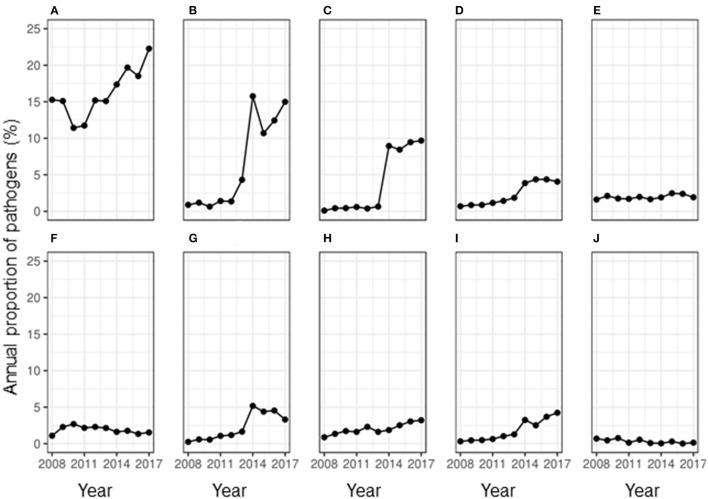
An understanding of the spatio-temporal distribution of several groups of mastitis pathogens can help to inform programs for the successful control and management of mastitis. However, in the absence of an active surveillance program such information is not readily available. In this retrospective study we analyzed passive surveillance data from a diagnostic laboratory with an aim to describe the spatio-temporal trend of major mastitis pathogens between 2008 and 2017 in Ontario dairy cattle. Data for all milk culture samples submitted to the Animal Health Laboratory (AHL) at the University of Guelph between 2008 and 2017 was accessed. Descriptive analyses were conducted to identify the major pathogens and Chi-square goodness-of-fit tests were used to compare between multiple proportions. Likewise, univariable logistic regression analysis was performed to determine if there was a change in the probability of isolating the major mastitis pathogens depending on geography or time. Seasonality was assessed by calculating the seasonal relative risk (RR). Of a total of 85,979 milk samples examined, more than half of the samples (61.07%) showed no growth and the proportion of samples that showed no growth almost halved during the study period. Of the samples (36.21%, = 31,133) that showed any growth, the major bacterial pathogens were (15.60%), Non-aureus Staphylococci (NAS) (5.04%), spp. (2.96%), and (2.00%). Of the NAS, the major species reported were (69.02%), (14.45%), (12.99%), and (2.13%). A temporal change in the prevalence of contagious pathogens like and spp. was observed with an increasing odds of 1.06 and 1.62, respectively. Likewise, except for , the prevalence of all the major environmental mastitis pathogens increased during the study period. The isolation of most of the pathogens peaked in summer, except for , and which peaked in spring months. Interestingly, a regional pattern of isolation of some bacterial pathogens within Ontario was also observed. This study showed a marked spatio-temporal change in the prevalence of major mastitis pathogens and suggests that a regional and seasonal approach to mastitis control could be of value.
了解几组乳腺炎病原体的时空分布有助于为成功控制和管理乳腺炎的方案提供信息。然而,在缺乏主动监测方案的情况下,此类信息并不容易获得。在这项回顾性研究中,我们分析了一家诊断实验室的被动监测数据,目的是描述2008年至2017年安大略省奶牛主要乳腺炎病原体的时空趋势。获取了2008年至2017年提交给圭尔夫大学动物健康实验室(AHL)的所有牛奶培养样本的数据。进行描述性分析以确定主要病原体,并使用卡方拟合优度检验来比较多个比例。同样,进行单变量逻辑回归分析以确定根据地理位置或时间分离主要乳腺炎病原体的概率是否存在变化。通过计算季节性相对风险(RR)来评估季节性。在总共检测的85979份牛奶样本中,超过一半的样本(61.07%)未生长,并且在研究期间未生长的样本比例几乎减半。在显示有任何生长的样本(36.21%,n = 31133)中,主要细菌病原体为金黄色葡萄球菌(15.60%)、非金黄色葡萄球菌(NAS)(5.04%)、链球菌属(2.96%)和大肠杆菌(2.00%)。在NAS中,报告的主要菌种为表皮葡萄球菌(69.02%)、溶血葡萄球菌(14.45%)、人葡萄球菌(12.99%)和模仿葡萄球菌(2.13%)。观察到像金黄色葡萄球菌和链球菌属这样的传染性病原体的患病率随时间变化,优势比分别增加1.06和1.62。同样,除了大肠杆菌外,所有主要环境性乳腺炎病原体的患病率在研究期间都有所增加。除了金黄色葡萄球菌、表皮葡萄球菌和溶血葡萄球菌在春季达到峰值外,大多数病原体的分离率在夏季达到峰值。有趣的是,在安大略省内还观察到了一些细菌病原体的区域分离模式。这项研究表明主要乳腺炎病原体的患病率存在明显的时空变化,并表明采用区域和季节性方法控制乳腺炎可能具有价值。

 Zotero 插件