
前列腺癌质子治疗后前瞻性评分的晚期直肠和泌尿生殖系统发病率的正常组织并发症概率模型。
Normal tissue complication probability models for prospectively scored late rectal and urinary morbidity after proton therapy of prostate cancer.
作者信息
Pedersen Jesper, Liang Xiaoying, Bryant Curtis, Mendenhall Nancy, Li Zuofeng, Muren Ludvig P
机构信息
Danish Centre for Particle Therapy, Aarhus University Hospital/Aarhus University, Aarhus, Denmark.
University of Florida Health Proton Therapy Institute, Jacksonville, FL, USA.
出版信息
Phys Imaging Radiat Oncol. 2021 Nov 8;20:62-68. doi: 10.1016/j.phro.2021.10.004. eCollection 2021 Oct.
BACKGROUND AND PURPOSE
Photons and protons have fundamentally different properties, i.e. protons have a reduced dose bath but a higher relative biological effectiveness. Photon-based normal tissue complication probability (NTCP) models may therefore not immediately be applicable to proton therapy (PT). The aim was to derive parameters of the Lyman-Kutcher-Burman (LKB) NTCP model using prospectively recorded late morbidity data from PT, focusing on rectal morbidity and prostate cancer.
MATERIALS AND METHODS
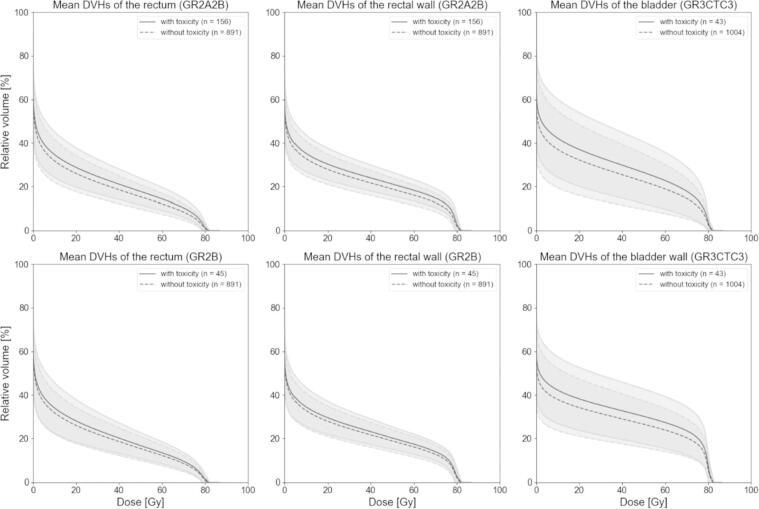
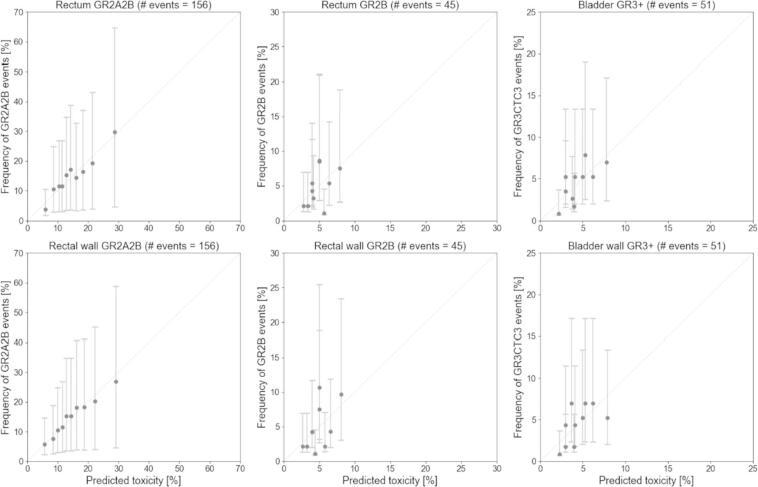
Prospectively collected data were available for 1151 prostate cancer patients treated with passive scattering PT and prescribed target doses of 78-82 Gy (RBE = 1.1) in 2 Gy fractions. Morbidity data (CTCAE v3.0) consisted of two alternative late grade 2 rectal bleeding endpoints: Medical Grade2A (GR2A) and procedural Grade2B (GR2B), as well as late grade 3 + urinary morbidity. GR2A + 2B were observed in 156/1047 patients (15%), GR2B in 45/1047 patients (4%), and urinary grade 3 + in 51/1151 patients (4%). LKB NTCP model parameters (D50, , and ) were derived by maximum likelihood estimation.
RESULTS
For the rectum/rectal wall the volume parameter was low (0.07-0.14) for both GR2A + 2B and GR2B, as was the parameter (range: 0.16-0.20). For the bladder/bladder wall both parameters were high (-range: 0.20-0.36; -range: 0.32-0.36). D50 parameters were higher for GR2B of the rectum/rectal wall (95.9-98.0 Gy) and bladder/bladder wall (118.1-119.9 Gy), but lower for GR2A2B (71.7-73.6 Gy).
CONCLUSION
PT specific LKB NTCP model parameters were derived from a population of more than 1000 patients. The D50 parameter differed for all structures and endpoints and deviated from typical photon-based LKB model values.
背景与目的
光子和质子具有根本不同的特性,即质子的剂量浴较低,但相对生物效应较高。因此,基于光子的正常组织并发症概率(NTCP)模型可能不适用于质子治疗(PT)。本研究旨在利用前瞻性记录的PT晚期发病率数据,推导莱曼-库彻-伯曼(LKB)NTCP模型的参数,重点关注直肠发病率和前列腺癌。
材料与方法
前瞻性收集了1151例接受被动散射PT治疗的前列腺癌患者的数据,处方靶剂量为78-82 Gy(RBE = 1.1),分2 Gy分次给予。发病率数据(CTCAE v3.0)包括两个替代的晚期2级直肠出血终点:医学2A级(GR2A)和手术2B级(GR2B),以及晚期3级及以上泌尿发病率。156/1047例患者(15%)观察到GR2A + 2B,45/1047例患者(4%)观察到GR2B,51/1151例患者(4%)观察到泌尿3级及以上。LKB NTCP模型参数(D50、 和 )通过最大似然估计推导得出。
结果
对于直肠/直肠壁,GR2A + 2B和GR2B的体积参数 较低(0.07-0.14), 参数也较低(范围:0.16-0.20)。对于膀胱/膀胱壁,两个参数都较高( -范围:0.20-0.36; -范围:0.32-0.36)。直肠/直肠壁GR2B和膀胱/膀胱壁的D50参数较高(95.9-98.0 Gy),但GR2A2B较低(71.7-73.6 Gy)。
结论
PT特异性LKB NTCP模型参数来自1000多名患者的群体。所有结构和终点的D50参数均不同,且偏离了基于光子的典型LKB模型值。

 Zotero 插件